Planning, Design and Construction (PDC), under the guidance of Vanderbilt University’s Academic Strategic Plan and FutureVU Initiative, oversees a variety of Capital Projects. Over the past few years, the PDC team has worked diligently to complete many projects in order to achieve the university’s FutureVU goals of:
Integrating academic, residential and trans-insitutional spaces;
Connecting Vanderbilt’s community of neighborhoods;
Respecting the university’s historic identity;
Promoting diversity and inclusion;
Making the campus more walkable, bikeable and sustainable; and
Being a good citizen of Nashville and the region.
Residential Colleges
Warren College
The College Halls at Kissam Quad is Vanderbilt University’s largest certified building to date and is the 7th largest LEED certified building in Middle Tennessee (24th in the State). It is also currently the largest certified multi-unit higher education residence building in the State of TN.
Other notable statistics:
Potable water use reduction: Building = 43.64%; Irrigation = 58.56%
Design Energy Cost Savings: 28.74% (compared to ASHRAE 90.1-2007 baseline)
Construction Waste Diverted from the Landfill: 83.36%
Recycled Content in Materials: 24.61% (by cost)
Regional Materials: 37.86% (by cost)
Spaces with Direct Line of Sight to Outdoors: 90.82% (of regularly occupied spaces)
Use of at least 20 products with material inventory reporting: Documented using Pilot Credit 76 – Material Ingredient Reporting
Use of Low Mercury Lamps: 30.59 average mercury content in pictograms per lumen hour
Moore College
The College Halls at Kissam Quad is Vanderbilt University’s largest certified building to date and is the 7th largest LEED certified building in Middle Tennessee (24th in the State). It is also currently the largest certified multi-unit higher education residence building in the State of TN.
Other notable statistics:
Potable water use reduction: Building = 43.64%; Irrigation = 58.56%
Design Energy Cost Savings: 28.74% (compared to ASHRAE 90.1-2007 baseline)
Construction Waste Diverted from the Landfill: 83.36%
Recycled Content in Materials: 24.61% (by cost)
Regional Materials: 37.86% (by cost)
Spaces with Direct Line of Sight to Outdoors: 90.82% (of regularly occupied spaces)
Use of at least 20 products with material inventory reporting: Documented using Pilot Credit 76 – Material Ingredient Reporting
Use of Low Mercury Lamps: 30.59 average mercury content in pictograms per lumen hour
The Commons
Vanderbilt’s application for and achievement of LEED certification was a partnership between the university’s administration and its students. The building saves an estimated 900,000 gallons of potable per year and saves 28% of the energy used by similar buildings. At the Commons Center site, 95% of demolition and construction waste was recycled, reused and diverted from the land fill.
Primary environmentally-friendly features that achieve LEED certification by the U.S. Green Building Council (USGBC) are as follows:
Fifty-two percent of waste generated during construction was diverted from the landfill.
Many local manufacturers and materials were selected to reduce the environmental impact related to transportation of the products. Fifty percent of project materials were obtained from within 500 miles of the site.
Efficient mechanical systems were selected, reducing energy usage by approximately 20%.
Reflective roofing, light colored concrete, and tree-plantings were utilized so that the amount of solar energy absorbed by the building and site is minimized, reducing the urban “heat island” effect.
Atriums and stairwells allow maximum natural lighting, also called “daylighting.”
Recycled glass is incorporated into terrazzo floors.
Bamboo was used for flooring and furniture because its rapid growth-rate allows for faster replenishment.
The dormitories use low-flow and waterfree fixtures to reduce their overall potable water consumption.
Pervious pavement allows rainwater to pass through paving and recharge the groundwater, reducing the development’s impact on neighboring streams.
All HVAC equipment used on this project meets strict guidelines to ensure very little leakage of HCFCs.
All materials, paints, adhesives, sealants, and carpets used in Commons Residence Houses contain little or no volatile organic compounds (VOCs).
All residence houses have accessible aluminum, plastic, paper, and cardboard recycling, and each room is furnished with a recycling bin.
Student rooms are equipped with individual temperature controls and operable windows to allow for most efficient use of heating and cooling.
Vanderbilt’s E. Bronson Ingram College has been awarded LEED Gold certification by the U.S. Green Building Council. The council’s Leadership in Energy and Environmental Design Green Building Rating System is the nationally accepted benchmark for the design, construction and operation of high-performance sustainable buildings. Organizations must apply for the certification, which is recognized as proof that a building is environmentally responsible and a healthy place to live and work.
“We believe that community and sustainability are symbiotic, and this Gold LEED certification from the USGBC is a resounding affirmation of that approach,” Interim Chancellor and Provost Susan R. Wente said. “I congratulate the leaders, faculty, students, staff, donors and partners whose vision and talents have created this remarkable residential college, which will provide sustainable living and learning spaces for generations of students to come.”
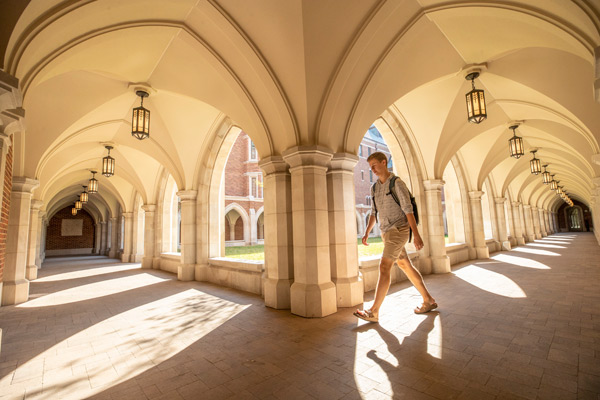
E. Bronson Ingram College, which achieved LEED Gold status in the New Construction category, opened its doors to 340 residential students in August 2018. The college features state-of-the art accommodations inside stunning Collegiate Gothic-style architecture. The building includes living spaces, a communal dining hall, a great room, a performing arts rehearsal studio and three courtyards.
The responsible environmental design features of the college closely align with Vanderbilt’s core missions of teaching, research and discovery through the Academic Strategic Plan. The green design also builds upon the university’s ongoing commitment to investing in sustainable and smart infrastructure through FutureVU, a holistic planning process for developing spaces on campus and investing in initiatives that support the people who live, work and learn in them.
“As we continue on this journey of transforming Vanderbilt’s residential education, the guiding principles of FutureVU ensure we do so in a way that aligns with our mission,” Vice Chancellor for Administration Eric Kopstain said. “This LEED Gold designation shows we can create state-of-the-art facilities that are also environmentally responsible and efficient.”
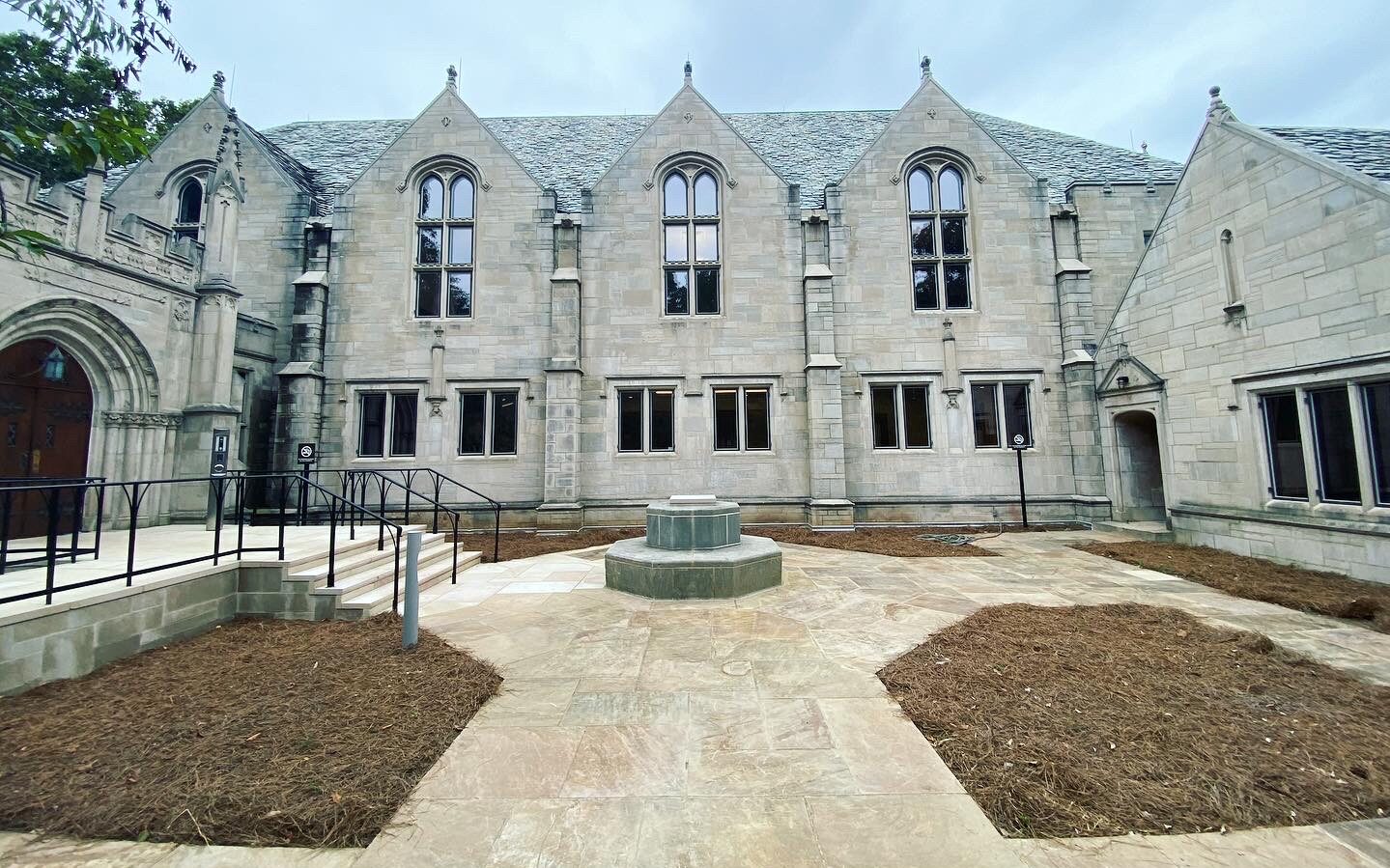
Courtyard view of E. Bronson Ingram College. (John Russell/Vanderbilt)
Some notable aspects of the college and its building process that helped achieve the LEED Gold certification include installing high-efficiency flush and low-flow plumbing fixtures to reduce potable water use; utilizing high-performance building mechanical systems to save energy; diverting construction waste from the landfill; choosing building materials with recycled content; sourcing building materials from the nearby region; using low-emitting materials for paints, coatings and composite wood products; increasing natural light and improving campus views from regularly occupied areas; and creating green and open spaces that are friendly to pedestrians.
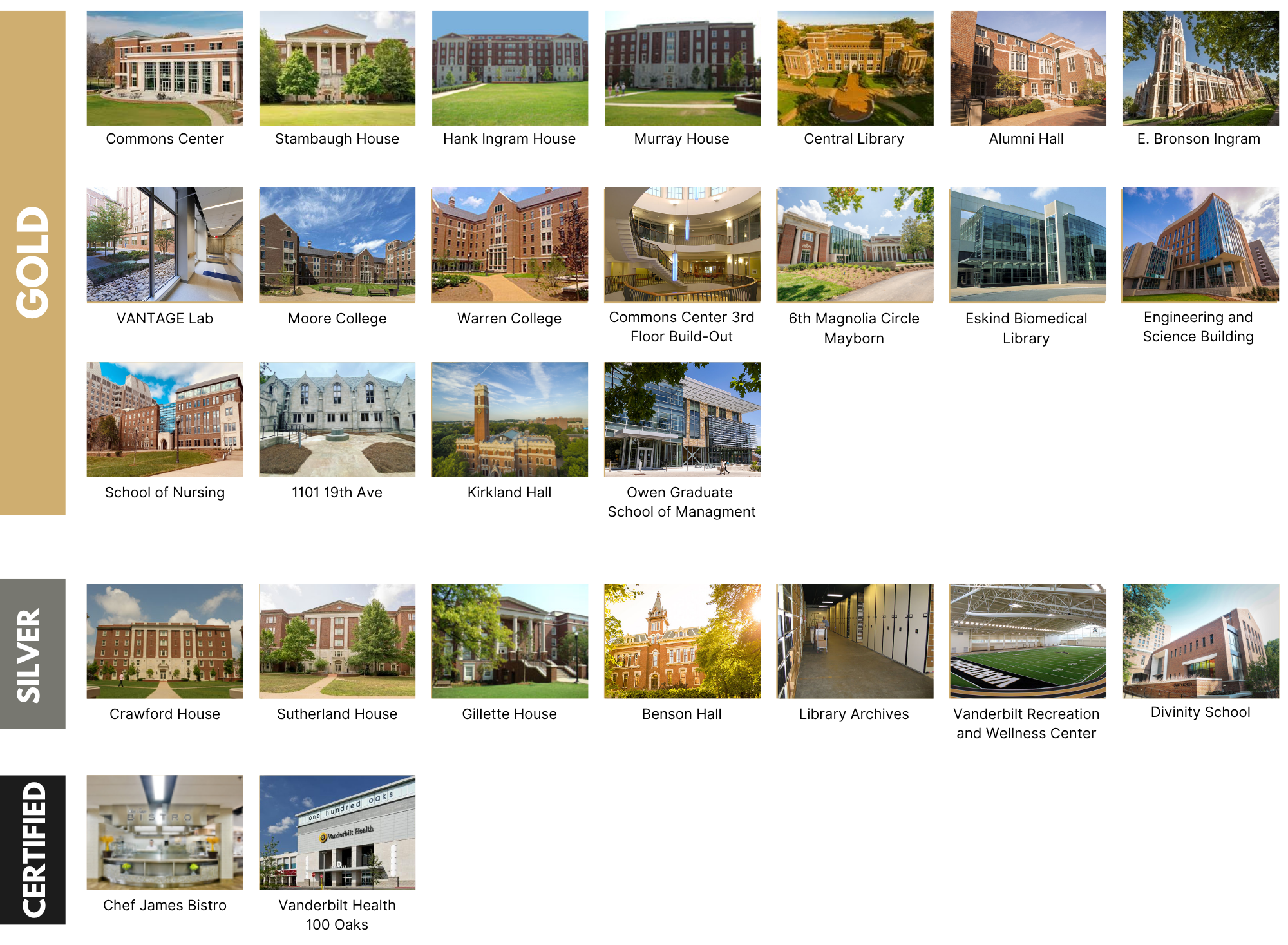
With the addition of E. Bronson Ingram College, Vanderbilt has completed a total of 21 LEED-certified new construction or renovation projects since 2007. Other LEED-certified projects include The Commons Center, Stambaugh House, Hank Ingram House, Murray House, Central Library, The Commons Center third floor build-out, the VANTAGE Lab, Warren and Moore Colleges, Alumni Hall, the Engineering and Science Building, Crawford House, Sutherland House, Gillette House, Benson Hall, the Library Archives, the Vanderbilt Recreation and Wellness Center Fieldhouse, Chef James Bistro in Rand Dining Hall, and the Eskind Biomedical Library.
Zeppos College
The construction of the Nicholas S. Zeppos Residential College, located at the corner of West End Avenue and 25th Avenue South, is a part of the university’s reenvisioning of the West End Neighborhood and is named in honor of Chancellor Emeritus Nicholas S. Zeppos‘ visionary leadership and legacy. Zeppos College, designed to achieve LEED certification (certification pending), can house up to 335 sophomores, juniors and seniors in four-person suites double rooms and single rooms. The 242,400-square-foot building features a state-of-the-art dining hall, great room, study lounges and other event spaces.
Rothschild College
Rothschild College is the second residential college to be built in the West End Neighborhood along West End Avenue. The Collegiate Gothic-style design will be approximately 205,00-square-feet with over 330 beds and a variety of learning spaces and special features. In order to make room along West End Avenue for Rothschild College, Carmichael Towers 1 and 2 were demolished. Rothschild College welcomed students in Fall 2022.
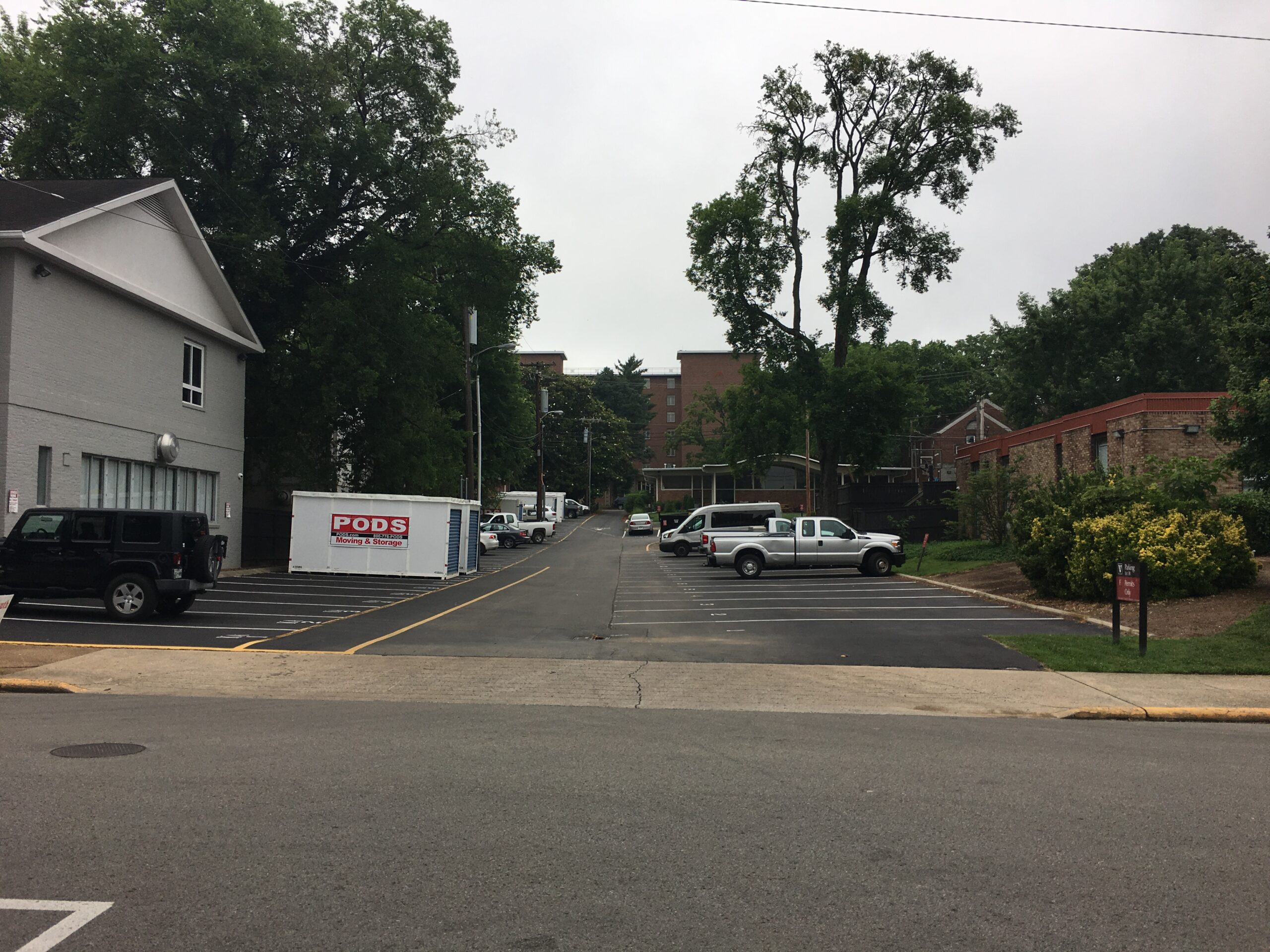
The West End Neighborhood was transformed from vehicular streets and alleyways into an area that promotes the university’s core values and holistic approach to its mission of teaching, research and service. Guided by the university’s FutureVU initiative, the design of the neighborhood, including four residential colleges, prioritized inclusivity and sustainability.
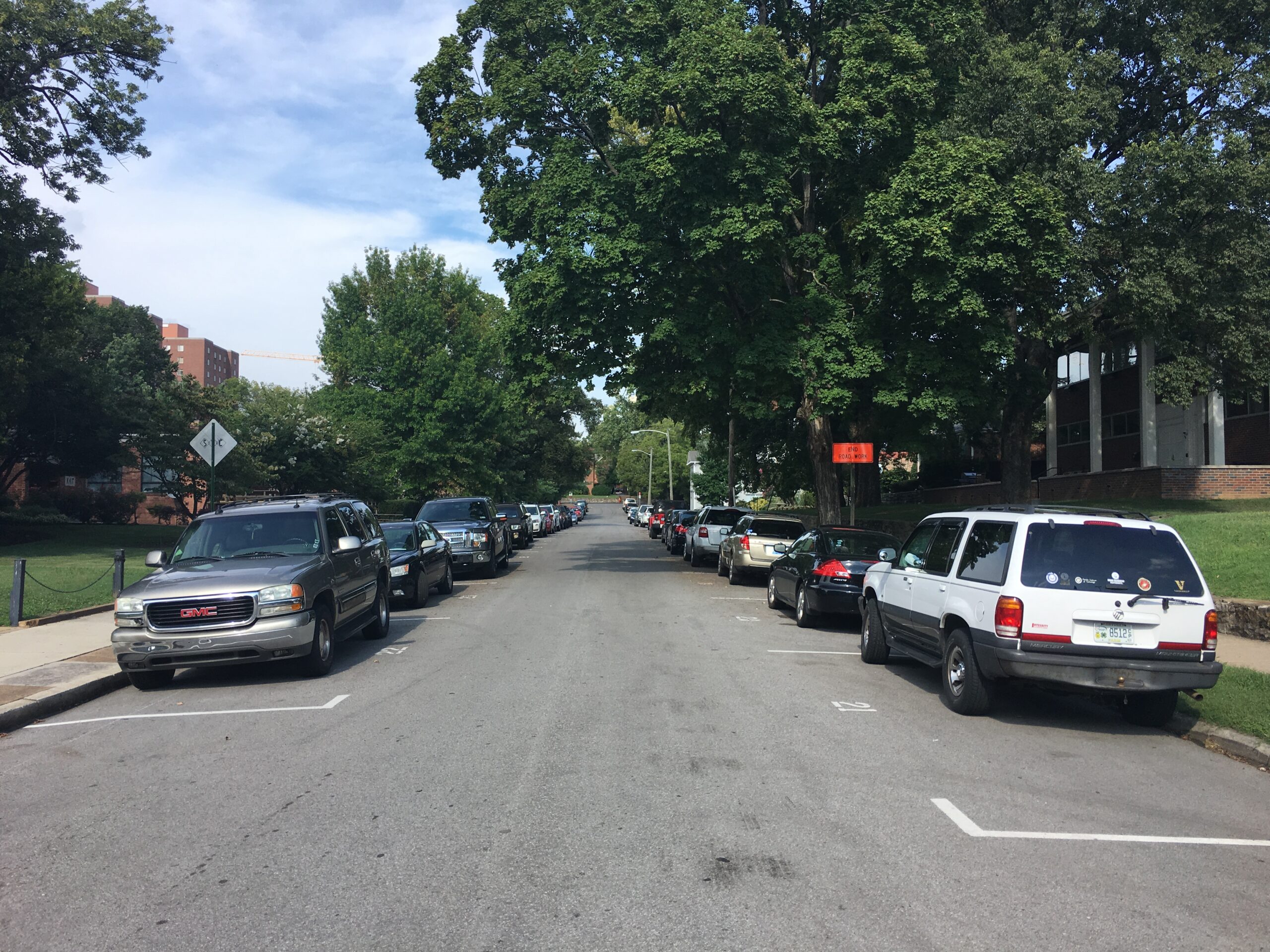
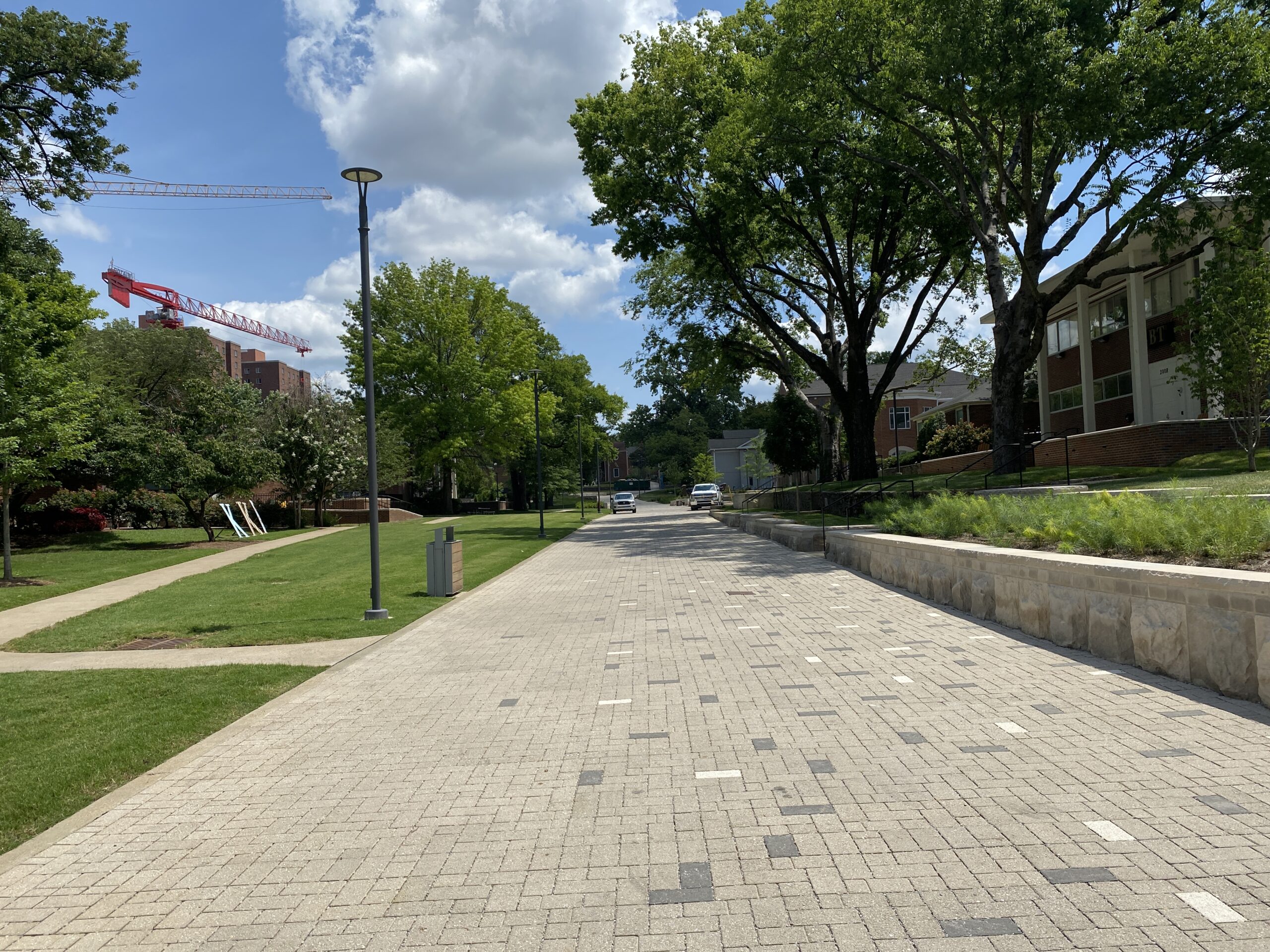
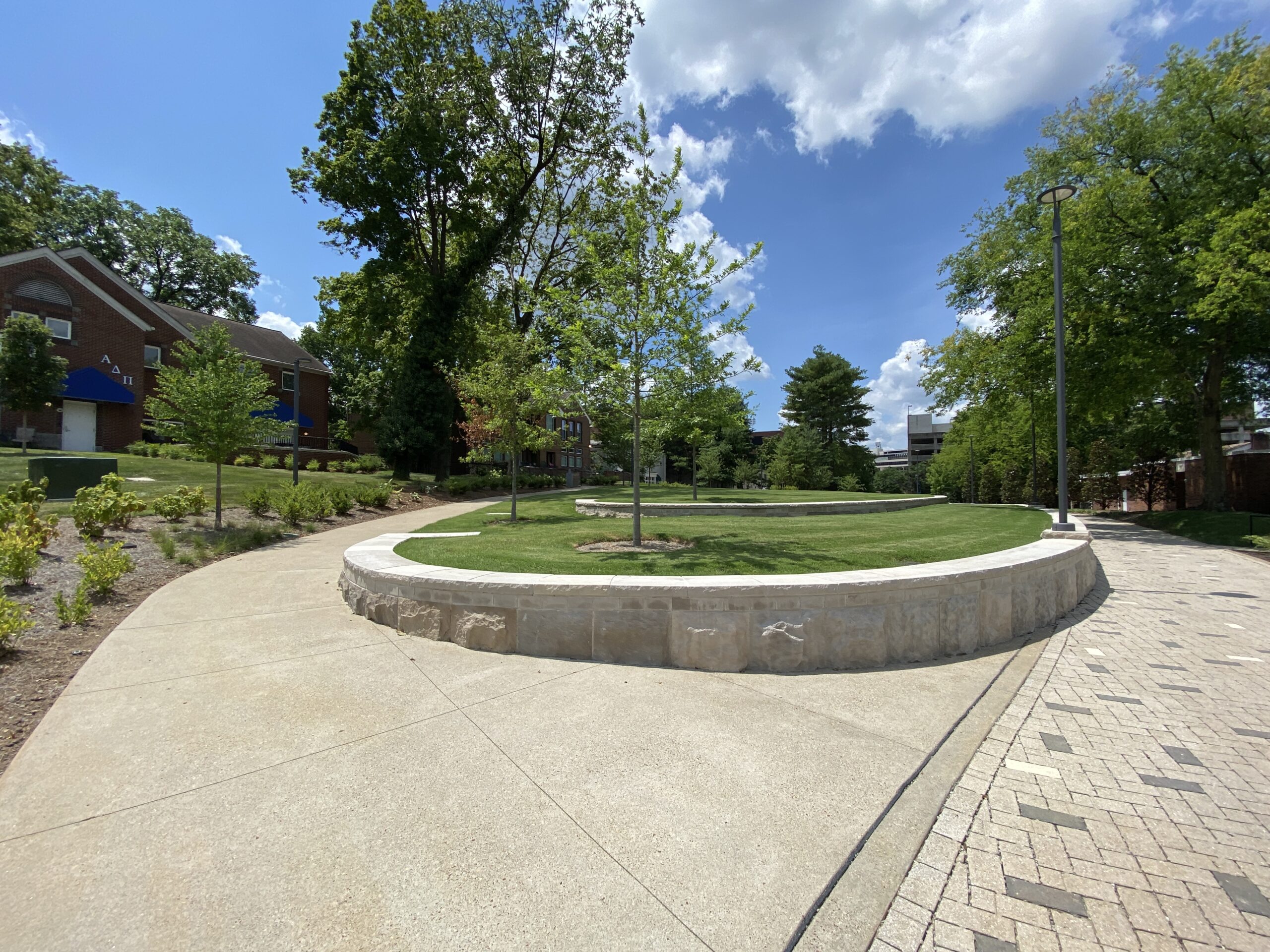
The West End Neighborhood Beautification project is just one example of how Vanderbilt University is redesigning its campus to be a more park-like setting. This area used to feature many ally and roadways, and have heavy vehicular traffic. Today former Kensington Avenue and 24th Avenue South, between West End Avenue and Vanderbilt Place, have been transformed into accessible pedestrian-and bicycle-friendly pathways and greenway.
CLICK HERE to view a 360 degree Panorama image of the West End Neighborhood Project
Kensington Promenade Before and After
The Green Before and After
The Greek Community
Another aspect of the West End Neighborhood project was renovations and construction to the Greek houses. The project included the demolition of the former Kappa Sigma and Lambda Chi Alpha houses, the construction of the National Panhellenic Council (NPHC), the Delta Kappa Epsilon, the Kappa Sigma, Lambda Chi Alpha houses, as well as, a community event center for the neighborhood.
Academic
Six Magnolia, Mayborn and Connector Buildings
The goal of changes in the Peabody neighborhood is to create state of the art facilities that match the quality of research and teaching associated with the college’s top ranked program. In addition, FutureVU Land Use Plan calls for connections from Peabody to the main campus to be strengthened. Enhancements both at and above grade will be explored as a part of the master planning process underway for the neighborhood. Phase one of the Peabody efforts includes the renovations of the Home Economics and Mayborn buildings.
Peabody Neighborhood Progress To Date – 6 Magnolia Circle and Mayborn (Phase One)
Vanderbilt broke ground September 5, 2018 on the first phase of a $41.5 million multi-building construction and renovation plan at Peabody College. The historic 6 Magnolia Circle formerly known as the Home Economics Building and Frank W. Mayborn Building—each more than 100 years old—was renovated, and a new 15,000 square-foot building was constructed to connect them. When completed in January 2020, the 6 Magnolia Circle-Mayborn complex reflected higher sustainability standards and reduced energy usage through new flexible, active learning spaces, advanced technology for modernized instruction, a digital observation space for teacher training, flexible research space, a café, and administrative offices.
6 Magnolia Circle and Mayborn (formerly called the Industrial Arts Building) were the first two buildings to open in 1916 at the then-named George Peabody College for Teachers. The twin structures boasted marble floors and impressive columns, but Mayborn was the more elaborate of the two, with its limestone facings, smokestack and ornate staircase. The complex homes to Peabody’s largest undergraduate major, Human and Organizational Development, which is also the second-largest major at Vanderbilt.
The second phase of work is being considered for Payne Hall, Hobbs Laboratory, the Jessup Psychology Building and the Peabody Library.
Notable Features
As the design team considered renovations to Mayborn and 6 Magnolia Circle, the following elements were incorporated into the future design of the renovated buildings to better meet the needs of all of the Vanderbilt community members and align with FutureVU principles of diversity, inclusion and accessibility:
Mayborn now includes a modern learning environment for Vanderbilt’s 2nd most popular major (HOD) and top masters program. It features space to welcome Nashville’s non-profit organizations and community leaders.
The Connector building was constructed to strengthen connections across Peabody and the community. A multi-stop elevator was added to the new Connector building, which provides accessibility to all floors in the Mayborn and 6 Magnolia Circle buildings. There is no difference in regards to access for a person with a disability or a person without a disability. Everyone will use the same route to enter the building and access all floors by the same means.
The 6 Magnolia Circle renovation was focused on strengthening science, pedagogy and practice. The building now features science labs for K-12 programs and opportunities to teach instruction techniques, as well as maker space for students and to facilitate faculty design of learning experiences.
Before beginning the renovations of Mayborn and 6 Magnolia Circle, a thorough accessibility examination of all relevant items such as restrooms on all floors of each building, door hardware, restroom fixture locations, signage, water coolers and exterior access was conducted. Spaces or items were updated during the renovation to ensure that any person with a disability is now able to take full advantage of all amenities of the buildings.
As exterior grading is reworked, slopes were eased to make the exterior access around the entire site more accessible for everyone.
1101 19th Avenue South
1101 19th Avenue South
In 2015 Vanderbilt University acquired the Disciples of Christ Historical Society building, located at 1101 19th Avenue South. Since Fall 2023, this space has served as the university’s hub for preserving and providing access to rare books, manuscripts, and archival materials for the Jean and Alexander Heard Libraries.
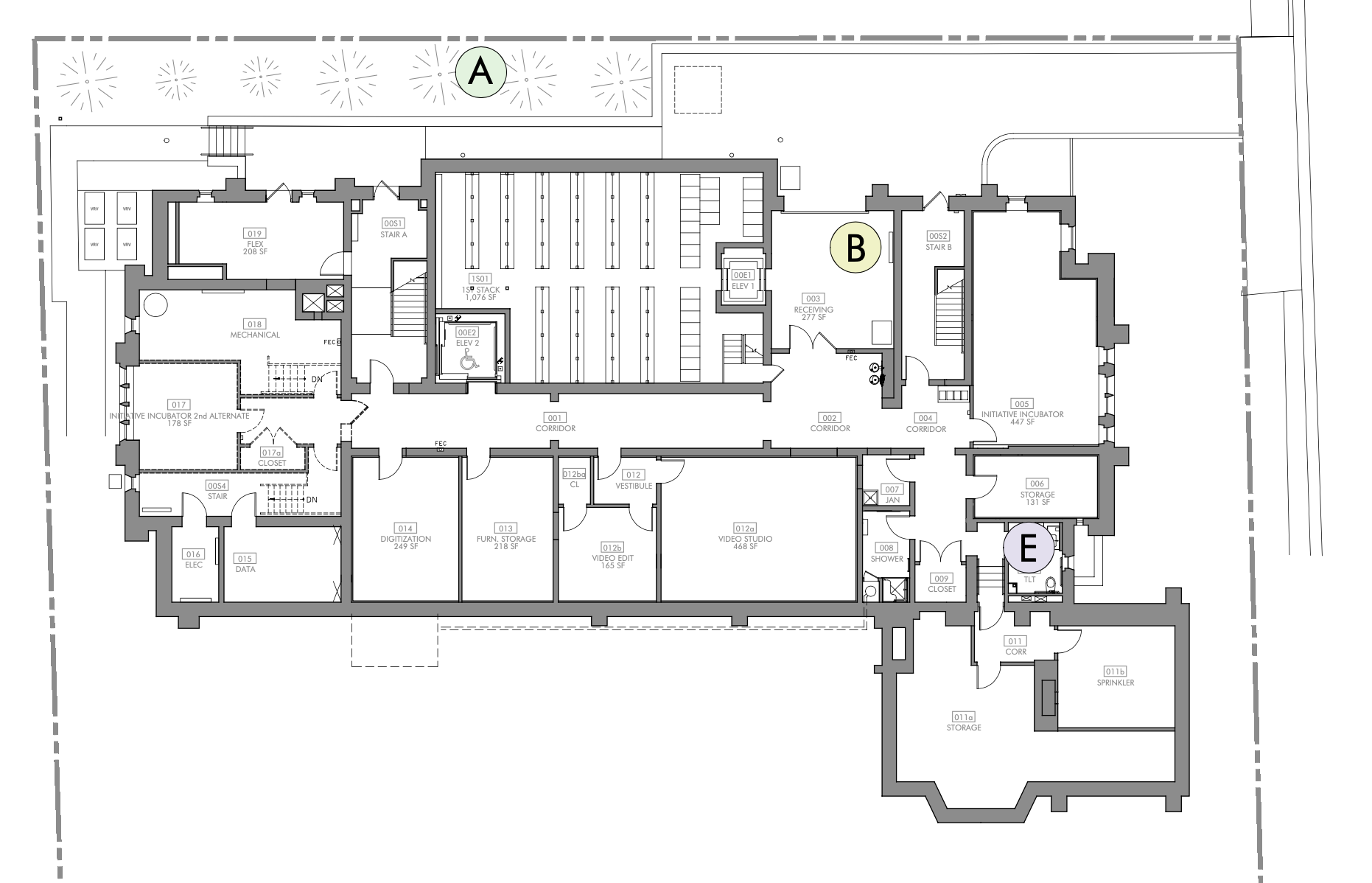
Guided by the university’s FutureVU and FutureVU Sustainability initiatives, 1101 19th Avenue South was designed as a flexible space for the university and to achieve LEED Green Building Education credit. In order to earn a LEED Green Building Education credit (certification pending), the project underwent a case study which included:
Student-driven embodied carbon calculations;
Describing major sustainability measures and embodied carbon calculations within the case study; and
Comprehensive signage that will educate the visitor on the various sustainability measures incorporated into the building as it was being renovated.
During the design and renovation of 1101 19th Avenue South building, these key goals were incorporated:
Historic preservation;
Retention of as much of the original structure as possible to retain embodied energy of the existing structure;
Emphasis and maintenance of existing urban density, walkability and access to mass transportation;
Energy conservation, energy efficiency and avoidance of on-site combustion by using electricity only for HVAC and water heating;
Preservation of existing vegetation and soils, which are long-since adapted to the natural water cycle, thereby preserving the existing biodiversity and avoiding additional demands on city’s potable water system; and
Increased student involvement to maximize learning opportunities.
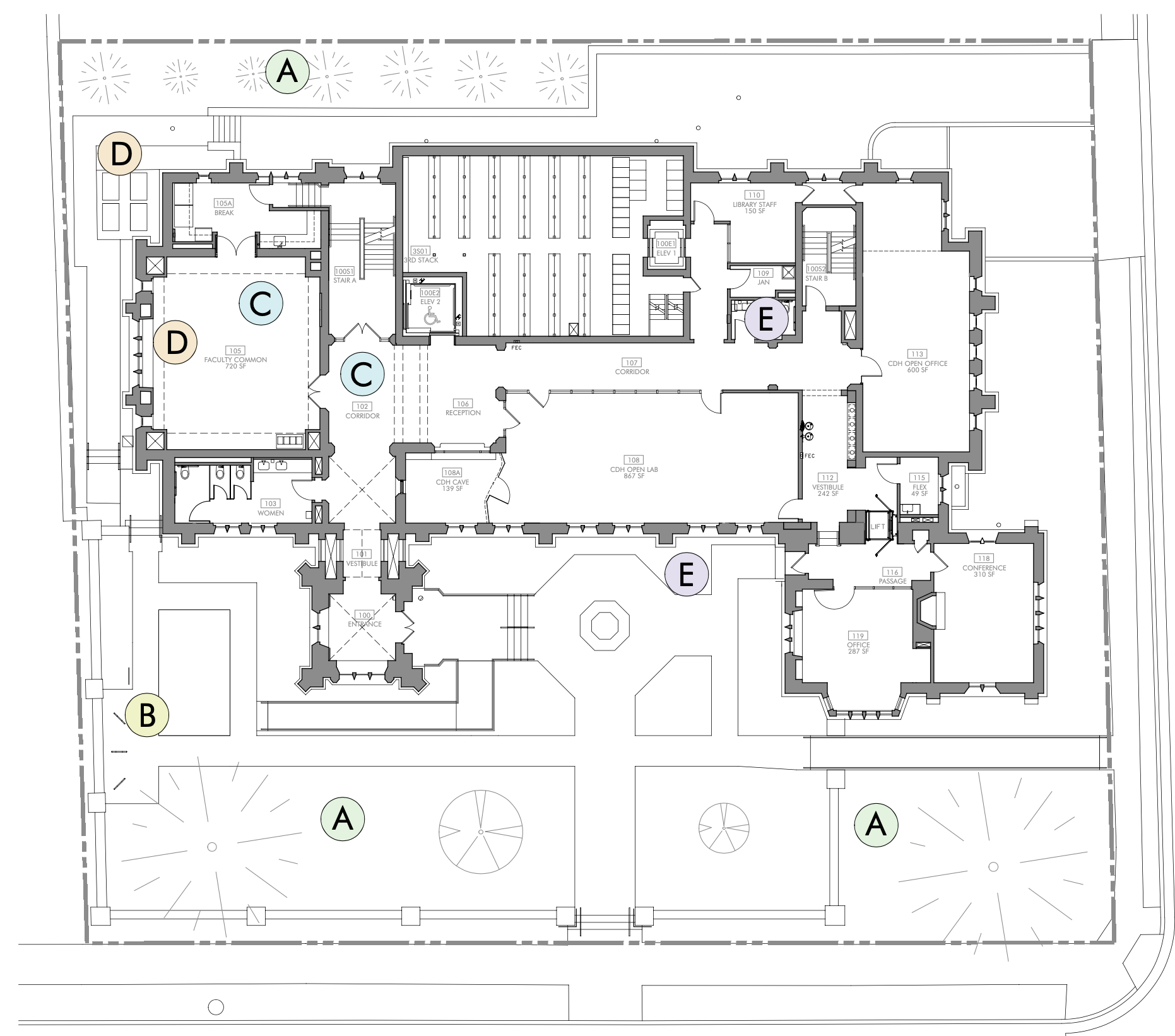
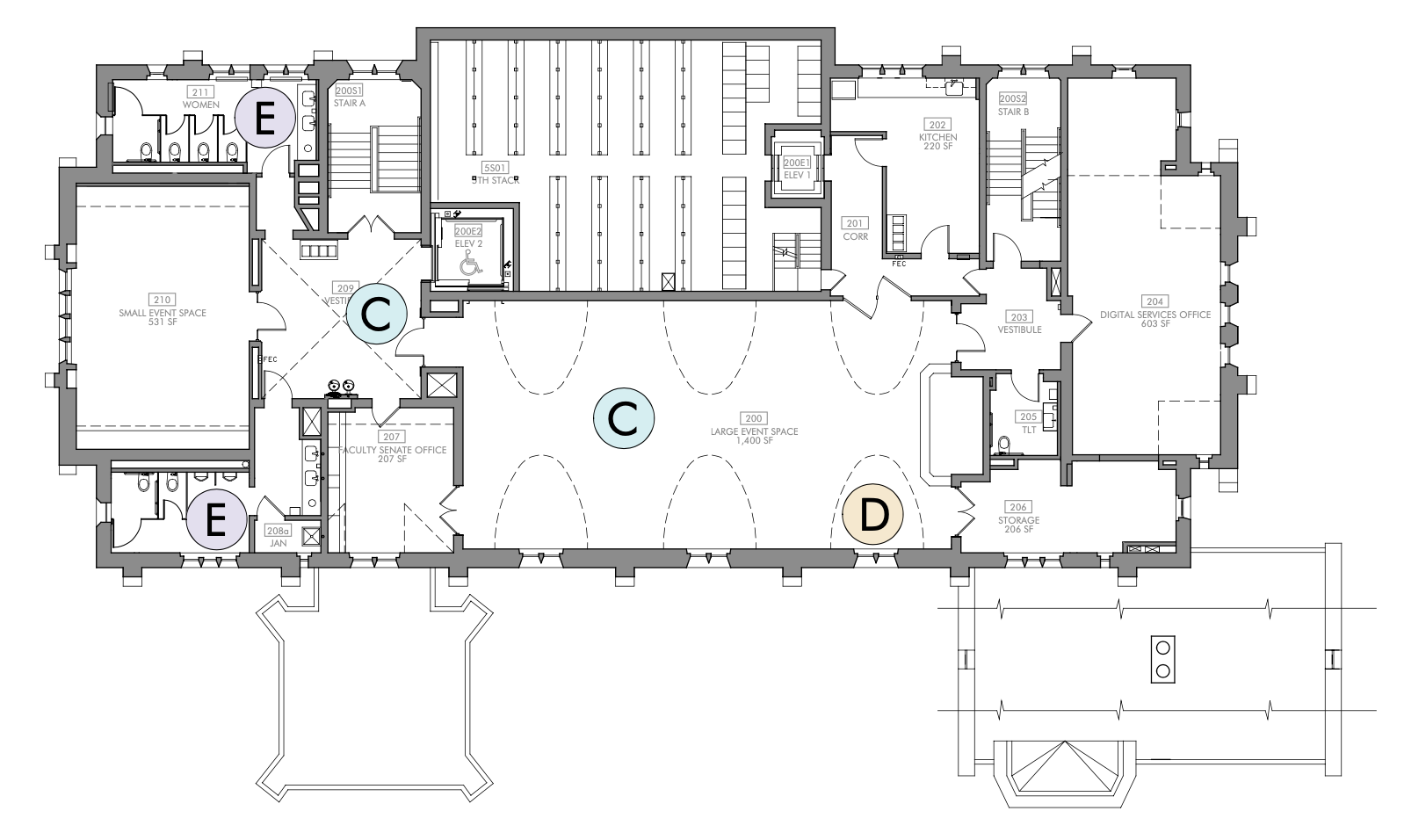
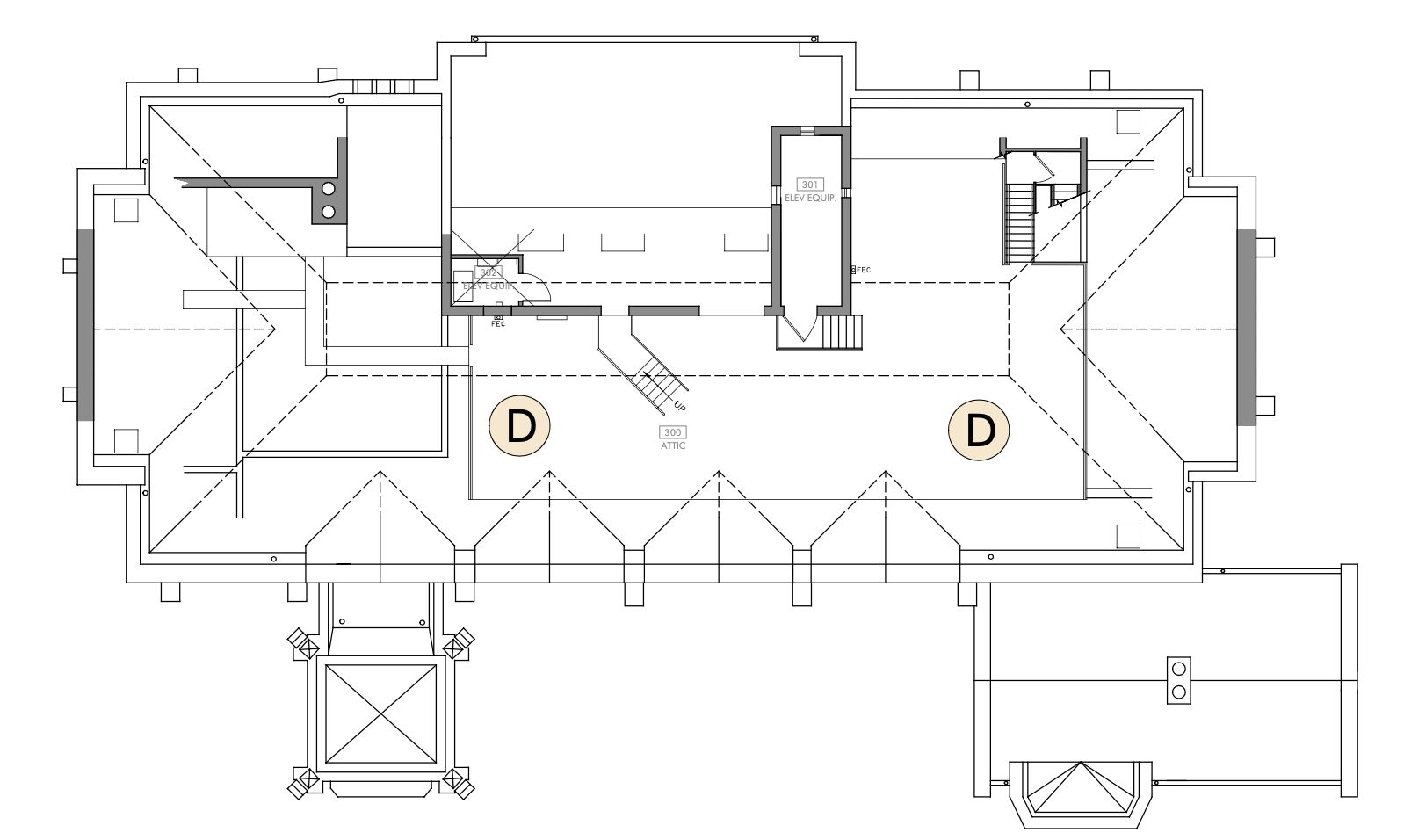
Self-guided Sustainability Tour
Although the project is complete, the university offers a self-guided tour of the sustainability features as a part of the LEED Green Building Education credit (certification pending).
Notable Tour Features:
A. Sustainable Sites | Since the building’s construction in 1956, nature has regenerated the site’s soil and plants into a mature landscape. With this renovation adapted landscape, preserving the existing healthy biodiversity.
B. Location and Transportation | The university’s FutureVU initiative emphasizes walkability and connectivity. This historic building is co-located with mass transit, providing access to low-carbon transportation. Bike racks are provided outside to be convenient for short-term visitors, as well as installed inside the building to communicate that bikes would be secure and out of the weather, promoting alternative transportation and reducing the use of personal cars.
C. Materials and Resources | By renovating instead of building new, the university was able to preserve this unique neo-Gothic building and retain 81% of the original structure. Vanderbilt students assessed all building elements and calculated the percentage elements and calculated the percentage retained showing clear environmental benefits from significantly reducing the carbon that would have been embodied in the extraction, manufacturing and transportation of new materials.
D. Energy and Atmosphere | This renovation supports the university’s Carbon Neutrality by 2050 Goal by introducing energy conservation and energy efficiency measures, including a high-efficiency HVAC system and added roof insulation. New internal windowpanes reduce leakage, insulated the building envelope, and reduce energy use while still preserving the building’s historic character.
E. Water Efficiency | By preserving existing vegetation and soils, which are long-since adapted to the natural water cycle, there is no need for irrigation. In addition, water-efficient fixtures were installed in the building including low-flow faucets and low-flow, dual-flush toilets. As a result, the building’s total potable water use decreased by 55 percent.
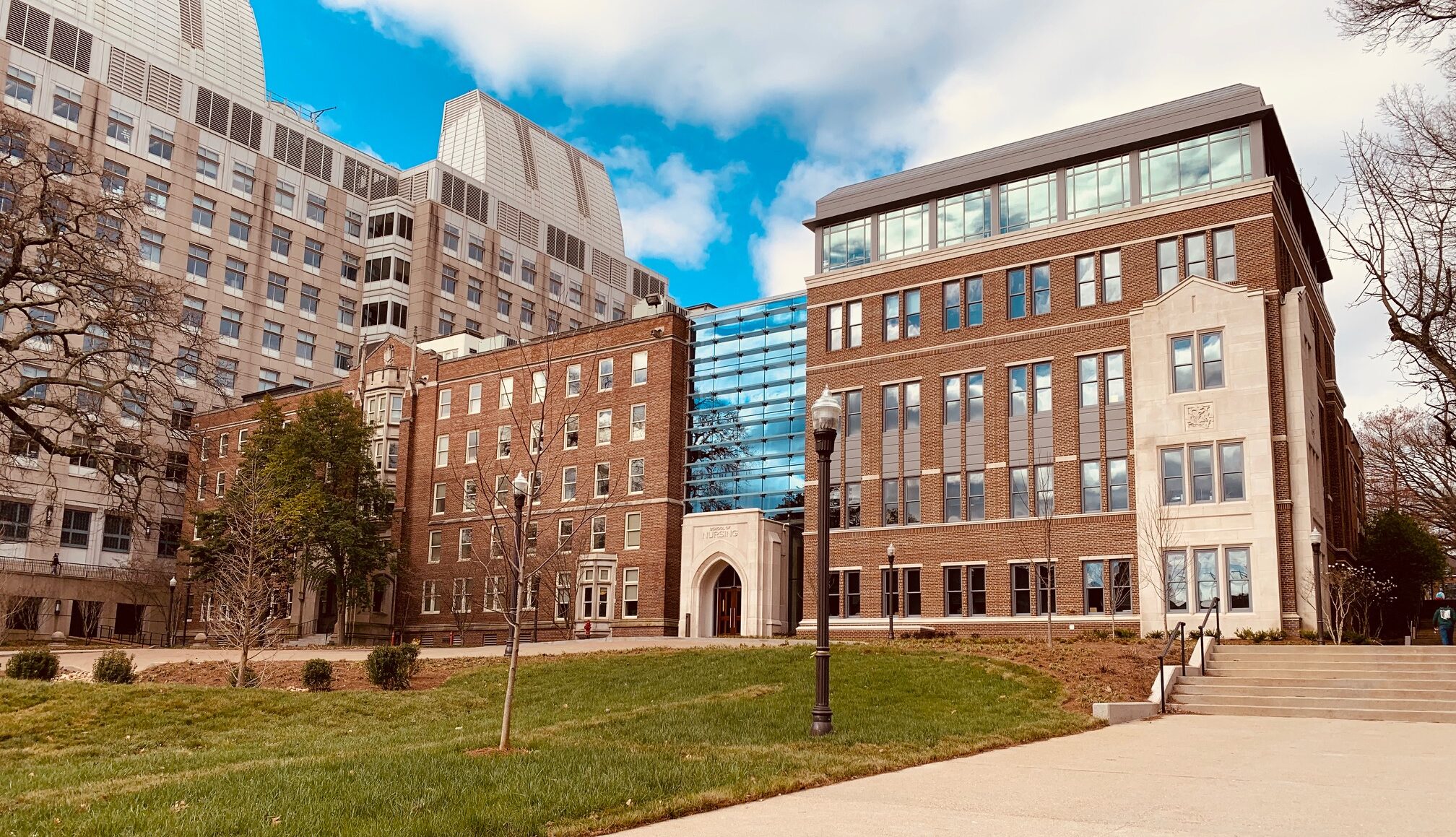
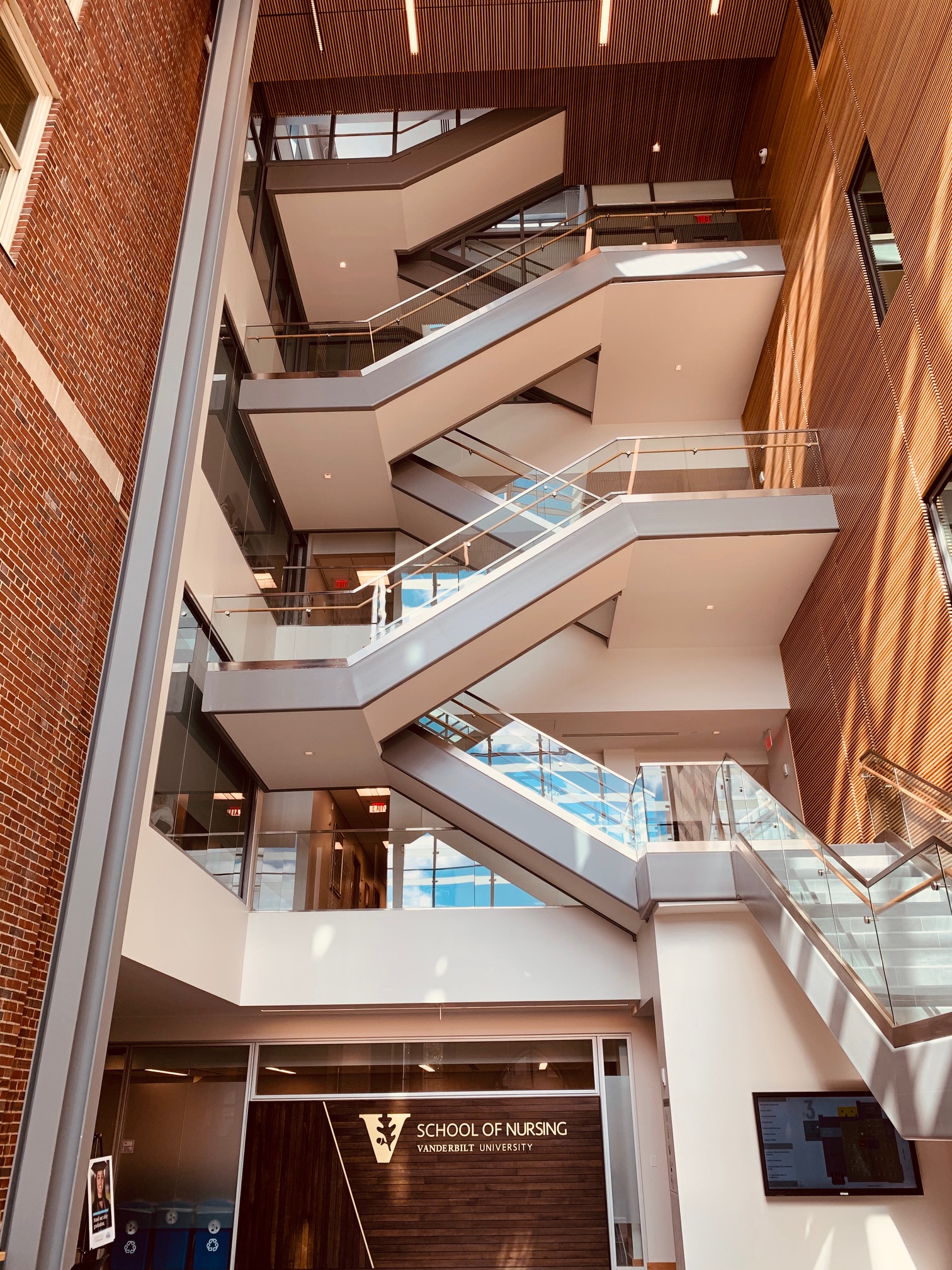
The Vanderbilt School of Nursing added 29,947-square-foot connector building between its existing buildings in August 2018. The $23.6 million facility, approved by Chancellor Nicholas S. Zeppos and the Vanderbilt University Board of Trust, is located between VUSN’s historic Godchaux Hall and the Patricia Champion Frist Hall near the south side of the Heard Library. The five-floor structure houses technologically advanced classrooms, conference and seminar rooms, student services offices, faculty offices and a state-of-the-art simulation teaching lab that allow complex skills development and real-time feedback on students’ clinical nursing skills. The building’s virtual classroom incorporates leading-edge online and distance technology to facilitate distance learning, and its interactive classroom facilitates large- and small-group interactions with electronic methods that allow for sharing of group data and findings.
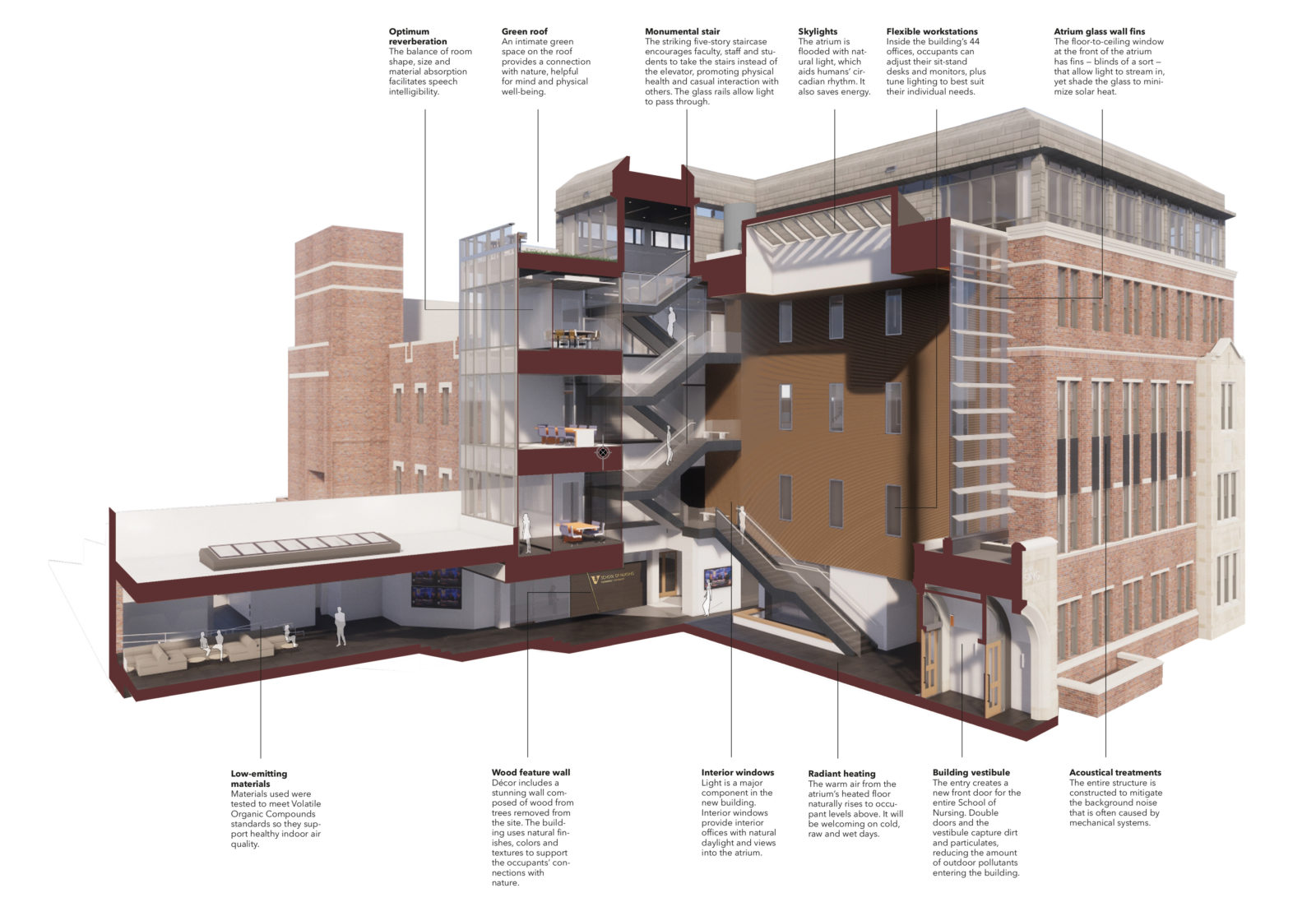
The School of Nursing capital project is the university’s and Nashville’s first WELL-designed building. The building, which opened in January 2019, was designed to WELL Building Standards which is a performance-based system of measuring, certifying and monitoring features that affect human health and well-being in the built environment including air quality, water, nourishment, light, fitness, comfort and mind. The building was also designed to achieve LEED Silver certification.
Health and well-being is infused throughout the new School of Nursing building, from the ductwork to the carpet to the lighting. (Click to expand)
Engineering and Science Building, Eskind Biomedical Library designated LEED Gold by USGBC
U.S. Green Building Council President and CEO Mahesh Ramanujam presented Vanderbilt with a plaque designating the university’s Engineering and Science Building and Eskind Biomedical Library with LEED Gold status at a community-wide gathering on Tuesday afternoon in the Engineering and Science Building lobby.
“It is an honor for Vanderbilt to receive this designation from the USGBC. The recognition this brings will be carried forward by every person who enters this building, not just by seeing the plaque recognizing the distinction, but also in terms of how they will be working, learning and discovering here,” said Provost and Vice Chancellor for Academic Affairs Susan R. Wente.
“This is part of our commitment to making our physical spaces embody our values and enable our mission as a university,” she said. “It’s our belief that community and sustainability go hand in hand, and that fuels not only this project, but all of the projects across our campus.”
“LEED is a revolutionary rating system that is the world standard for measuring and rating buildings of all types, and in a building like this, that consumes a lot of energy and has a wide and highly varied range of activities, accomplishing LEED Gold is something we are extraordinarily proud of,” said Vice Chancellor for Administration Eric Kopstain. “We are very excited to receive such a prestigious honor that exemplifies our commitment to our sustainability goal, which has been championed by our visionary chancellor, Nicholas S. Zeppos.”
The Engineering and Science Building houses the university’s most energy efficient lab space, numerous classrooms, and a state-of-the-art cleanroom that hosts both faculty and student learning and innovation. During the design phase of the building, 3D modeling was used to evaluate site conditions such as orientation, heat gain from windows, natural light and other factors to ensure optimized design. Additional green design elements include a 10,000-gallon cistern to capture rain water for irrigation, sun shading on glass to optimize natural solar light and prevent bird strikes, chilled beams supported by hot and cold water that are used to condition spaces more efficiently than conditioning with air systems, and more.
The Annette and Irwin Eskind Family Biomedical Library and Learning Center, which reopened in July 2018 after a yearlong renovation, is energy efficient and meets modern technology requirements. The renovated design includes technology-enhanced classrooms and study spaces, a lounge, a rooftop patio, and flexible seating and learning spaces designed for interactive teaching strategies that complement the School of Medicine’s Curriculum 2.0. The building’s design also was recognized for its use of low-emitting materials and reduction in potable water use and interior lighting power, among several other green features.
“Thanks to the hard work of USGBC members like Vanderbilt and other partners, we have been able to establish LEED as a common language for buildings to become sustainable and create a roadmap for defining how to build better buildings that save energy, save water, provide space, improve air quality, and importantly, create less burden on the environment, use resources responsibly and drive economic benefits,” Ramanujam said. “I’m really proud to be here at Vanderbilt University to celebrate their journey of LEED. LEED is not new to the campus, but being able to see a building of this profile and caliber to be LEED Gold-certified by the U.S. Green Building Council is a distinct honor for me, our staff and for the members.”
Both buildings’ responsible environmental design features closely align with Vanderbilt’s core missions of teaching, research and discovery through the Academic Strategic Plan. The green design also builds upon the university’s ongoing commitment to investing in sustainable and smart infrastructure through FutureVU, a holistic planning process for developing spaces on campus and investing in initiatives that support the people who live, work and learn in them.
Engineering and Science Building, Eskind Biomedical Library designated LEED Gold by USGBC
U.S. Green Building Council President and CEO Mahesh Ramanujam presented Vanderbilt with a plaque designating the university’s Engineering and Science Building and Eskind Biomedical Library with LEED Gold status at a community-wide gathering on Tuesday afternoon in the Engineering and Science Building lobby.
“It is an honor for Vanderbilt to receive this designation from the USGBC. The recognition this brings will be carried forward by every person who enters this building, not just by seeing the plaque recognizing the distinction, but also in terms of how they will be working, learning and discovering here,” said Provost and Vice Chancellor for Academic Affairs Susan R. Wente.
“This is part of our commitment to making our physical spaces embody our values and enable our mission as a university,” she said. “It’s our belief that community and sustainability go hand in hand, and that fuels not only this project, but all of the projects across our campus.”
“LEED is a revolutionary rating system that is the world standard for measuring and rating buildings of all types, and in a building like this, that consumes a lot of energy and has a wide and highly varied range of activities, accomplishing LEED Gold is something we are extraordinarily proud of,” said Vice Chancellor for Administration Eric Kopstain. “We are very excited to receive such a prestigious honor that exemplifies our commitment to our sustainability goal, which has been championed by our visionary chancellor, Nicholas S. Zeppos.”
The Engineering and Science Building houses the university’s most energy efficient lab space, numerous classrooms, and a state-of-the-art cleanroom that hosts both faculty and student learning and innovation. During the design phase of the building, 3D modeling was used to evaluate site conditions such as orientation, heat gain from windows, natural light and other factors to ensure optimized design. Additional green design elements include a 10,000-gallon cistern to capture rain water for irrigation, sun shading on glass to optimize natural solar light and prevent bird strikes, chilled beams supported by hot and cold water that are used to condition spaces more efficiently than conditioning with air systems, and more.
The Annette and Irwin Eskind Family Biomedical Library and Learning Center, which reopened in July 2018 after a yearlong renovation, is energy efficient and meets modern technology requirements. The renovated design includes technology-enhanced classrooms and study spaces, a lounge, a rooftop patio, and flexible seating and learning spaces designed for interactive teaching strategies that complement the School of Medicine’s Curriculum 2.0. The building’s design also was recognized for its use of low-emitting materials and reduction in potable water use and interior lighting power, among several other green features.
“Thanks to the hard work of USGBC members like Vanderbilt and other partners, we have been able to establish LEED as a common language for buildings to become sustainable and create a roadmap for defining how to build better buildings that save energy, save water, provide space, improve air quality, and importantly, create less burden on the environment, use resources responsibly and drive economic benefits,” Ramanujam said. “I’m really proud to be here at Vanderbilt University to celebrate their journey of LEED. LEED is not new to the campus, but being able to see a building of this profile and caliber to be LEED Gold-certified by the U.S. Green Building Council is a distinct honor for me, our staff and for the members.”
Both buildings’ responsible environmental design features closely align with Vanderbilt’s core missions of teaching, research and discovery through the Academic Strategic Plan. The green design also builds upon the university’s ongoing commitment to investing in sustainable and smart infrastructure through FutureVU, a holistic planning process for developing spaces on campus and investing in initiatives that support the people who live, work and learn in them.
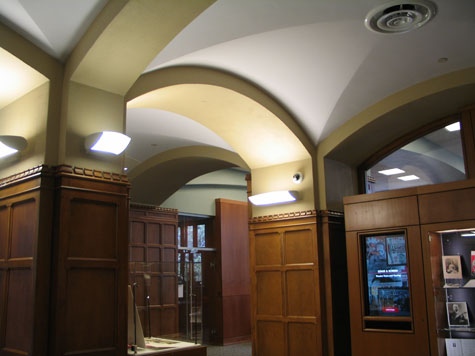
Central Library was awarded gold certification for its environmentally friendly 2010 renovation from the U.S. Green Building Council’s Leadership in Energy and Environmental Design (LEED) Green Building Rating System. The recognition makes the Central Library the first Vanderbilt campus renovation to achieve this high honor. “One of the most sustainable aspects of the renovation was the restoration of the building to its original grandeur while meeting the needs of today’s students,” said Keith Loiseau, university architect.
As part of its LEED-Gold certification, the renovation achieved credits for:
Installation of 30 percent more efficient lights
Installation of an Encelium lighting control system
Enhanced use of natural lighting and daylight harvesting
Recycling of 75 to 80 percent of demolition waste
Placement of recycling containers in 25 locations throughout the building
Installation of dual flush/low flow toilets and low flow faucet fixtures
Installation of high efficiency variable flow refrigerant HVAC mechanical system
Recycled content in 10 percent of the new furniture and furnishings
Credits were also given for the Central Library’s “community connectivity” as the building is located within one-half mile of a residential area and 10 basic services. In addition, there are two bus routes within one-quarter mile of the building.
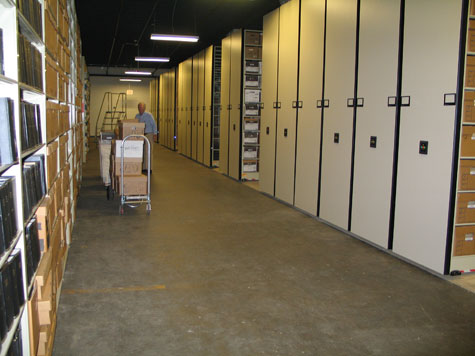
The Library’s Archival Storage Facility received LEED Silver Certification for New Construction. The building, located about two miles from campus on 21st Avenue North, was originally built in 1910; after acquiring the space, Vanderbilt shelled out and rebuilt the interior. The archival storage space has unique humidity and temperature parameters to ensure its contents’ preservation and durability.
Sustainable and environmentally-friendly elements of the Library Archival Storage Facility include:
Reuse of 98.6 percent of the existing walls, floors and roof;
Diversion of 77 percent of construction waste from the landfill;
Bicycle storage and preferred parking for fuel-efficient/low-emitting vehicles;
Reflective roofing materials;
Storage and collection of recyclables;
Materials with post-consumer recycled content and little or no volatile organic compounds (VOCs); and
Automatic lighting controls and water-conserving plumbing fixtures
Benson Hall, home of the English and History departments, was awarded LEED Silver Certification for Commercial Interiors (CI). LEED-CI allows for the incorporation of sustainable interior features during renovations, as opposed to new construction, to reduce operating and maintenance costs while also reducing a facility’s environmental footprint. Vanderbilt University’s Campus Planning and Construction team worked with Gobbell Hays Partners to incorporate sustainable and environmentally friendly elements into Benson Hall including:
77 percent of renovation waste was diverted from the landfill;
Renovation materials were sourced locally;
Energy-efficient lighting fixtures and water-conserving plumbing fixtures were installed;
Renovation materials with post-consumer recycled content and little or no volatile organic compounds (VOCs) were used;
Energy Star-rated computers, monitors, printers, copiers, fax machines, refrigerators and televisions were purchased; and
A green cleaning program was implemented which uses cleaning products with a low impact on the environment.
Alumni Hall has received LEED Gold certification from the U.S. Green Building Council for its recent renovation and addition. LEED stands for Leadership in Energy and Environmental Design and is a certification program that sets the standard for environmentally responsible construction in the United States. Alumni Hall, which was originally constructed in 1924, has been renovated to include many new green features while maintaining much of its historic character.
Alumni Hall was first used as the campus’s original student center for 50 years until Sarratt Student Center opened in 1974. Since its construction, the building has served many purposes, from administrative offices to student spaces. Today, Alumni Hall includes a classroom, student lounge and study space, a café, offices and a gym.
In 2011, the building was added to the National Register of Historic Places for its architectural significance. The renovation of Alumni Hall was approved by the Board of Trust in 2011, and construction began in spring 2012.
“The renovation of Alumni Hall was a special project for Vanderbilt,” said Paul Marshall, campus planning and construction architect and Alumni Hall project manager. “We were able not only to restore a historic building to its original purpose as a student center, but we were able to preserve much of the history of that building while bringing it into the 21st century technologically.”
During the renovation, careful attention was paid to ensure historical features of the building were preserved. Much of the millwork was repaired and reinstalled, the windows were disassembled and rebuilt to include the original cathedral glass, and other design elements were either preserved or restored in the building.
To achieve its LEED Gold certification, Alumni Hall’s energy efficiency, water efficiency and indoor air quality were significantly improved. An innovative technology called variable refrigerant flow was installed that cools and heats air by moving a refrigerant through pipes instead of moving air through a duct system. This method is not only extremely energy efficient, it also takes up much less space than a traditional heating and cooling system, allowing the original design details of the building to remain.
In order to preserve the historic windows while increasing the efficiency of the building, the cathedral windows were restored and secondary panes were installed on the interior of the building, creating windows with modern efficiency. The building was also made more energy and water efficient by installing an intelligent lighting system, increasing insulation and installing low-flow bathroom fixtures.
Alumni Hall brings Vanderbilt’s total number of LEED-certified projects to 16. It joins eight other projects on campus that are LEED Gold certified.
Owen Graduate School of Management (OGSM)
Vanderbilt University’s Owen Graduate School of Management (OGSM) provides world-class business education on a personal scale and pursues a level of excellence worthy of global recognition. OGSM offers a variety of programs in a diverse, close-knit and collaborative environment, and promotes inquiry and discovery amongst its students, faculty, and administration. In order to fulfill its goals of bringing all of its students and faculty under one roof, and in support of the university’s Academic Strategic Plan and FutureVU initiative, the project at OGSM upholds the university’s goals in sustainability, community connectivity and pursuit of excellence in education.
Coming on the heels of the Owen School’s 50th anniversary, this project has received significant support from donors. The Owen Century Partners, a group of early supporters of the project, committed to helping launch the building renovation and expansion, and since then more alumni have committed additional gifts. This project is the university’s first to be completely funded by donations.
Project Details
OGSM Conceptual Rendering
The renovation and expansion of Management Hall included a total of 48,000-square-feet, extending the size of Management Hall by 50 percent to better accommodate the wider Vanderbilt and Nashville business communities.
The project includes a new entrance facing 21st Avenue to make the university’s campus more accessible to the Vanderbilt community and the surrounding Nashville community. In addition to the new entrance on the first floor, a new cafe, flexible active learning classroom, collaboration spaces for students and a multipurpose room that fit OGSM’s entire MBA student body are part of the design.
A building addition allows for larger classrooms on the second floor and office spaces on the third floor. Another part of the project included adding a fourth floor to the existing OGSM building which will feature an outside deck, an event space and two classrooms.
Walk & Roll Loop
Conceptual Rendering
A part of the OGSM project included the removal of parking lot 6B on 21st Avenue, between Scarritt Place and Grand Avenue. The removal of this hardscape is in support of the university’s FutureVU initiative and sustainability goals to add more green space and create a more park-like setting on campus. The parking lot transformed into a new welcoming entrance along 21st Avenue, and a portion of the Walk & Roll Loop, a wide comfortable loop encircling campus for active transportation and recreation. The enhanced, ADA accessible pathways, Walk & Roll loop and green space support the university’s goal to improve connectivity and enhance accessibility throughout its campus.
Parking Update
All the ADA parking spots in the permanently closed 6B lot have been relocated to surrounding parking lots and structures. These nearby parking lots also have amble existing ADA parking spots available. For annual permit holders, nearby lots include 5, 5A, 5B, 6 and 6A, all along 21st Avenue. There are also multiple lots along 19th Avenue available. Daily Parking participants can still use the Wesley Place, Terrace Place and Sony garages.
Virtual Tour
First Floor
The redesigned floor offers a wide variety of features that:
Improve the classroom experience Foster collaboration Maintain our sense of personal scale
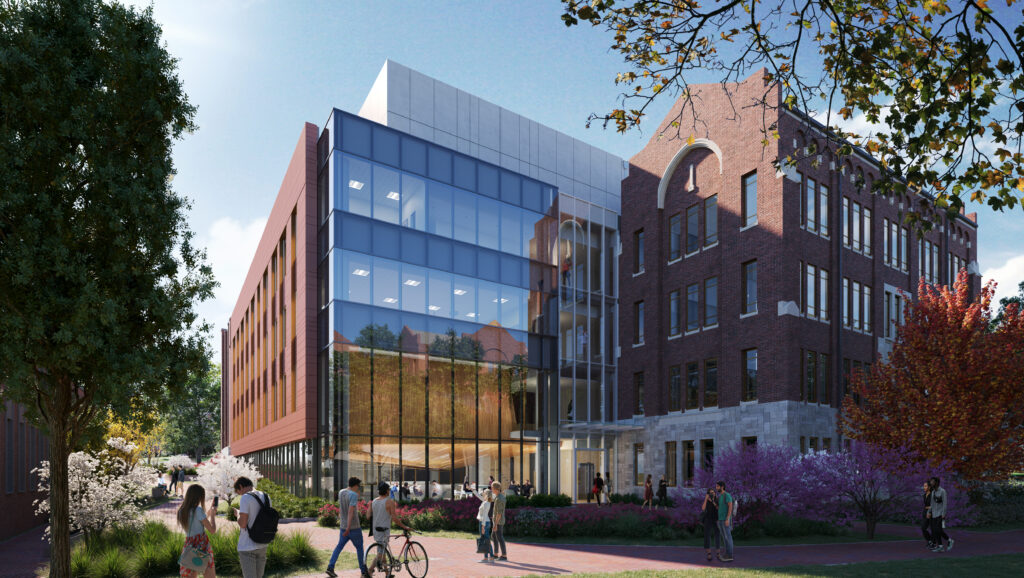
Project Information: Renovation and expansion of Garland Hall to align the facilities with College of Arts & Science's mission of teaching, research and service; create flexible, state-of-the-art space that meets current and future academic needs; and connect the historic core of campus to the university’s transinstitutional mission.
Timeline
Start: May 2023
Completion: July 2025
Occupancy: Summer 2025
Project Team
Project Manager: Cathy Bartlett
Construction Manager: Skanska USA Building Inc.
Architecture Firm: Ayers Saint Gross Inc.
Administration
Kirkland Hall
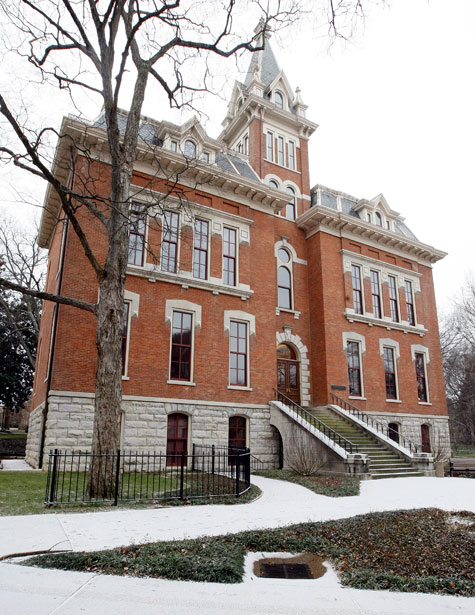
Kirkland Hall and its clock tower stand as an iconic landmark on Vanderbilt’s campus. Originally called the “Main Building”, Kirkland initially housed all of Vanderbilt’s classrooms and laboratories, as well as a chapel, museum and library. While the building was first dedicated in 1875, the hall was rebuilt in 1906 after a devastating fire in 1905 and was renamed in honor of Vanderbilt’s second chancellor, James Hampton Kirkland, and his wife, Mary Henderson Kirkland, in 1937. Renovations to Kirkland Hall have occurred over the years, including a 1968 project that added the rear entry stairs, the rear 4th and 5th floors, elevators and dock ramp. Kirkland’s last major renovation took place in 1988 when the current HVAC and electrical systems were installed.
Kirkland Hall underwent a significant renovation that is reflective of the institution’s purpose and commitment to excellence and sustainability.
Project Details
The renovation is aligned with the FutureVU campus planning framework and its core themes which includes accessibility and inclusion, connectivity and community enhancement, and sustainability. The improvements include:
Making the spaces more inclusive and compliant with ADA regulations and addressing critical infrastructure improvements
Reimagining the front entrance to Kirkland to make both ground-level entrances fully accessible through grading changes
Ramp implementation and reconfiguration of parts of the esplanade area in front of the building
Transforming the building’s interior to intentionally optimize collaboration and communication among leadership and staff members
Modifying the trench drain line at the loading dock to avert flooding of the first floor during heavy rains
Restoring the building roof and tile coping
Upgrading stair towers to enhance safety and vertical circulation through the building
Redesigning bathrooms to be single stall.
Centric Architecture, a Nashville-based design firm, led the Kirkland Hall renovation. Centric recently completed the 6 Magnolia Circle, Mayborn and Connector buildings project on the Peabody campus, for which it received a Historic Preservation Award of Excellence from Associated General Contractors of America.
Time Capsule
During the university’s renovation of Kirkland Hall in 2022, in anticipation of the Sesquicentennial celebration this year, a tantalizing piece of history awaited construction crews. In its cornerstone was a time capsule, interred in 1874 when the building was still known as the Main Building. In Summer of 2023, with help from University Archivist Kathleen Smith, the box was opened. Watch the video.
Dining
Chef James Bistro
Certified; Year Achieved: 2009
Chef James Bistro, a 2,000-square-foot student dining facility located within Rand Hall at Vanderbilt University, received LEED for Commercial Interiors (CI) certification from the US Green Building Council (USGBC). In order to receive certification, the design team incorporated several sustainable elements including the specification of design materials located within a 500-mile radius of Nashville – drastically reducing the carbon footprint of the project. These materials accounted for nearly 75 percent of the total material cost and included tile and millwork among other construction materials. Additionally, a high percentage of regional materials, low-emitting materials and materials with high recycled content were also used. To improve energy consumption and support energy efficiency, 95 percent of all kitchen equipment installed are Energy Star-rated.
Athletics
David Williams II Recreation and Wellness Center
Vanderbilt Recreation and Wellness Center earns LEED Silver certification
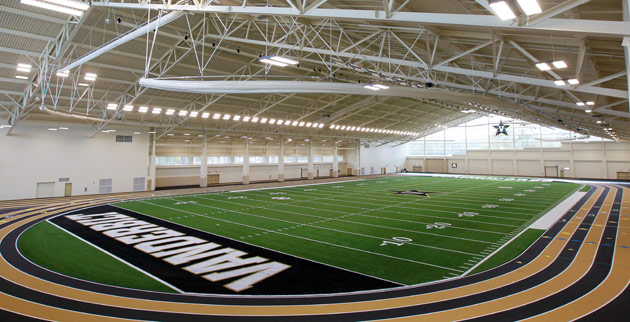
The newest addition to the Vanderbilt Recreation and Wellness Center, the fieldhouse, has received LEED Silver certification from the U.S. Green Building Council. LEED, Leadership in Energy and Environmental Design, is a certification program that is considered the standard for environmentally responsible construction.
The renovated VRWC opened to the campus community in January 2014 with upgrades including the fieldhouse, demonstration kitchen and bowling alley. The fieldhouse includes an indoor turf football field and a 300-meter track.
The use of natural light through the north- and south-facing window walls lessen the need for interior lighting in the fieldhouse. To supplement the natural light in the space, energy-efficient LEDs were installed, including high bay fieldhouse lighting.
“During the initial phases of design, the team planned on using high-efficiency/high-discharge fluorescent lighting,” said Paul Marshall, project manager and architect in Campus Planning and Construction. “However, as we were completing design, new LED high bay luminaires showed up at the industry trade show LightFair. Upon further evaluation, we made the decision to install these state-of-the-art fixtures to provide the most efficient, long-lasting and controllable lighting solution for the indoor practice facility. This was Vanderbilt’s first large-scale installation of athletic LED sports lighting, which were later used at Hawkins Field.”
In addition, the air conditioning units used in the fieldhouse recirculate conditioned air rather than using all outside air, improving efficiency of the system. Particular attention was paid to indoor environmental quality during construction, and low-emitting materials were chosen when installing finishes such as paint, flooring and adhesives.
Williams’ legacy honored with name on building close to his heart
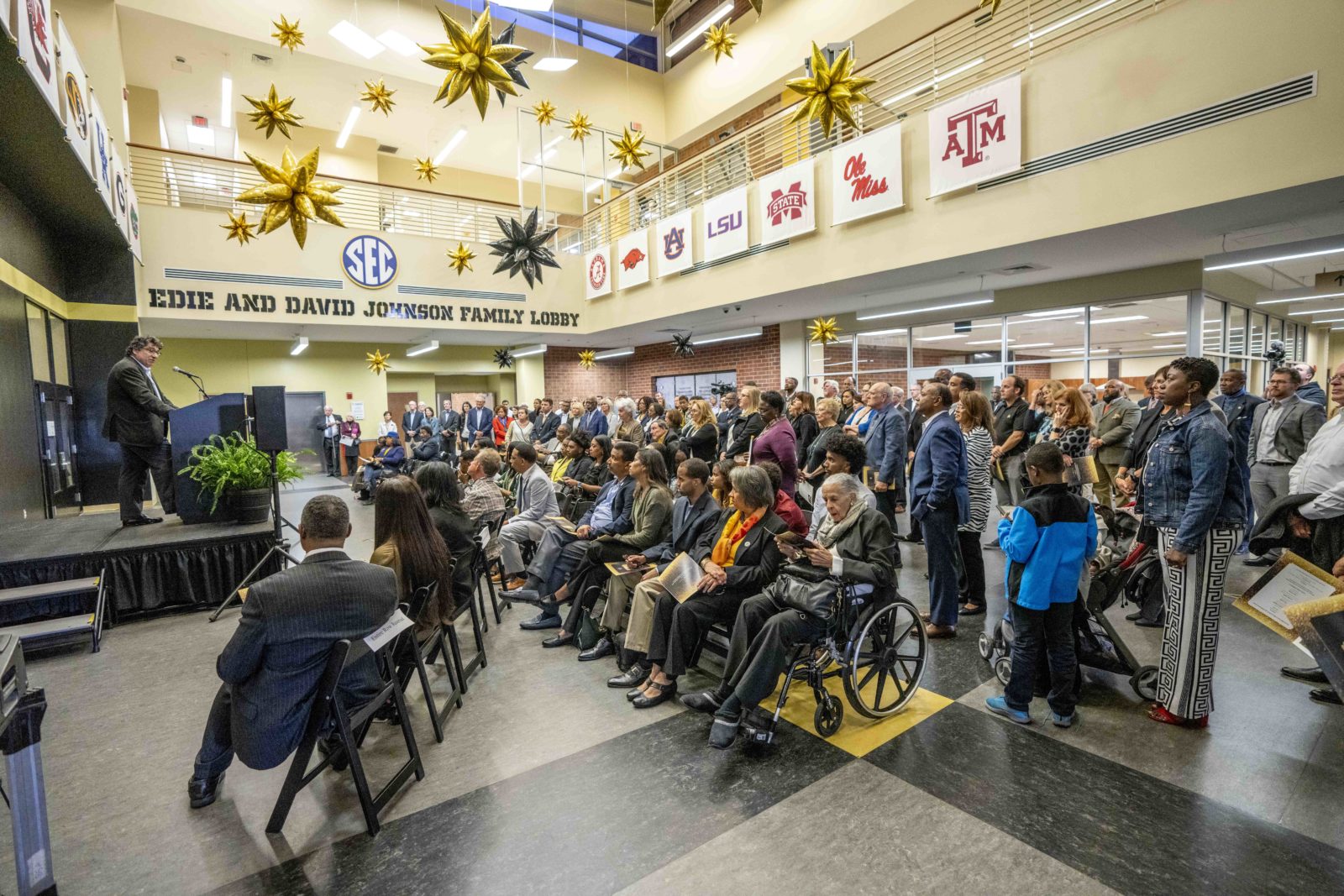
Vanderbilt University paid tribute to the trailblazing leadership of David Williams II with the naming of its recreation and wellness center for Williams, the university’s first African American vice chancellor, who made a transformative impact on college athletics and higher education.
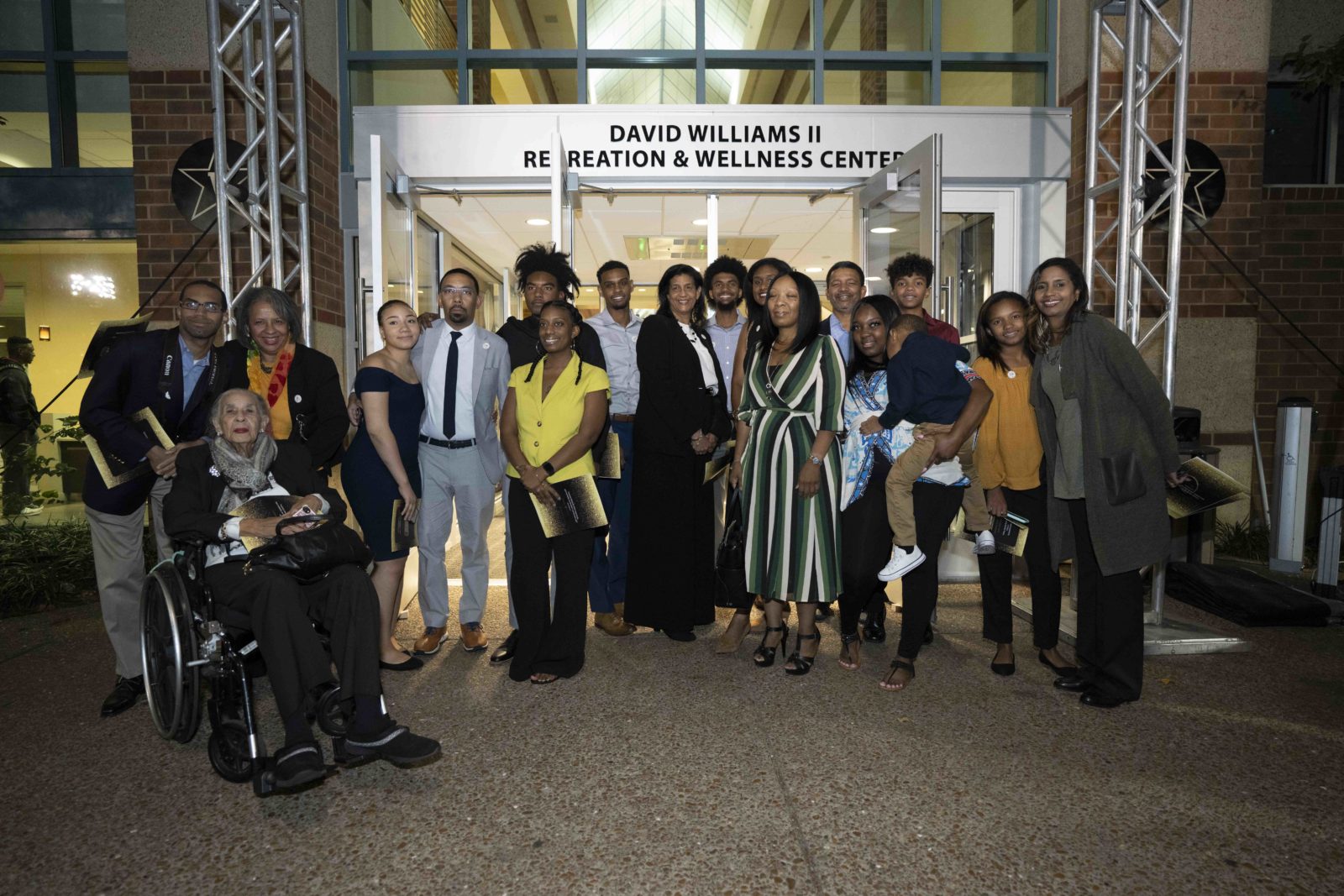
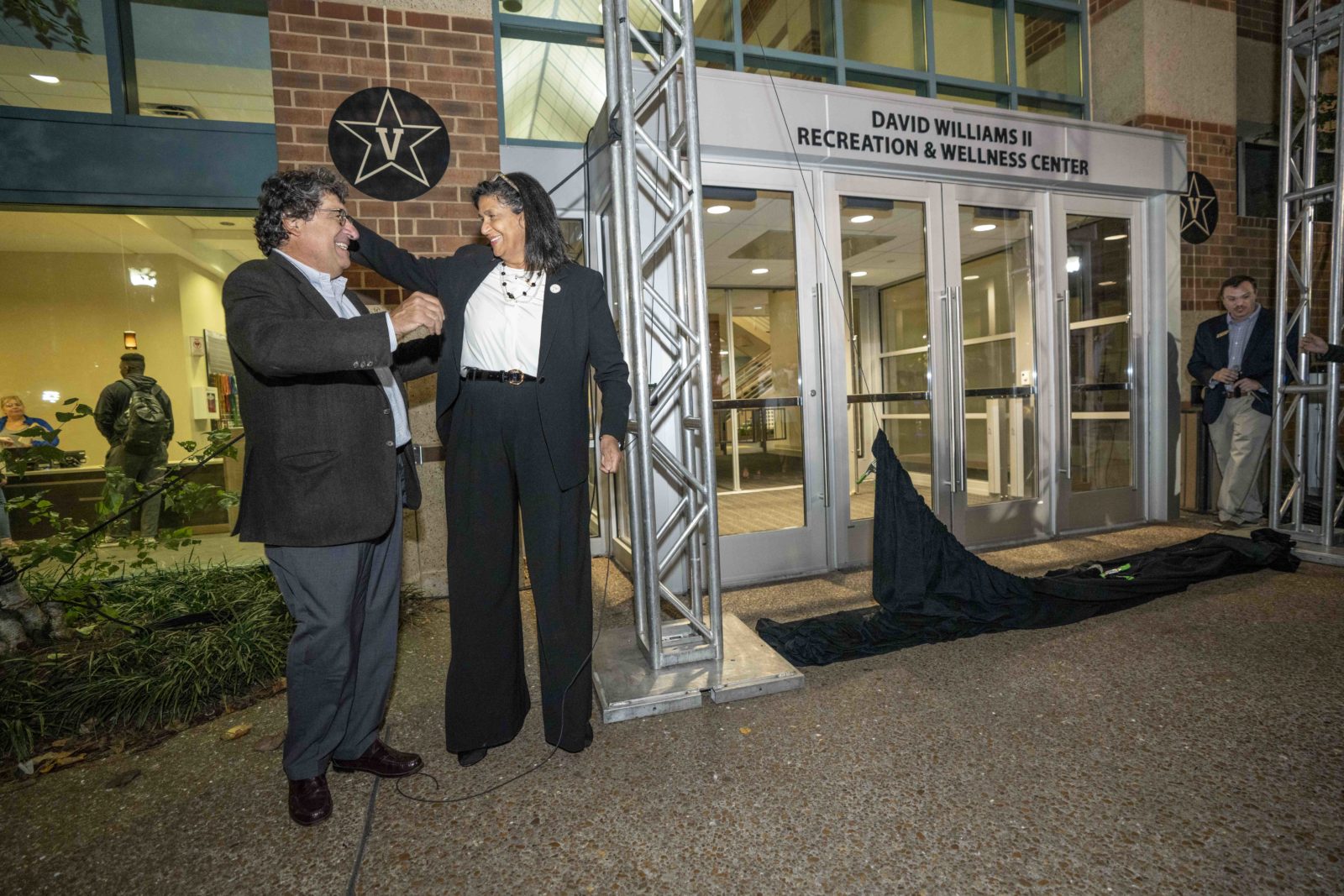
A ceremony unveiling the new name—David Williams II Recreation and Wellness Center—and remembrances of the man affectionately called the “Goldfather” took place on Oct. 18 at the facility where Williams oversaw a significant expansion and renovation.
Friends and family of David Williams stand in front of the new signage at the David Williams II Recreation and Wellness Center. (John Russell/Vanderbilt University)
“The name on a building should be a teacher; it should spark curiosity, admiration, inspiration,” Chancellor Emeritus Nicholas S. Zeppos said. “The name on this building is a fitting tribute to David because he was the ultimate teacher. He believed that if you give someone an education, you give them an opportunity to change their lives, just like education changed his life.”
Williams died unexpectedly at age 71 on Feb. 8, just eight days after stepping down as vice chancellor for athletics and university affairs and athletics director. He had returned to being a full-time law professor at Vanderbilt Law School, where he was focused on establishing a new Sports, Law and Society Program. Earlier on the morning of Feb. 8, the Vanderbilt Board of Trust, on recommendation from Zeppos, had voted to rename the Student Recreation and Wellness Center after the former vice chancellor and athletics director.
Under Williams’ direction, the 2013 renovation and expansion of the recreation and wellness facility was designed to serve the entire Vanderbilt community. Upgrades included a four-lane bowling alley, a demonstration kitchen for preparation of healthy meals, and expanded cardiovascular and fitness areas. In addition, the field house was constructed, featuring a 120-yard-long indoor turf practice field surrounded by a 300-meter track. The field house received LEED silver certification from the U.S. Green Building Council for its environmentally responsible construction. Williams also oversaw major improvements at Hawkins Field, Brownlee O. Currey Tennis Center and McGugin Center, among other facilities.
Williams also brought Vanderbilt Athletics into a new era of prominence, with the Commodores winning four national championships under his leadership.
Friends and family of David Williams gather in the SEC Johnson Lobby of the David Williams II Recreation and Wellness Center. (John Russell/Vanderbilt University)
“In 2014 when we won the College World Series, he was on the field,” said Tim Corbin, head baseball coach. “I could see tears coming down both cheeks. He looked like a proud dad, and I’ll never forget that look.”
A hallmark of Williams’ tenure was the expansion of academic and experiential opportunities for student-athletes. Thanks to his leadership, Vanderbilt now offers the nation’s most comprehensive summer internship program for student-athletes.
Zeppos recounted Williams’ push to change NCAA rules to better support student internships, as well as his constant dedication to Vanderbilt’s student-athletes, crediting him with pioneering the Vanderbilt Way. “College athletics is part of the student-athlete experience. He believed that you could achieve athletically and academically, and David is the person who built the Vanderbilt Way,” Zeppos said.
“Students inspired David because he was an educator. Everything he did, he did for students,” said Williams’ wife, Gail, associate director of community engagement in Vanderbilt’s Division of Government and Community Relations. “He was inspired by the kindergarteners he first taught as a teacher in the 1970s, but he was also inspired by the kindergarteners he worked with at Buena Vista right here in Nashville. And he was inspired by all those students in between, to whom he got to bring his passion.”
Chancellor Emeritus Nicholas S. Zeppos and Gail Williams next to new signage at the front of the David Williams II Recreation and Wellness Center. (John Russell/Vanderbilt University)
Williams also will be remembered for the attention he brought to sports’ impact on society and the university’s troubled history during the civil rights movement. He helped lead efforts for recognition of and reconciliation with Vanderbilt pioneers that included student-athletes Perry Wallace and Godfrey Dillard.
“He realized that if Vanderbilt faced up to its past of racial exclusion and discrimination in an honest light, that there was a glimmer of hope,” Zeppos said. “If we could be honest, there was a better way forward for a more perfect university. He did so much to try to lead us to that place.”
Also speaking at Friday evening’s program was Jennifer Edobi, a Class of 2018 alumna who was a member of the track and field team. She credited Williams with helping to recruit her to the university and making her feel at home once she was a Commodore.
“I quickly started calling him ‘Grandpa,’” Edobi said. “It didn’t matter where I saw him—whether on Jess Neely Drive riding on a golf cart or at the end of a finish line when I was ready to pass out and couldn’t feel my legs—it was always, ‘Hey, Grandpa!’ and I would sneak in a hug.”
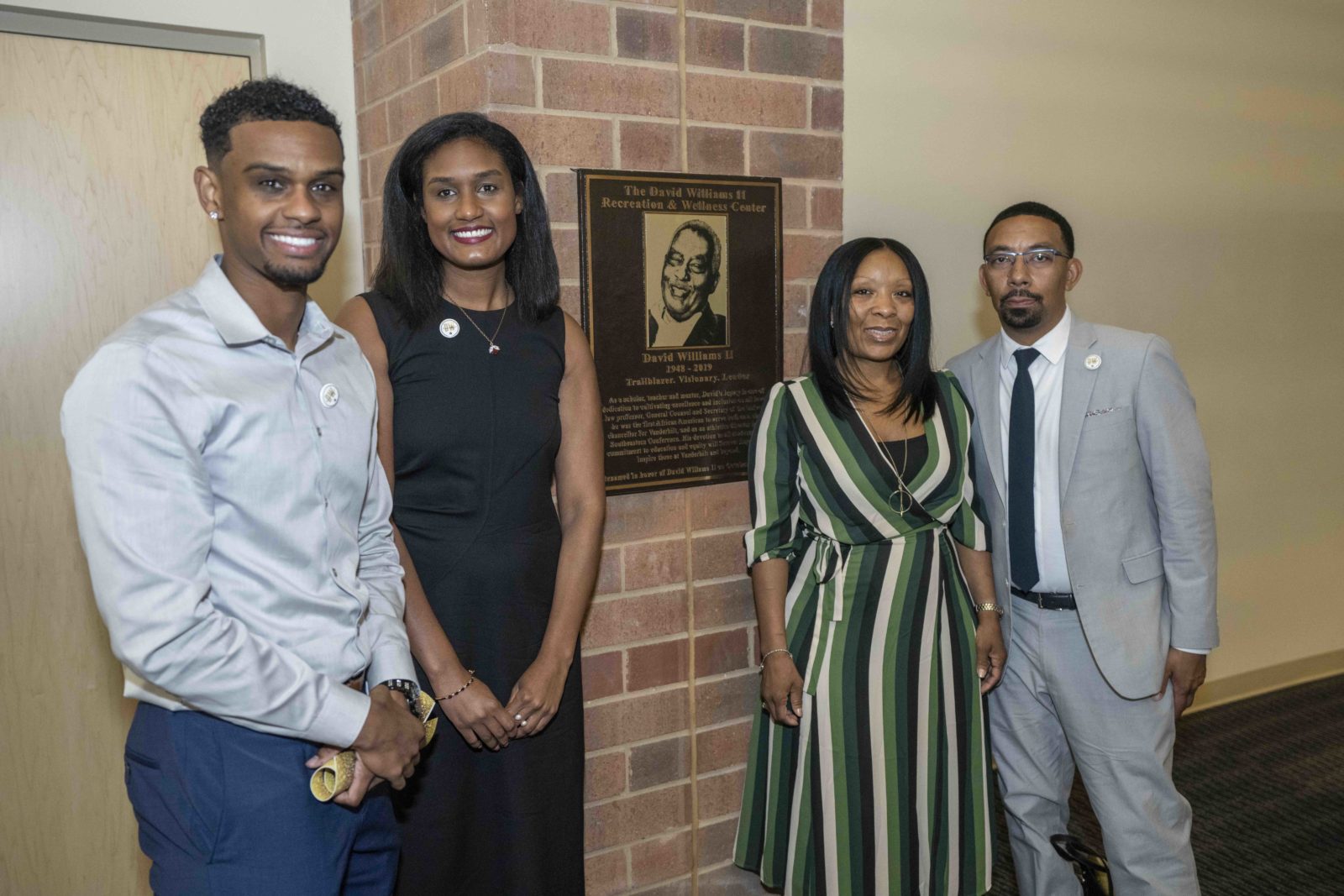
David Williams’ children stand next to a new plaque honoring Vanderbilt’s late former athletics director and vice chancellor. (John Russell/Vanderbilt University)
Edobi also spoke of Williams’ ability to empower student-athletes on and off the field, making them feel like people first, students second and athletes third. “It didn’t matter who you were, he made his office and presence feel like home to you. Whatever level you were on, he met you on that level.”
Curt Moody, CEO and founder of Moody Nolan, the construction company that oversaw the renovation of the recreation center, also spoke, noting Williams’ vision for the field house. “When building this indoor practice facility, David didn’t want this building just to be for the football team. He wanted it to be for all students. That’s the kind of facility he wanted for Vanderbilt University,” Moody said.
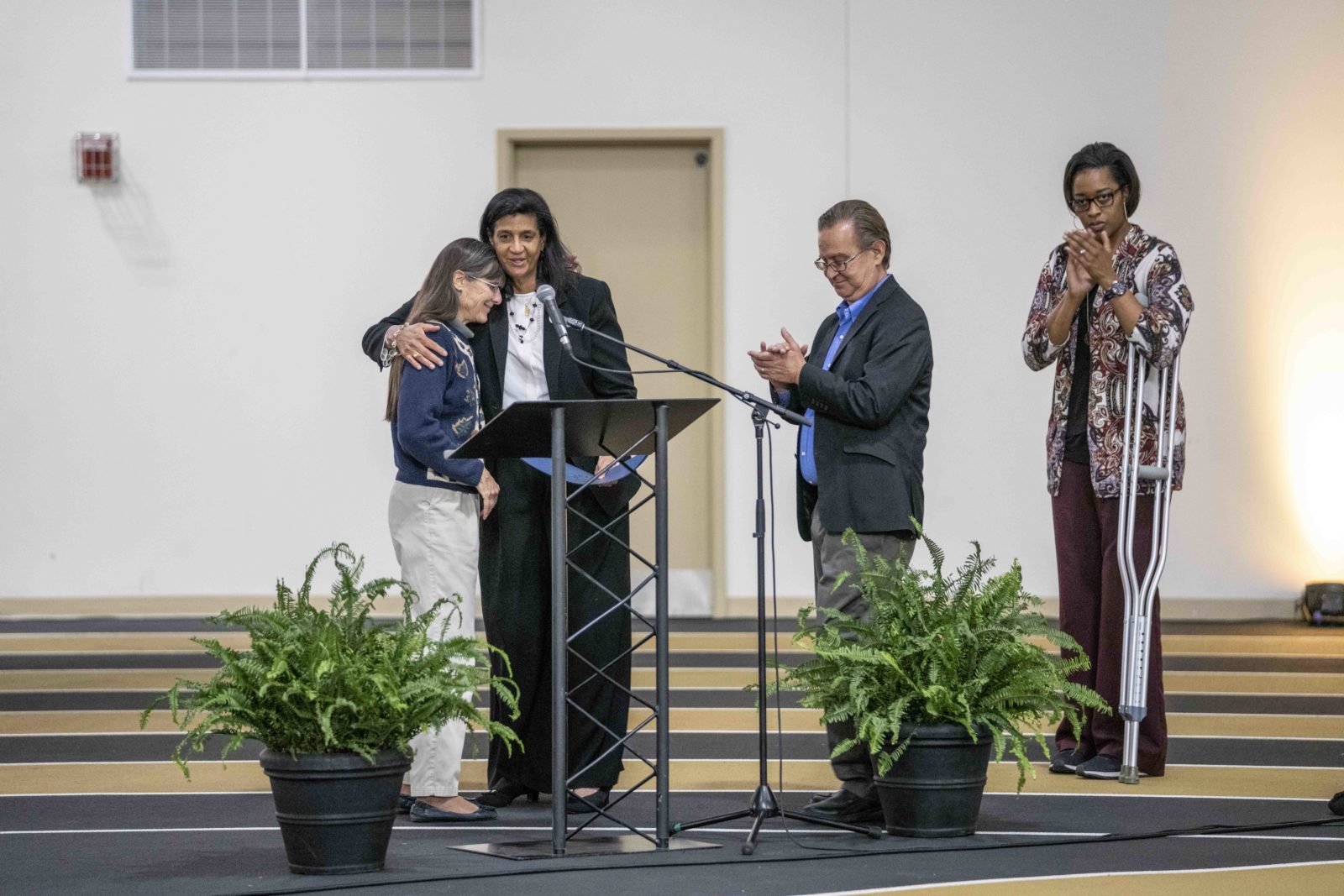
Gail Williams concluded the remarks and remembrances. “I thank the university for celebrating David’s body of work and for allowing it to live on at Vanderbilt,” she said. “Others can come to this campus and visit and be a part of a building that celebrates the things that David was all about. Our family is so grateful. David would be so deeply appreciative, and he would have said, ‘But I was just doing my job.’”
Gail Williams hugs Metro Council Member Burkley Allen in the field house as fellow Council Member Thomas Cash and Associate Vice Chancellor for Student Affairs and Deputy Athletics Director Candice Storey Lee look on, following the reading of a Metro Council resolution in honor of David Williams. (John Russell/Vanderbilt University)
The celebration was one of many ways Vanderbilt honored Williams during Reunion Weekend. Wente unveiled a Vanderbilt Trailblazers portrait of Williams that now hangs in Kirkland Hall, and Williams also was recognized with a Legacy Pioneer Portrait at the Bishop Joseph Johnson Black Cultural Center.
Gail Williams noted, “It’s his family’s hope that his trailblazing legacy creates more trailblazers for us to follow in the many years to come.”
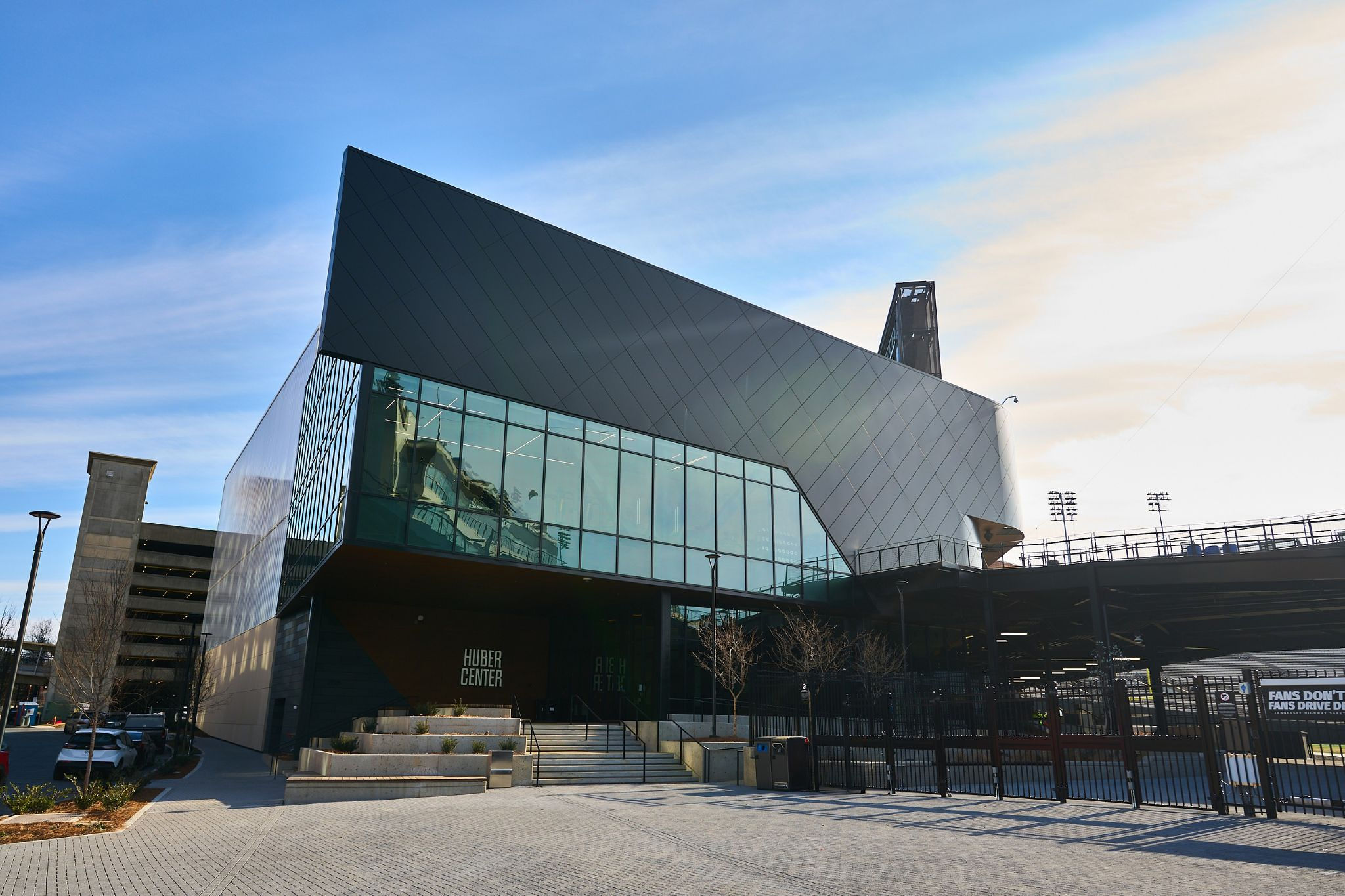
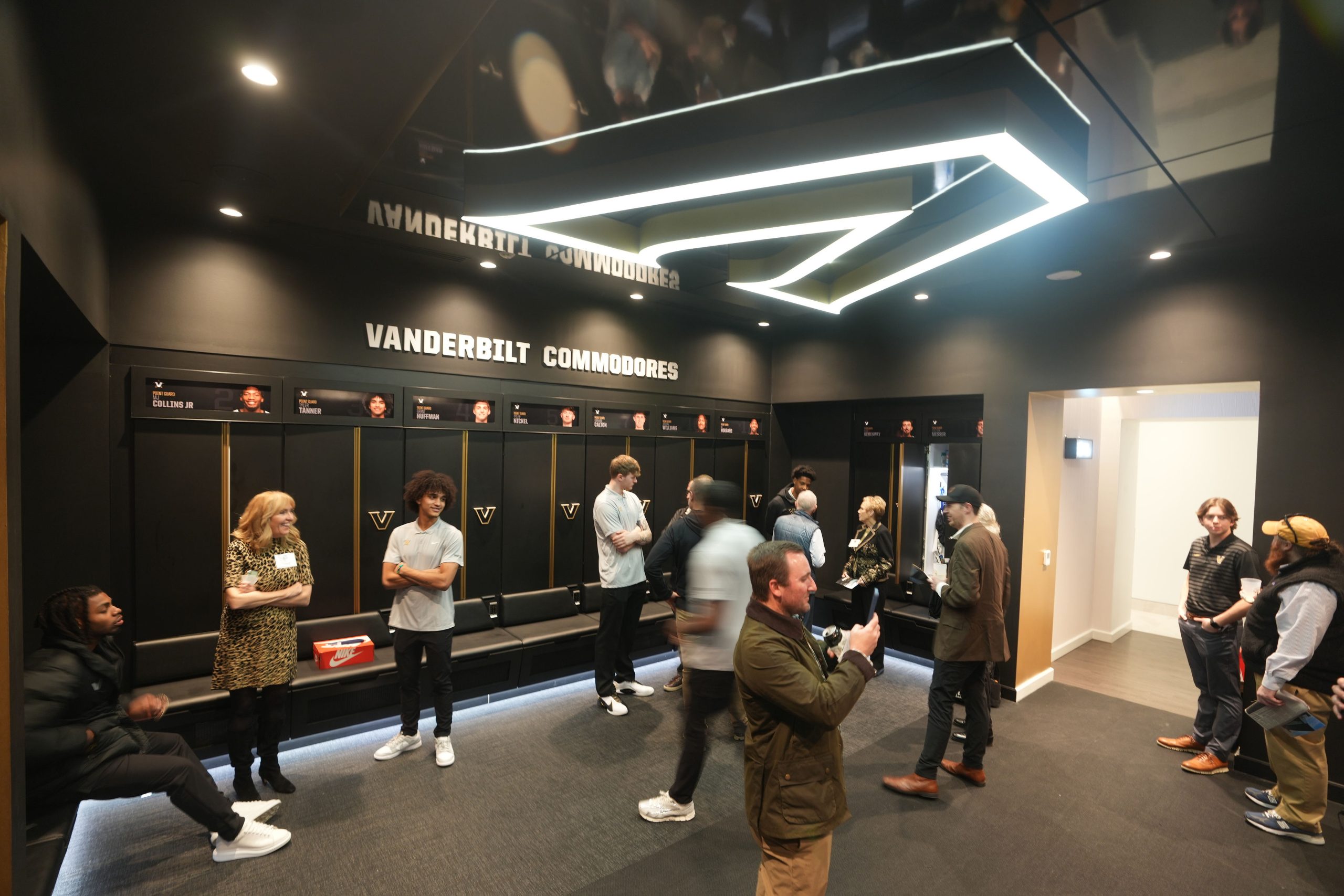
Located in the current north end zone of FirstBank Stadium, the Huber Center is a multi-floor building featuring two practice gyms and spanning more than 90,000 square feet. It includes new student-athlete locker rooms and lounges, a new weight room, and a new athletic training facility. Premium hospitality areas and a new video board enhance the football game day experience. Additionally, there is new premium seating, including loge boxes for football game days, a visiting football locker room, and a new north concourse expansion connecting FirstBank Stadium’s east and west concourses. The facility also offers convenient access to Memorial Gymnasium.
FirstBank Football Stadium Renovations
Project Overview
Details
Square Footage: 130,000
LEED: Gold
Project Information: Renovations to the south end zone including the addition of new premium seat offers for game day including living room boxes, loge boxes, club seating, field-level seating, founders' suites and open air tailgate. The concourse footprint will be expanded to double the number of concession stands available. A new video board and acoustics system installed within the stadium. Part of the north end zone renovations includes the construction of the Huber Center, a 90,000 SF, basketball facility that overlooks the FirstBank Stadium field.
The U.S. Green Building Council’s Leadership in Energy and Environmental Design (LEED) Green Building Rating System is the nationally- accepted benchmark for the design, construction and operation of high- performance sustainable buildings. Organizations must apply for the certification, which is recognized as proof that a building is environmentally responsible, profitable and a healthy place to live and work. Vanderbilt University has a total of 27 LEED-Certified projects since 2007.
WELL Buildings
The WELL Building Standard is a performance-based system of measuring, certifying and monitoring features that affect human health and well-being in the built environment, including air quality, water, nourishment, light, fitness, comfort and mind. Organizations must apply for certification, which certifies that the building is optimal for human health and well-being.
WELL pilot: Nursing Health and well-being inform every part of Vanderbilt University School of Nursing’s new $23.6 million building expansion, opening Jan. 22. The expansion was designed to target WELL Silver certification, which is garnered by meeting specific requirements in building design and implementing specific operational policies, such as housekeeping standards. Once the certification process concludes, the university anticipates that this building will be the first complete, ground-up structure in Nashville to carry the WELL designation.