Principles and Properties of Lasers
Background:First of all, there are some really good sites that may be worth checking out:
http://www.netaxs.com/~klipstei/laserfaq.htm
http://hometown.aol.com/WSRNet/tut/t1.htm
http://vcs.abdn.ac.uk/ENGINEERING/lasers/lasers.html
History of the Laser
The word Laser is an acronym for Light Amplification by Stimulated Emission of Radiation. The process of stimulated emission was described (theoretically) by Einstein in 1917. However it was not until 1954 when Gordon, Zeiger and Townes took advantage of the stimulated emission process to construct a microwave amplifier, referred to as a maser. This device produced a coherent beam of microwaves to be used for communications. The first maser was produced in ammonia vapor with the inversion between two energy levels that produced gain at a wavelength of 1.25 cm.

In 1960, Theodore Maiman of Hughes Research laboratories demonstrated the first laser using a ruby crystal as the amplifier and a flashlamp as the energy source. Results of this work were published in Nature after the manuscript was first rejected for publication in Physical Review Letters. The helical flashlamp surrounded a rod-shaped ruby crystal, and the optical cavity was formed by coating the flattened ends of the ruby rod with a highly reflecting material. An intense red beam was observed to emerge from the end of the rod when the flashlamp was fired.
The first gas laser was developed in 1961 by A. Javan, W. Bennett, and D. Harriot of Bell Laboratories, using a mixture of helium and neon gases. This was followed in 1962 by the first semiconductor laser, demonstrated by R. Hall at the General Electric Research Laboratories. In 1963, C.K.N. Patel of Bell Laboratories discovered the infrared carbon dioxide laser, which is one of the most efficient and powerful lasers available today. Later that same year, E. Bell of Spectra Physics discovered the first ion laser, in mercury vapor. Today there are hundreds of laser sources that emit from the X-ray region to the UV to the visible and the IR and beyond. These sources are capable of emitting continuous wave radiation as well as very short pulses of light. (Silfvast)
Laser Components
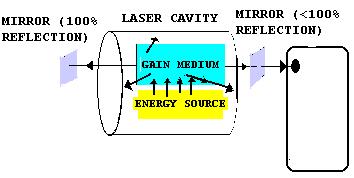
The output of a laser may vary in any number of ways. However, nearly all lasers consist of an energy source, a gain medium and a resonator cavity. The keys to laser operation are attainment of a population inversion and creation of an environment in which the gain is greater than the losses.
- ENERGY SOURCE - This is used to pump energy into the gain medium to boost it to the higher energy level. This energy source can be optical, electrical, chemical, etc.
- GAIN MEDIUM - This can be a solid, liquid, gas, or semiconductor material which can be pumped to a higher energy state. For lasing to occur, it must be possible to boost a majority of the lasing medium to an upper energy level (electron, ion, vibrational) called population inversion.
- MIRRORS - The mirrors allow stimulated light to bounce back and forth through the lasing medium. One mirror is 100% reflective while the other (the 'outcoupler') allows some light to pass through creating the laser beam.
A Brief Overview of the Lasing Process
In the figure a simplified energy-level diagram for either an atomic or molecular species is shown. Such a species forms the basis for the laser gain medium. For the unexcited species, the electrons are in the ground state, S0. When energy is pumped into the gain medium the electrons can be excited to a higher energy level, S2.
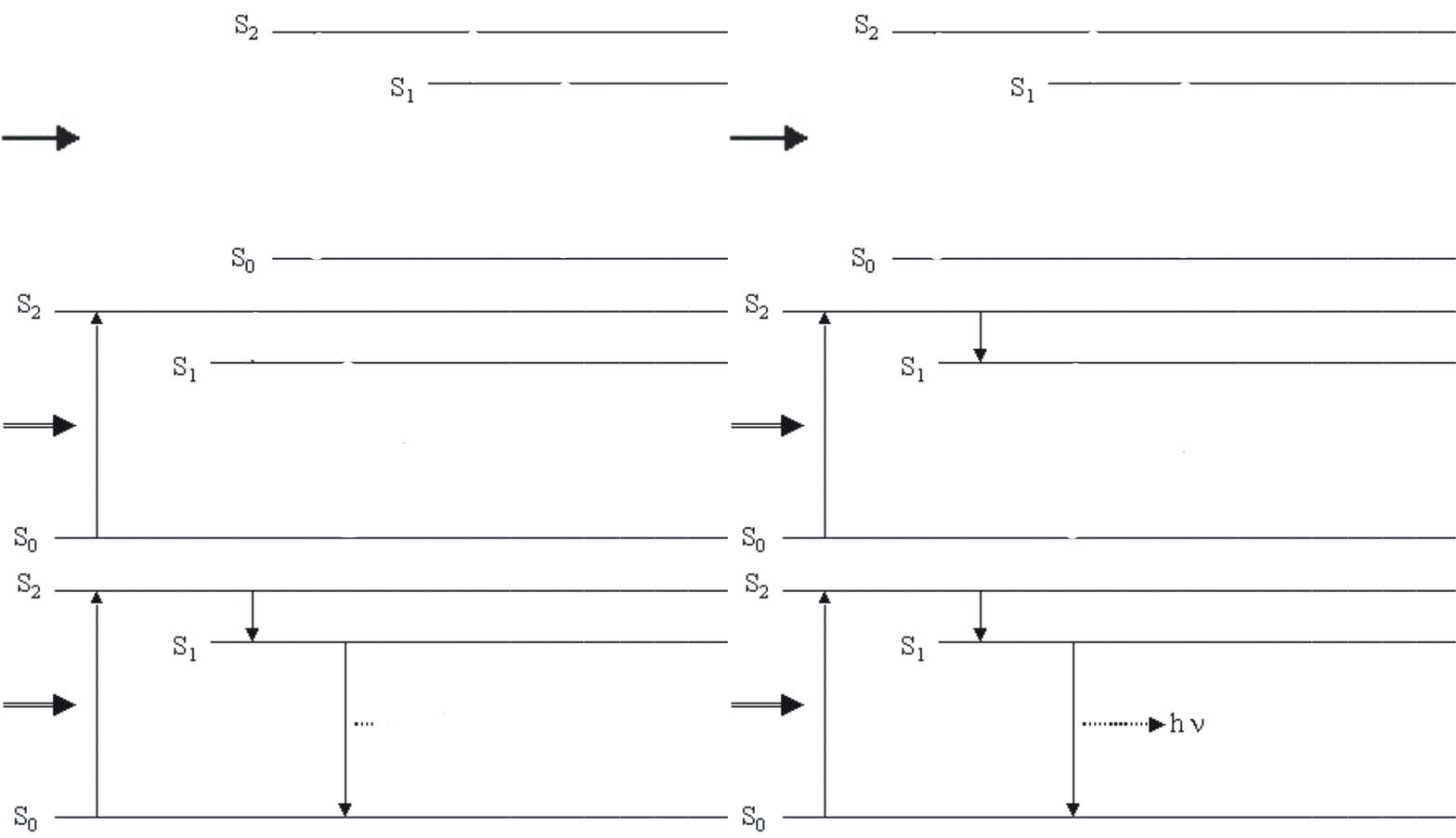
The source of the pump energy varies with the type of laser but is generally electrical, optical (i.e. a flashlamp or another laser). In order to achieve lasing the electrons must rapidly relax down to the excited state S1. The energy released in the S2--S1 transition is typically in the form of heat, which is often removed from the system by water cooling. To start the laser there must be spontaneous relaxation from S1 to the ground state S0. The S1--S0 transition results in the spontaneous emission of a single photon with energy, and therefore wavelength determined by the energy difference between S1 and S0 (this is called fluorescence). It is in this way that the allowed energy levels of an atomic or molecular species determines the wavelength of the laser radiation.
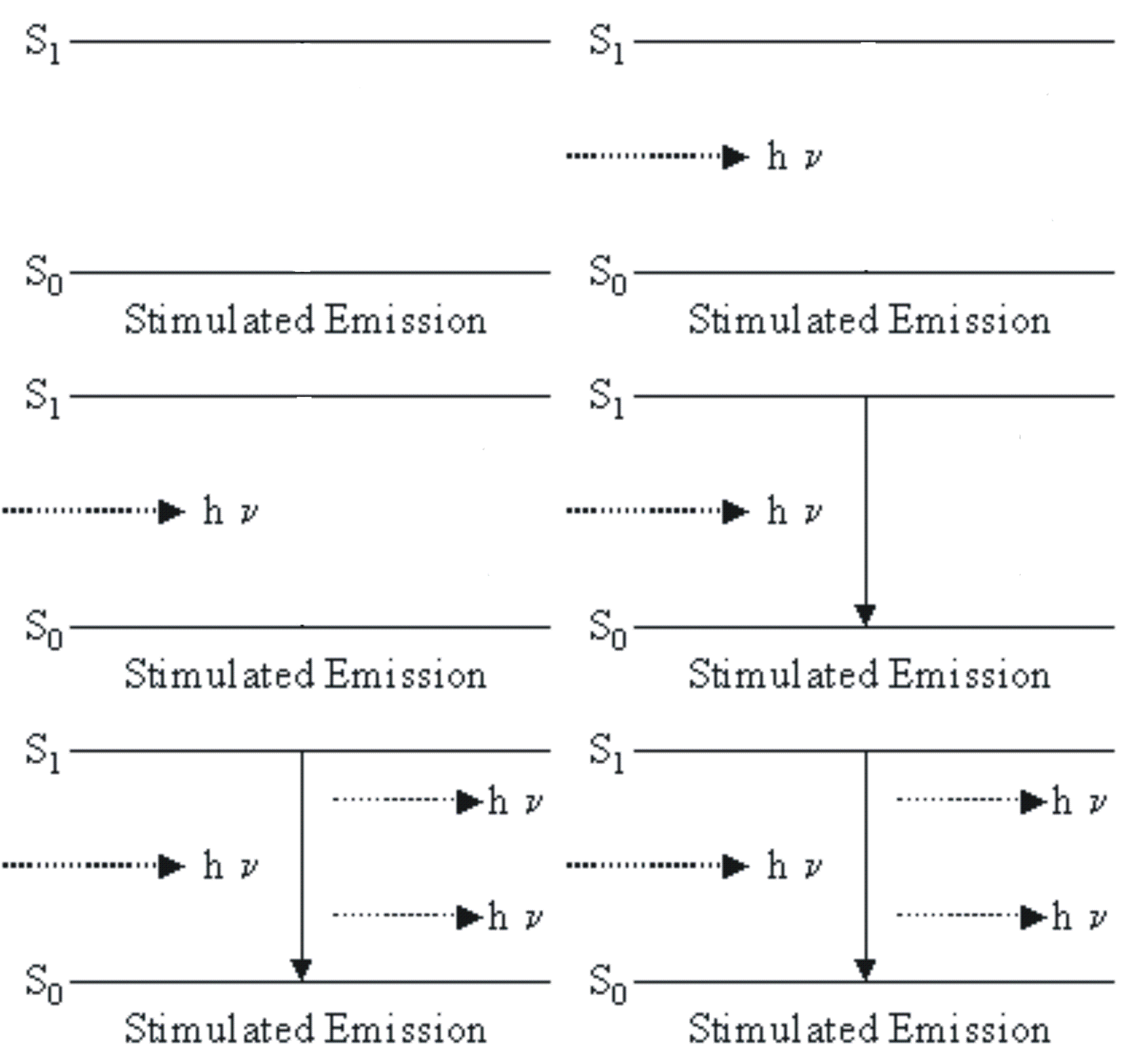
Thus far there has only been the spontaneous emission of a single photon. In the figure above, a photon of energy (S1 - S0) can cause two events to occur. Such a photon can be absorbed and thereby excite ground state electrons to the excited state (i.e. cause an S0--S1 transition). Or the photon can de-excite one of the excited electrons that is in the S1 state (i.e. cause an S1--S0 transition). The result of the latter process is the production of a photon with energy equal to (S1-S0). Both photons, the initial and the new one, are identical in every way; they are in phase, of the same wavelength, have the same polarization direction, etc. The production of this second photon occurs by a process called Stimulated Emission which leads to amplification of the incident light, i.e. where initially only one photon existed there are now two photons.
Whether there is stimulated emission of a second photon or absorption of the initial photon depends on the ratio of the number of electrons in the excited state to the number in the ground state. That is, if there are more electrons in the ground state than in the excited state, then absorption is the more likely event. If, however, there is a 'population inversion', i.e. the excited state is more populated than the ground state, then stimulated emission is more likely than absorption. Thus population inversion, having more electrons in the excited state than in the ground state is one of the keys to operation of a laser.
Another key is that the gain must be greater than all of the losses. If in the gain medium there are impurities that scatter or absorb light, then amplification would occur on if, on average, for every photon injected into the gain medium, more than one photon emerged. The total amplification on one pass through the medium is equal to the gain, G, minus the losses, L. In order to get more amplification, the light that emerges from the gain medium is reflected back into the medium for further amplification. Thus, at one end of the gain medium is a mirror that reflects nearly 100% of the light. At the other end there is a mirror that reflects less than 100% of the incident light. This latter mirror is called the output coupler because it transmits some of the incident light to the external world, thus making a laser a source of optical energy. The rest of the light is reflected back into the gain medium for further amplification. Note that the release of some of the light to the external world represents a loss that must be overcome by the amplification that occurs in the gain medium. This simplified view of laser operation highlights a few of the key points to laser operation.
Spontaneous emission sends photons in all directions. The photons that are not aligned with the mirrors are not amplified and thus are lost. This feature is reponsible for the fact that laser beams are parallel (collimated).
An output laser beam may be either continuous or pulsed, based on the pumping scheme and the response of the gain medium.
Pumping Schemes
When considering how to produce a population inversion in a given material, it may seem possible to achieve this through the interaction of the material with a sufficiently strong electromagnetic wave. Since at thermal equilibrium, more electrons are in the ground state than are excited, absorption predominates over stimulated emission. The incoming EM wave would then produce more transitions S0—S1 than transitions S1—S0, so one would perhaps expect in this way to end up with a population inversion. Such a system would not work, however. When there are equal numbers of ground state and excited electrons, absorption and stimulated emission processes compensate one another, and the material becomes transparent.

With just two levels, it is therefore impossible to produce a population inversion. In a three-level laser, however, electrons are raised from ground state, S0 to level S2. If the material is such that, after an atom is raised to level S2, it decays rapidly to level S1, then a population inversion can be obtained between levels S1 and S0.
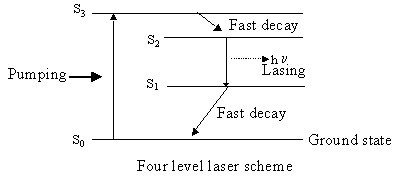
In a four-level laser, atoms are again raised from the ground level to an excited state, in this case S3. If the atom then decays rapidly to S2, a population inversion can again be obtained but now between S2 and S1. Once oscillation starts in such a four-level laser however, atoms are transferred to level S1 through stimulated emission. For reasons that we will not discuss here, it is much easier to produce a population inversion in a four-level scheme.(Svelto)
The process of raising atomic or molecular species from their ground state to some excited state is called pumping. Pumping is usually performed in one of the following ways: optically, i.e., by the continuous wave (cw) or pulsed light emitted by a powerful lamp or a laser beam; electrically, i.e., by a cw, radio-frequency, or pulsed current flowing in a conductive medium, such as an ionized gas or semiconductor. (Svelto)
Fundamental Properties of Laser Light
Due to the very nature of stimulated emission and the configuration of the laser cavity, lasers have four fundamental properties. Laser light is: 1) monochromatic; 2) collimated; 3) coherent; and 4) polarized.
1. MONOCHROMATICITY
Laser light is made up of only one wavelength. This property is due to the following two circumstances: (1) Only an EM wave of frequency n can be amplified. (2) Since a two-mirror arrangement forms a resonant cavity, oscillation can occur only at the resonance frequencies of this cavity. (Svelto)

2. COLLIMATED
Laser light typically contains only parallel rays. This property is a direct consequence of the fact that the active medium is placed in a resonant cavity. Only a wave propagating in a direction orthogonal to the mirrors can be amplified (and therefor sustained) in the cavity.

3. COHERENT
Laser light waves travel in phase with one another.
1) Spatial Coherence: Spatial coherence means that there is a fixed phase relationship between portions of light separated across, rather than along, the beam. This implies that the wavefronts, which are nothing more than lines connecting the same wave phase across the beam, are smooth and predictable for spatially coherent light and randomly bumpy and unpredictable for incoherent light.
2) Temporal Coherence: Temporal coherence means that there is a fixed phase relationship between portions of the light emitted at different times that is determined only by the time interval. This is the same thing as saying that the wave trains emitted by a temporally coherent source are very long and unbroken. Then one can be sure that on counting forward or backward a whole number of wavelengths one will find the wave in the same phase as the starting point. Temporally incoherent light has short wave trains with random intervals between them, so that moving a whole number of wavelengths along the wave places one at a phase of the wave that cannot be predicted. (Waldman)

4. POLARIZED
We have already discussed the concept of polarization in some detail in module I. Due to the nature of stimulated emission the oscillation direction of the electric field of the generated light is all in one plane. Thus laser light typically is linearly polarized.
Types of Lasers
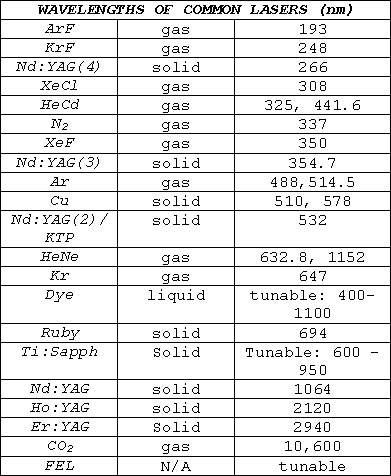
Lasers can be classified in three types of lasers based on the state of the gain medium. There are gas lasers, solid state lasers, and liquid lasers.
1. GAS Lasers
A gas laser uses a gas or a mixture of gases as its gain medium. Within this category there are: atomic lasers, molecular laser, ion lasers, excimer lasers, etc. In most cases the gas in the laser cavity is contained in a sealed tube. The energy source in these lasers is in most cases an electrical discharge. More information on gas lasers can be found at http://vcs.abdn.ac.uk/ENGINEERING/lasers/gas.html
2. SOLID STATE Lasers
A solid-state laser is one in which the gain medium is a solid, i.e. a crystal or glass which has a sharp fluorescent spectral line. Under strong optical excitation it is used as an oscillator or an amplifier at the fluorescence wavelength. Typically, the laser material is shaped into a cylindrical rod whose ends are ground and polished to be plane parallel. It is then called a laser rod (Shimoda). In many solid state lasers the energy source is optical, i.e. a bright light bulb or another laser. Semiconductor or diode lasers, although there main mechanism of operation is quite different also fall in this group.
3. LIQUID Laser
A liquid laser uses a dilute solution of an organic dye in ethanol, cyclohexane, toluene, or another organic solvent as its gain medium. This is called a dye laser, and, since the fluorescence spectrum of a dye is as wide as 100-200cm-1, the laser wavelength can be tuned with ease by the use of a diffraction grating or a prism. In most dye lasers, the energy source is optical (typically a flashlamp or another laser).