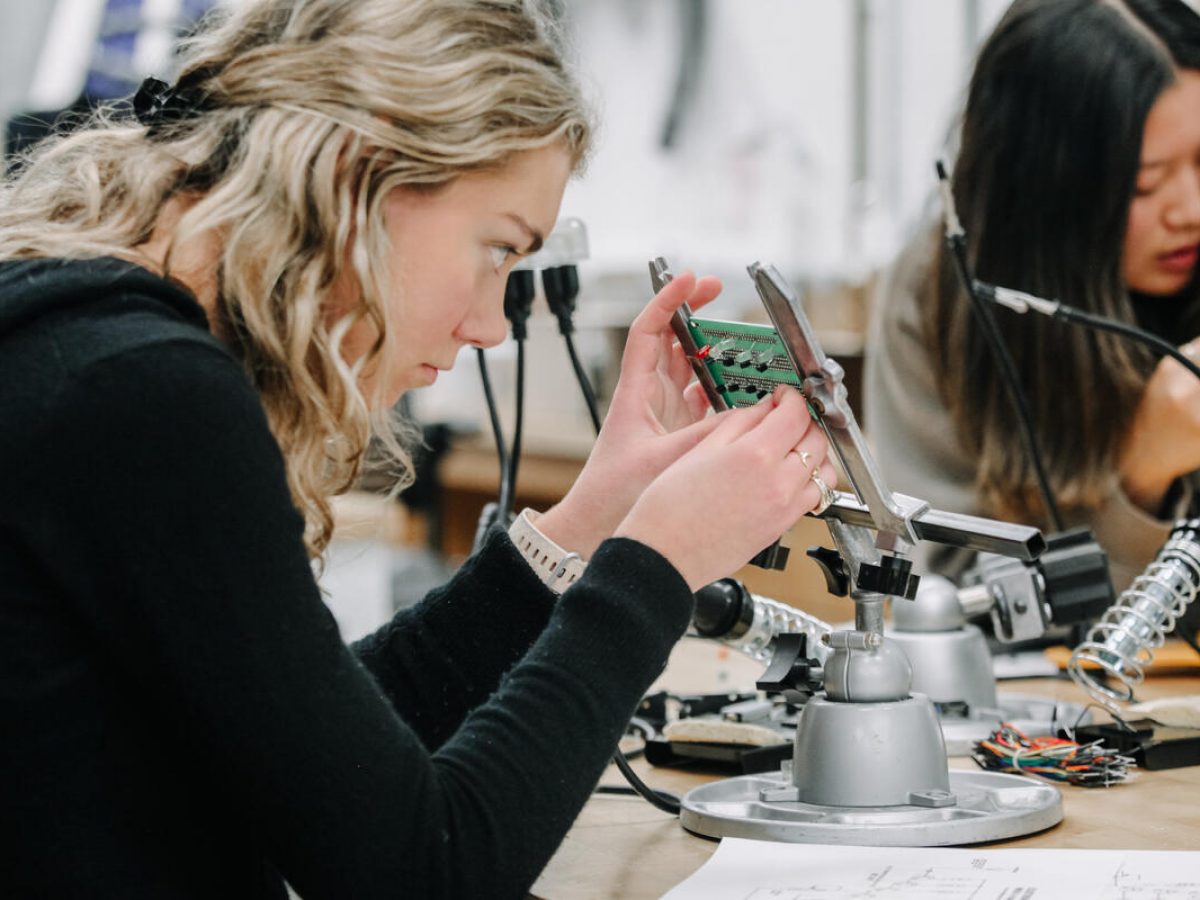
Wond'ry Makerspace Access
Operating hours for the Electrical Makerspace are listed on the Makerspaces Overview page.
To access the Wond'ry Makerspaces, you must take a short Safety Seminar.
Looking to 3D Print or Laser Cut a part for a project? Use our new Wond'ry Makerspace Jobs Request Form to submit your files.
Questions or Scheduling an Appointment? Email wondrymakerspace@gmail.com
Electrical Makerspace Team
-

Anupam Kumar
Electrical Makerspace Manager
Email
Available Equipment - Physical Prototyping
-
Soldering Irons
 The basic tool for electrical and electronic work, the soldering iron allows for the melting of solder metal to connect wires and components.
 -
Fume Extractors
 These desktop-mounted vacuum devices suction up any smoke or airborne residue created from the soldering process.
 -
Magnifiers
 A variety of microscopes, mounted lens, and screens allows for the visual magnification of the small components used in handcrafting electric and electronic devices.
 -
Helping Hands
 For those times when two hands are not enough (always!), these extendable, positionable gripping devices allow components to be held in place while working on them.
 -
Measuring Tools
 A variety of scopes and meters used to measure voltage, amperage, resistance, and other important indicators of electrical function.
 -
Breadboards
 The basic template for circuit design, these small plastic sheets are the frame that electrical components are added onto. Available in a variety of sizes.
 -
Infrared IC Heater
 This "microchip oven" is used to bake electrical components, adhering them together.
 -
PCB Printer
 This printer allows for the creation of personal circuit boards, the more finished, customized versions of a template breadboard.
 -
Hand Tools
 Tiny screwdrivers, pliers, cutters, non-static tweezers, and other analog implements for work on electrical devices.
 -
Components
 Wires, resistors, transistors, buttons, switches, jumpers, capacitors, pins, fuses, batteries, motors, LEDs, servos, actuators, meters, chips, memory, sensors, and all the other materials needed to make an electric or electronic device.
Available Equipment - Digital Prototyping
Curricular Classes
Several for-credit classes are taught in the Electrical Makerspace:
-
IDS 2273 : How to Make Almost Anything

Prerequisite: None
Open to 1st, 2nd, and 3rd year students. Being able to make things with hand tools and digital fabrication tools will help you quickly test ideas, clearly communicate concepts, and solve problems in your life. Hosted in the Wond'ry, this course provides an introduction to design thinking, computer-aided design (CAD), rapid prototyping methods, and the strategies to actualize your ideas. Also, you get to make stuff!
See the Classes page for course offerings and times.
-
ES 3890 : Prototyping Hardware Tech

Prerequisite: None
Rapid advances in electronics, automation, and connected devices are reshaping industries worldwide. This course addresses the growing demand for professionals who can bridge the gap between concept and manufacturable product by empowering students with both the technical foundations and the collaborative, documentation, and outsourcing skills essential to real-world product development. Students gain a competitive edge in fields ranging from consumer electronics and IoT to biomedical devices and sustainable technology-sectors driving innovation and shaping the future economy.
See the Classes page for course offerings and times.
-
ME 3890 : Make It Real and Make It Matter

Prerequisite: IDS-2273 or DF-2100
This making course builds on skills learned in IDS-2273: How to Make Almost Anything or DF-2100: Rapid Prototyping and is open to all majors. Students will embark on a team-based, semester-long design/build/test project, crafting a design with an external sponsor/client and then putting their design through test phases with potential customers or end users to determine needed modifications. Covered topics will include translation of client requirements and constraints, concept development, advanced prototyping methods, customer research and testing, and iterative client engagement.
See the Classes page for course offerings and times.
Mix Your Makerspaces!
The Wond'ry's Makerspaces are co-located to optimize interdisciplinary prototyping. Read below for ideas on how to mix different makerspace specialties for innovative creations. All the examples below are real ideas that have come through the Wond'ry!


