featured
Vanderbilt Postdoctoral Researcher Reveals Genomic Secrets of Ocean Sponges
Dec. 4, 2023—By: Sarah Ward Evolutionary Studies graduate communications assistant Picture a thriving marine environment. Perhaps you envision a community as colorful and lively as “Finding Nemo,” where massive schools of fish are flanked by sharks and sea turtles. What about sponges? While perhaps less popular than their flamboyant counterparts, these organisms are the foundation of life...

2023 Pilot Grants
Nov. 28, 2023—In the space below, find our stories about the pilot grants that were awarded in Summer of 2023. We are excited to be able to support work in 11 labs with this funding call!

Researchers Root US Maternal Health Disparities in the Social Environment
Oct. 15, 2023—By: Andy Flick, Evolutionary Studies scientific coordinator Monica Keith, assistant professor of Anthropology, recently published insights into the complex factors contributing to maternal hypertension and health disparities in a paper titled, “Social Determinant Pathways to Hypertensive Disorders of Pregnancy Among Nulliparous U.S. Women” in the journal Women’s Health Issues. This research, based on an analysis...

Evolutionary Studies pilot grant recipients reflect on last year’s research
Jul. 6, 2023—By Kelly Tingle, Evolutionary Studies communications assistant Last year (2022-2023), Evolutionary Studies at Vanderbilt awarded pilot grants to excellent proposals from four members of the ESI community: graduate students Samantha Schaffner (Biological Sciences, Patel Lab), Taiye Winful (Anthropology, Benn Torres Lab), and Katie McCormack (Anthropology, Benn Torres Lab) and Earth and Environmental Sciences Professor Lin...
How do interactions between individuals from different populations contribute to cultural richness?
May. 3, 2023—By: Yotam Ben-Oren (The Hebrew University of Jerusalem), Erella Hovers (The Hebrew University of Jerusalem), and Oren Kolodny (The Hebrew University of Jerusalem), Nicole Creanza Assistant Professor of Biological Sciences (VU) Why are human cultures so diverse? What makes some cultures richer than others? How can very small populations possess very complex cultures? According to...

Paleontology Graduate Student Uncovers Lessons from Microfossils of the Grand Canyon
Apr. 7, 2023—By Dr. Andy Flick Evolutionary Studies scientific coordinator Kelly Tingle, graduate student in Simon Darroch’s lab (Earth and Environmental Sciences), just published a new first-authored article outlining some exciting discoveries related to microfossils found in the Grand Canyon. Vase-shaped microfossils were amoebae that exist worldwide and can provide some insight into early life on Earth....
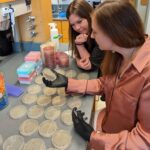
Trio of Vanderbilt Researchers Identify Variable Outcomes in Experimental Evolution
Apr. 7, 2023—By Dr. Andy Flick Evolutionary Studies scientific coordinator Sarah Worthan a postdoctoral researcher led a new effort with undergraduate researcher Robert McCarthy and their advisor, assistant professor of biological sciences Megan Behringer, to understand the effects of the environment on the outcome of experimental evolution studies. The article, “Case Studies in the Assessment of Microbial...

International Collaboration Uncovers Evolutionary History of Respiratory Virus in Argentina
Mar. 20, 2023—By Andy Flick Evolutionary Studies scientific coordinator Stephanie Goya, who did a rotation with the lab of Suman Das, recently published a paper with the lab about the evolution of respiratory syncytial virus in a population of humans in Buenos Aires, Argentina. The paper, “Evolutionary dynamics of respiratory syncytial virus in Buenos Aires: Viral diversity,...

Vanderbilt Researchers find Evidence for Evolutionary Constraints on Immunity
Mar. 18, 2023—By Dr. Andy Flick, Evolutionary Studies scientific coordinator A new study led by members of Ann Tate’s (Assistant Professor of Biological Sciences) lab found evidence that pleiotropy may slow down evolution of genes involved in immunity. Alissa Williams, postdoctoral researcher, and Thi Ngo, lab alumna, equally contributed to the new paper studying the evolution of...

Vanderbilt Team finds Evolutionary Support for Induced Defenses
Mar. 16, 2023—By Andy Flick, Evolutionary Studies scientific coordinator Graduate student Reese Martin and his doctoral advisor, Ann Tate, assistant professor of biological sciences, used theoretical modeling to identify a potential relationship between genetic pleiotropy and the evolution of immune responses. The pair authored a paper titled, “Pleiotropy promotes the evolution of inducible immune responses in a...