
October 2025 Brightspace Updates
Each month D2L (the company that makes Brightspace) releases updates to the platform. This month, there are several different updates to various parts of Brightspace. These are the highlights of what updates are coming to Brightspace this Friday.
Assignments — Annotation availability awareness enhancements in assignment creation
Annotations are only supported for File and File or Text Assignment Types. They are not supported for Text, Observed, or On Paper Assignment types. In response to requests from instructors for clearer indicators of which types of assignments support Annotations, we’ve enhanced the assignment creation experience with better tool tips, visual cues, and on-screen guidance. To this end, a new informational tool tip now appears beside the existing Annotations check box in the interface for creating assignments. When you hover over the new information ( ? ) button, a tool tip displays Annotation Tools help.
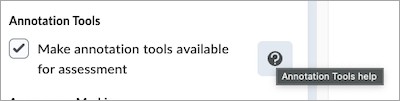 Figure: New Annotation Tools help tool tip.
Clicking the information ( ? ) button opens a pop-up window that explains what the Annotations tool does, and which types of assignments you can use it with. The text in the new window is as follows:
Additionally, to make it easier to immediately understand whether you can use Annotations on an assignment, the Annotations check box now appears disabled (grayed out) for non-file type assignments, such as Text, Observed, or On Paper assignments.
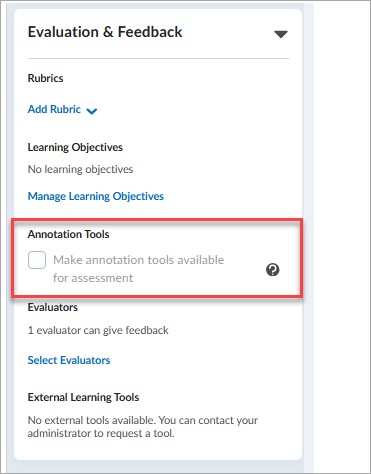 Figure: Visual cues indicate when Annotation Tools are not available for an assignment type.
When you cannot enable Annotations for an assignment because the type is Text, On paper, or Observed in person, hovering over the Annotations check box displays the following message: Annotation settings are locked for submissions that are not files.
 Figure: New on-screen guidance shows when Annotation settings are locked because the assignment type is not File or File or Text.
When you cannot enable Annotations for an assignment because learners already made submissions while the setting was disabled, hovering over the Annotations check box displays the following message: Annotation settings are locked after submissions are received.
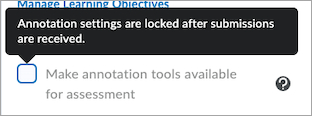 Figure: New on-screen guidance shows when Annotation settings are locked because learners made submissions for the assignment while Annotations were disabled.
Assignments — Improved assignment type selection interface
A usability improvement makes it easier to select the correct assignment type when you create an assignment. Previously, instructors used radio buttons to specify whether an assignment was for a Group or an Individual.
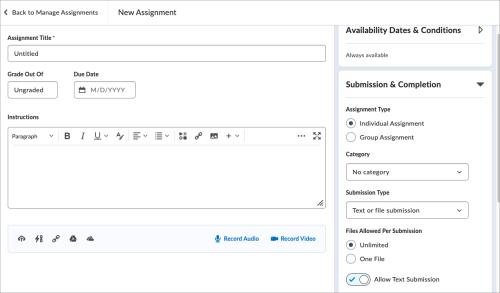 Figure: Previous interface showing radio buttons for selecting Assignment Type.
Starting with the October Brightspace update, a new drop-down menu for selecting the Assignment Type modernizes the interface and lays the groundwork for future enhancements to the Assignments tool.
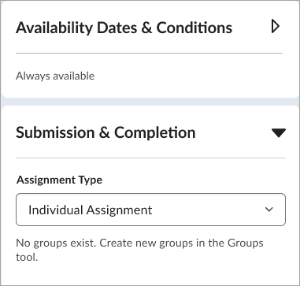
Figure: New drop-down menu for selecting Assignment Type.

Figure: New drop-down menu with Individual Assignment Type selected.
Grades – Comments and Assessments column always visible to learners
Learners can now always see the Comments and Assessments column in Grades, ensuring that feedback and links to assessments are consistently visible. The column is no longer conditionally displayed, supporting additional links from tools such as Rubrics, Assignments, and Quizzes. This update supports future enhancements that add information to learner feedback in Grades. Previously, the column only appeared when a grade item included feedback.
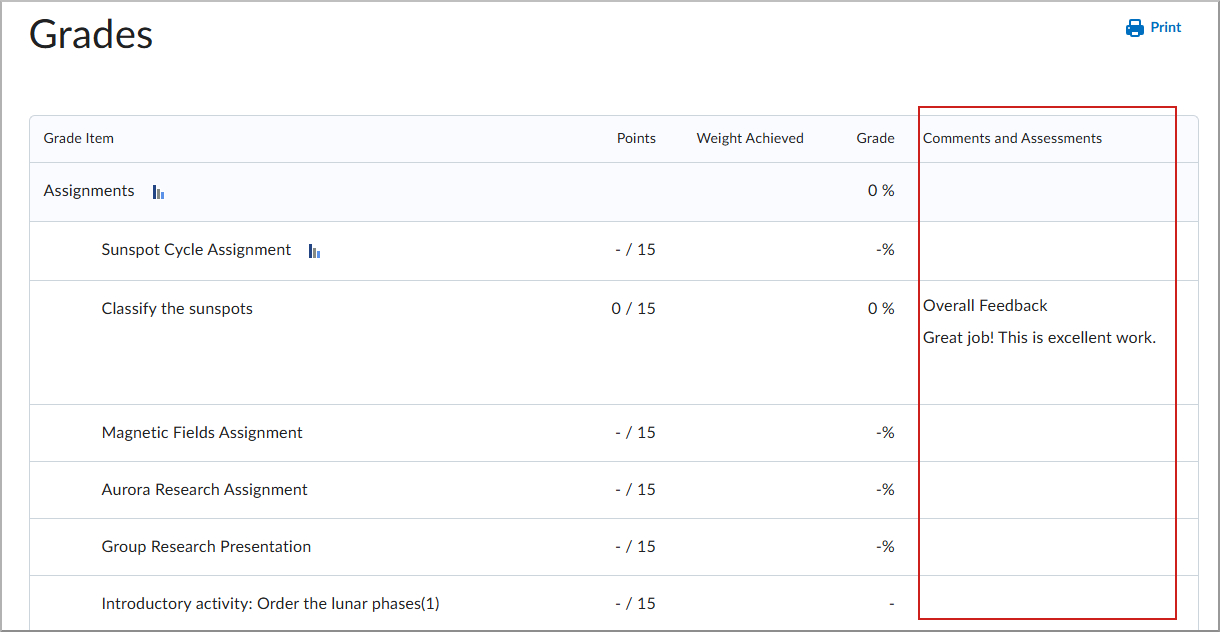
Figure: Comments and Assessments column now appears consistently to learners in Grades.
Quizzes – Hide Quiz Question Points
Instructors can now hide the point value for quiz questions to ensure learners focus on all questions equally, without the risk of inferring the number of correct answers based on point value. Previously, point values for quiz questions were always visible to learners.
The new feature helps with the following:
- Avoiding Hints in Multi-Select and Written Response Questions – Hiding point values prevents learners from guessing the number of expected answers based on the score, promoting a more consistent effort across all question types.
- Diagnostic Assessments – This option is beneficial for assessments like subject knowledge audits or start-of-term baseline knowledge checks, where the purpose is to gauge understanding rather than focus on scoring.
- Encouraging Equal Effort Across Questions – By hiding point values, learners are less likely to prioritize certain questions over others based on points. Hiding point values ensures a balanced effort and enables the inclusion of control or bonus questions without indicating their significance.
The new option is available within the Timing & Display section when creating or editing a quiz.
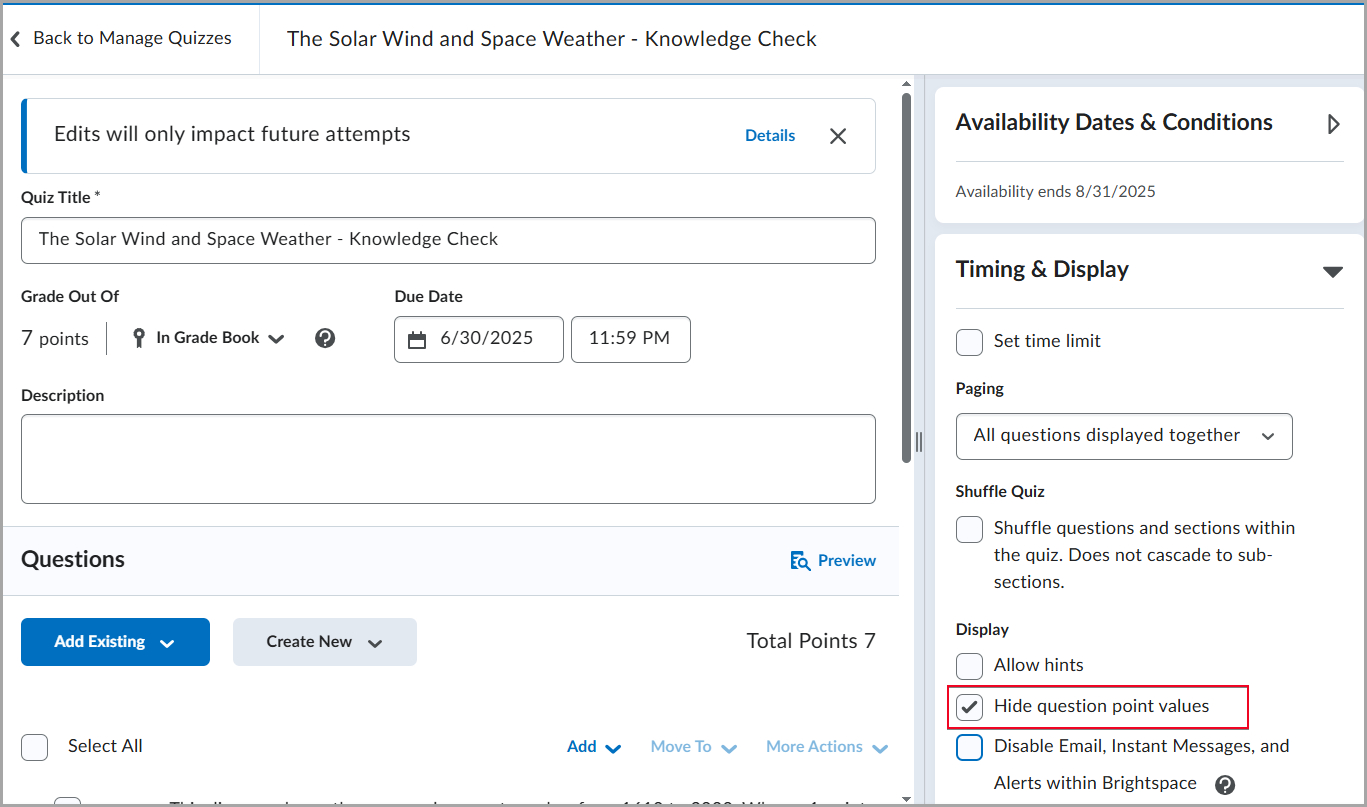
Figure: From the Edit Quiz page, under Timing & Display, select Hide question point values to prevent learners from seeing individual question scores.
Quizzes – Improved visibility for insufficient question pools
With this release, instructors can now see a status indicator when a question pool has insufficient questions, allowing them to resolve the issue before learners begin a quiz attempt.
If a quiz attempts to draw more questions than are available in a question pool (for example, 12 questions requested but only 10 available), the interface now displays a warning indicator. Previously, no visual indicators identified when question pools contained too few questions, and these could be imported or copied without warning.
This update adds visual warnings in the following areas:
- The Grading view: If learners have already completed a quiz containing an affected pool, messaging displays in the grading evaluation experience.
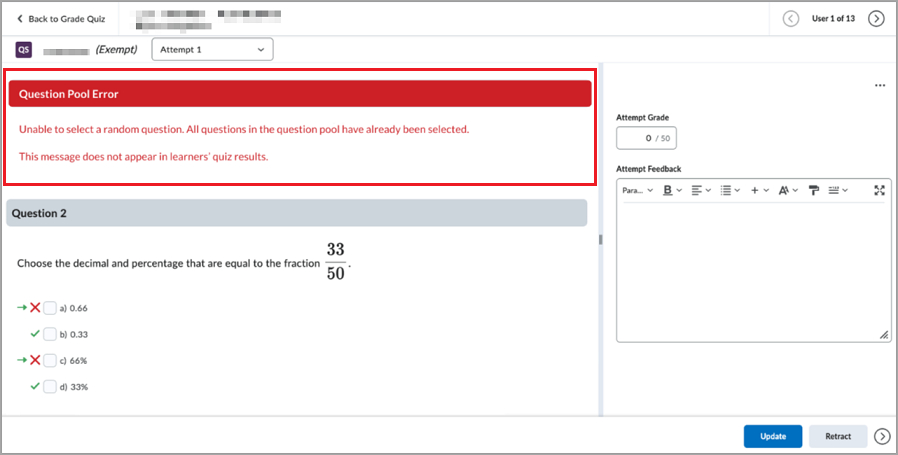 Figure: When grading a quiz, an error message appears indicating the question pool is exhausted. Instructors can review answer selections and enter a grade or feedback.
- The Manage Quizzes page: A status indicator flags quizzes with insufficient question pools.
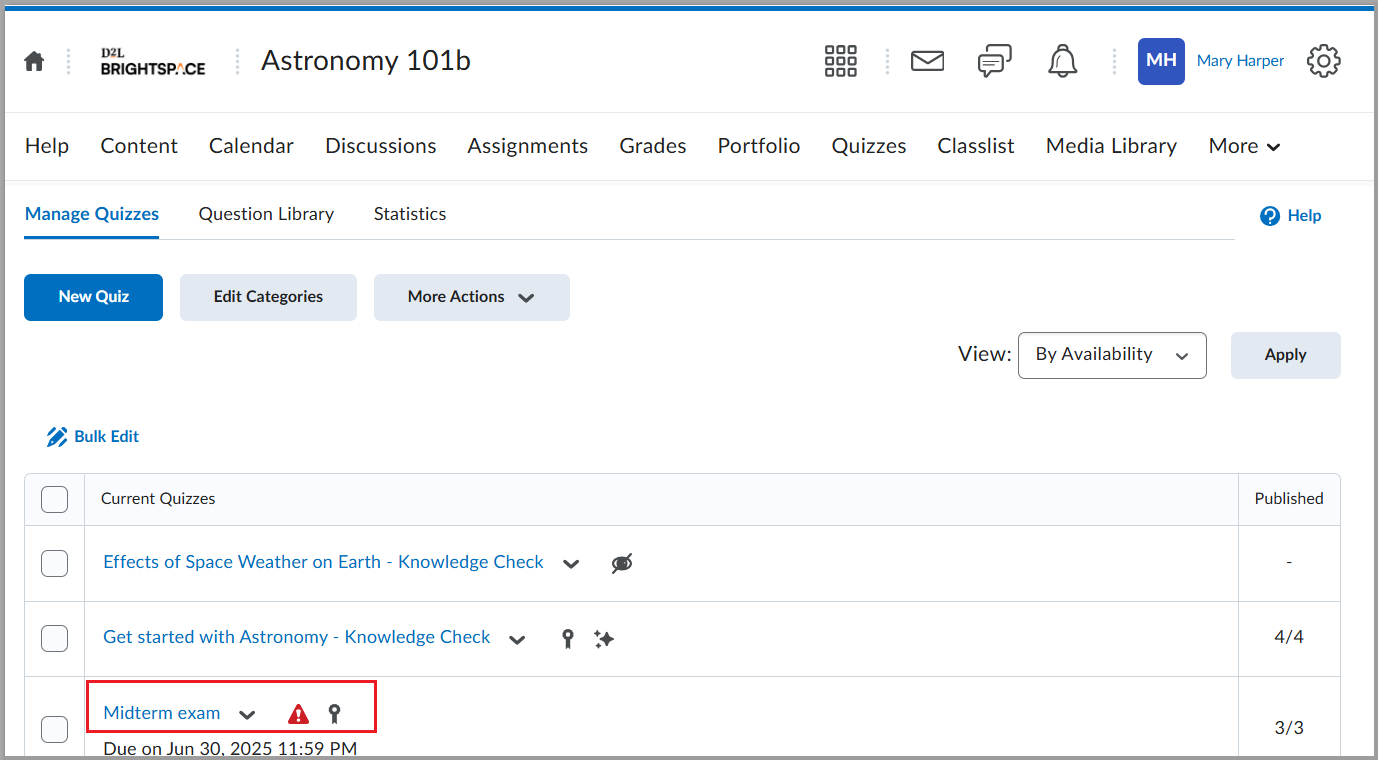 Figure: On the Manage Quizzes page, a red warning icon appears beside a quiz name. Instructors can review quiz settings to resolve the issue.
- The Edit Quiz page (Quiz Builder): A warning icon appears directly on the affected question pool.
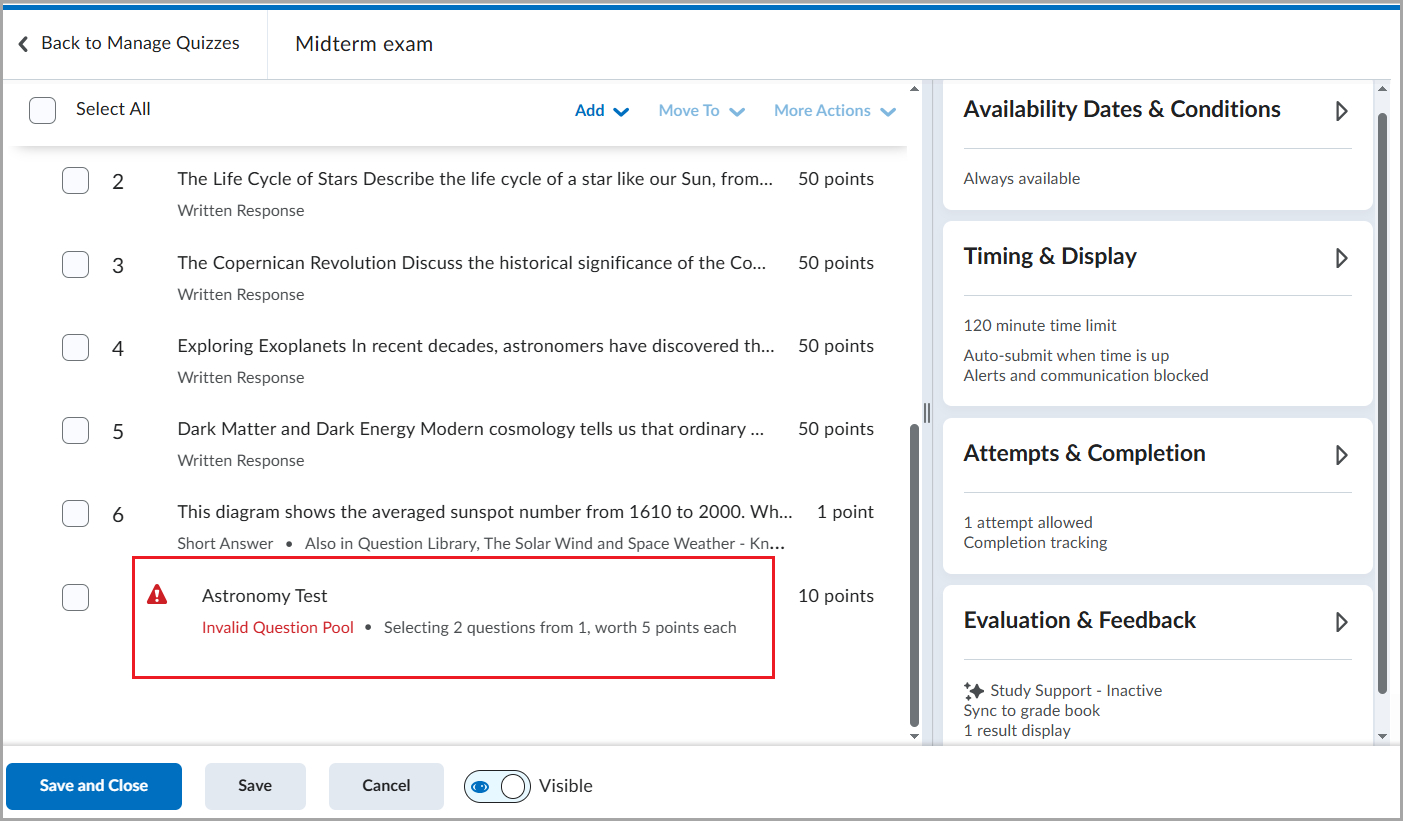 Figure: The Edit Quiz page displays a Question Pool with an error state, labeled Invalid Question Pool.
- The Course Import and Course Copy workflows: Validation now prevents importing or copying pools with an insufficient number of questions.
Leave a Response