Giant Ground Sloth Extinction Led to Loss of Ecological Services
By Andy Flick, Evolutionary Studies scientific coordinator

Giant ground sloths were more than just Ice Age oddities. They were ecosystem engineers whose disappearance reshaped the landscapes they once roamed. A new study from Vanderbilt University’s DREAM Lab reveals just how diverse these megaherbivores’ diets were, highlighting the ecological roles that vanished when they went extinct.
Led by Aditya Kurre (’25) and Associate Professor of Biological Sciences and current Guggenheim Fellow, Larisa DeSantis, the study shows that giant sloths were not simply oversized versions of today’s tree-dwelling sloths. Instead, they filled complementary ecological niches, helping to disperse plants and fungi, dig for roots and tubers, and keep woody vegetation in check. These were services that no other species fully replaced.
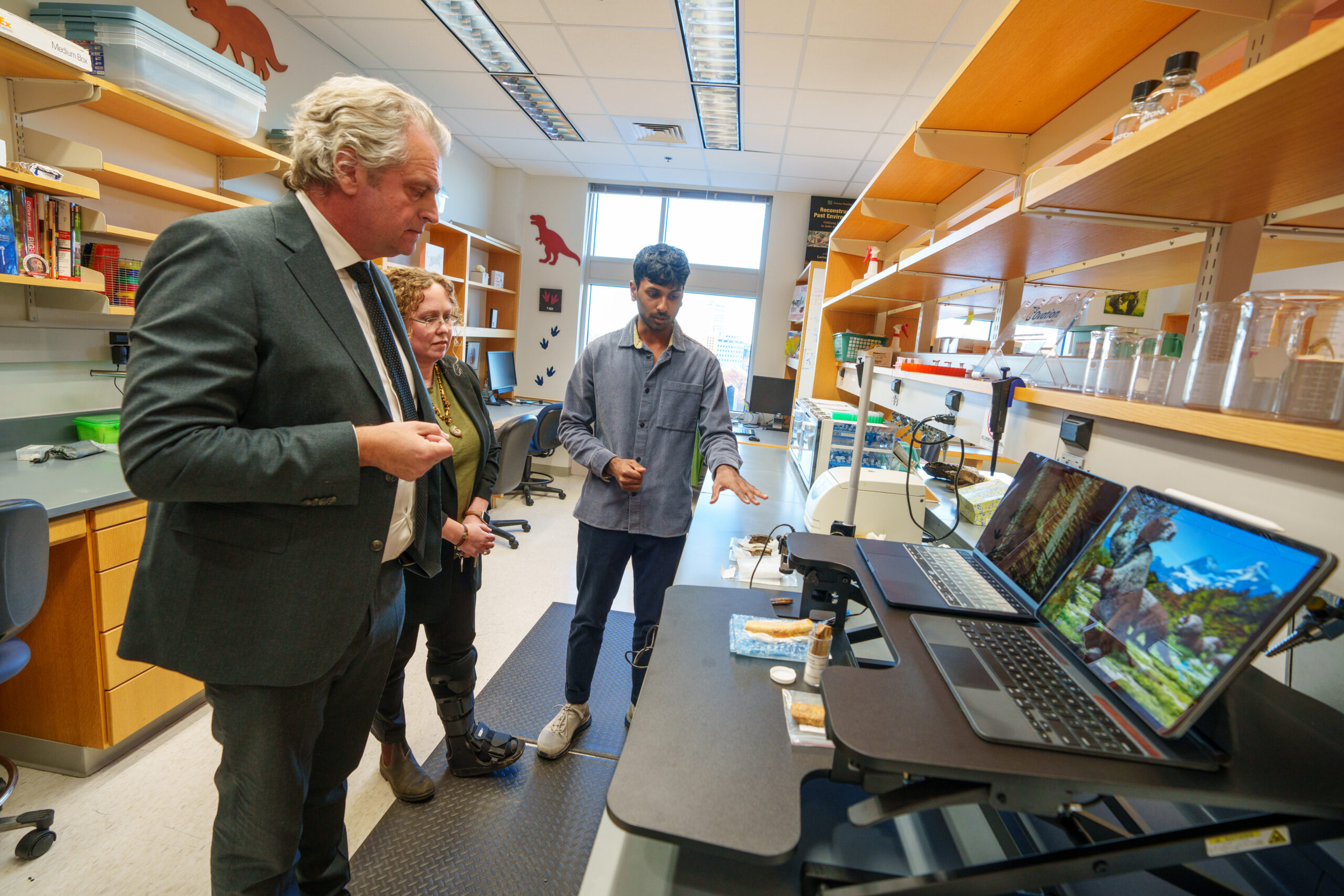
“When we think about modern sloths, we think of lethargic, gentle creatures. And while it is hard to imagine that their ancestors were some of the most gigantic and diverse mammals to inhabit the Western Hemisphere, layers of evidence show us that their diets and behaviors reflected these characteristics,” Kurre said.
The paper, published in Biology Letters and titled “Lost giants, lost functions: paleodietary insights into the ecological niches of Pleistocene ground sloths,” used dental microwear analysis to reconstruct these ancient diets.
“Sloth teeth do not have enamel like ours do, which makes them tricky to study,” DeSantis explained. “But by focusing on the dentin layer, we can still see microwear textures and compare them to living sloths that primarily eat leaves and closely related armadillos that are primarily insectivorous.”

The team made molds of fossil teeth, created clear casts, and scanned them under a 3D microscope. Computer software measured tiny scratches and pits that act as dietary fingerprints and reveal what these animals were really eating thousands of years ago.
Although once thought to be grass-eating grazers, evidence shows Paramylodon harlani specialized in hard foods such as roots, tubers, or fungi. Its powerful forelimbs and claws would have aided this behavior, making it a crucial forager of underground resources―bioturbating the soil and dispersing fungi, fruit seeds, and other living organisms longer distances than otherwise possible. Nothrotheriops shastensis, on the other hand, was a selective browser, feeding on desert plants like yucca, agave, pine, and saltbush and shaping shrubland habitats in the process.
“Modern sloths are exclusively arboreal leaf-eaters that reside in the tree canopies of Central and South America,” DeSantis said. “But giant ground sloths were neither analogous to living sloths nor ecological replicates of other herbivores at the La Brea Tar Pits. They played unique and complementary roles, and when they disappeared, entire ecological functions were lost.”
Their extinction reminds us that when we lose species, we also lose the ecological services that keep ecosystems functioning. As we celebrate International Sloth Day on October 20th, this research underscores the deep evolutionary legacy of sloths, past and present.
Citation: Kurre, A. & DeSantis, L.G. Lost giants, lost functions: paleodietary insights into the ecological niches of Pleistocene ground sloths. Biology Letters.
Funding Statement: Funding for this project was provided by the National Science Foundation (EAR 1053839 and 1757545) and Immersion Vanderbilt.