Annie Hatmaker Explores the Global Diversity of a Pathogenic Fungus
By Andy Flick, Evolutionary Studies scientific coordinator
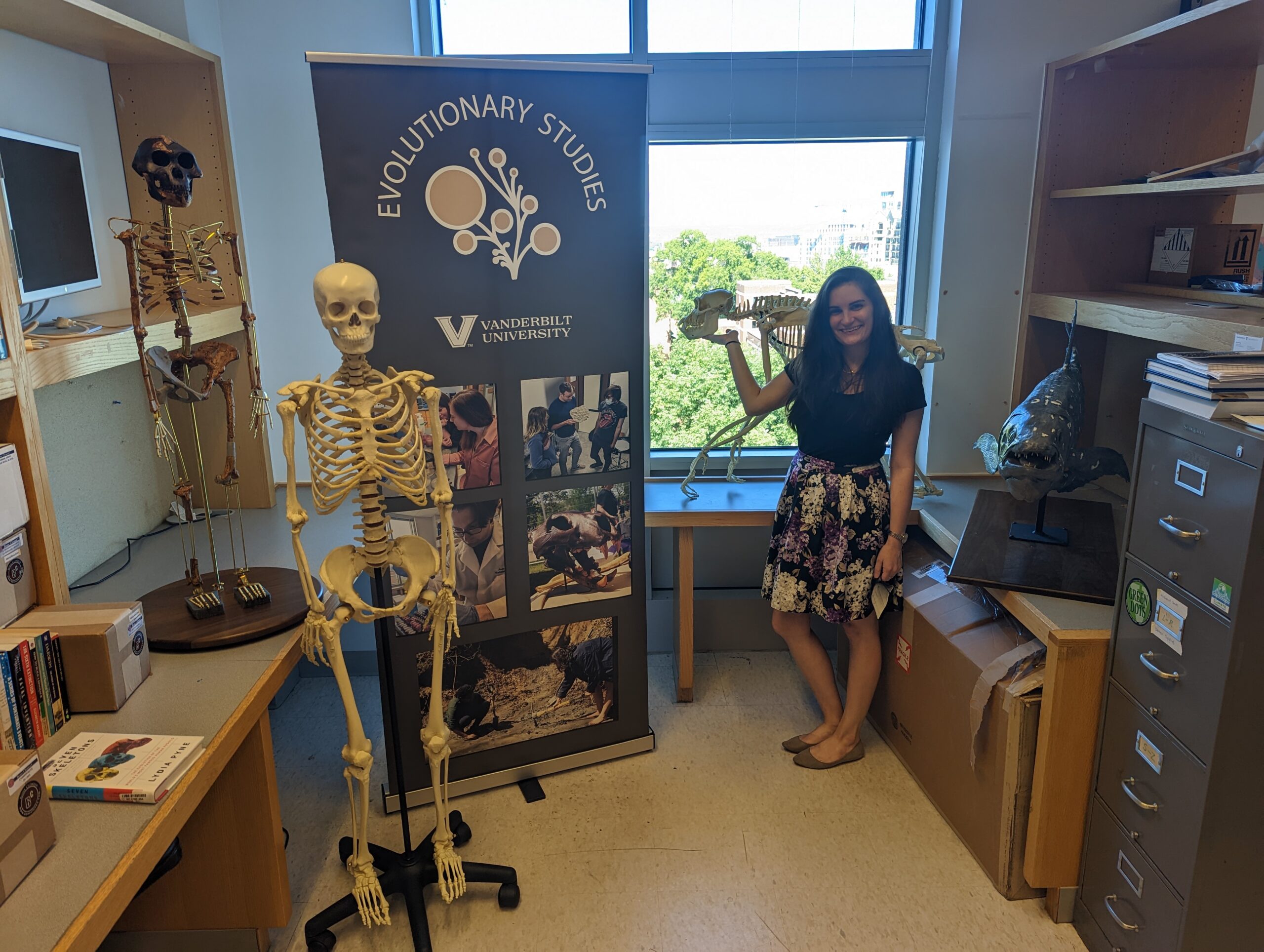
Annie Hatmaker, Ph.D., has spent the better part of a decade studying fungi and their secondary metabolites – small molecules they use to communicate, defend, and thrive. Her new publication, “Population structure in a fungal human pathogen is potentially linked to pathogenicity,” closes her dissertation work and opens up a world of possibilities. Her fungus of choice is the Aspergillus genus, in this study, Aspergillus flavus.
This story is based on clinical and environmental data from more than a dozen countries. Using genomic methods on 300 collected isolates of A. flavus, the team created an evolutionary tree suggesting that the isolates consist of five distinct populations.
Hatmaker was excited about the potential research prospects offered by the A. flavus system and other projects in her Ph.D. advisor Antonis Rokas’ lab.
“Several studies had published whole-genome sequencing of Aspergillus flavus isolates just as I was considering topics,” she said. “I was incredibly interested in how it was a human pathogen and also of agricultural interest due to its ability to produce aflatoxin (a type of secondary metabolite called a mycotoxin).”
Providing broader context on mycotoxins, collaborator from the Rokas Lab, postdoctoral researcher Thomas Sauters, explained that mycotoxins are toxic chemical compounds produced naturally by certain fungi, including A. flavus, which can contaminate crops such as corn, peanuts, and tree nuts. Aflatoxins are among the most potent naturally occurring carcinogens known, posing serious risks to human and animal health when ingested. Their production is influenced by environmental factors such as temperature, humidity, and nutrient availability, and while they are a major concern in agriculture, their role in human infections remains less clear.
“We know that aflatoxin production is reduced at the temperature of the human body, possibly indicating it is not necessary or important for human infections,” explained Hatmaker. “In other studies, however, there’s evidence that strains lacking the capability to produce aflatoxin are able to produce other metabolites which might play a role in infections. There’s plenty of future work to be done regarding aflatoxin, so this remains a mystery!”
While working with a broad international dataset, Hatmaker also led a team of scientists from institutions across the U.S. and Europe, reflecting a broad transatlantic collaboration. Contributors came from Vanderbilt University (Hatmaker, Thomas Sauters, Adiyantra Gumilang, and Rokas), the USDA Agricultural Research Service, University of Wisconsin-Madison, and University of Texas in the United States; Friedrich Schiller University, Hans-Knoell-Institute, and the University of Würzburg in Germany; Instituto de Salud Carlos III in Spain; and Institut Pasteur in France.
Citation: Hatmaker, E.A., Barber, A.E., Drott, M.T. et al. Population structure in a fungal human pathogen is potentially linked to pathogenicity. Nat Commun 16, 7594 (2025). https://doi.org/10.1038/s41467-025-62777-9
Funding Statement: This work was partially funded by the National Institutes of Health/National Eye Institute (F31 EY033235 to E.A.H.) and the National Institutes of Health/National Institute of Allergy and Infectious Diseases (R01 AI153356 to A.R.). Research in A.R.’s lab is also supported by the National Science Foundation (DEB-2110404) and the Burroughs Wellcome Fund. A.E.B is funded by the Deutsche Forschungsgemeinschaft (DFG, German Research 358 Foundation) under Germany’s Excellence Strategy—EXC 20151—Project-ID 390813860. M.T.D. is supported by the United States Department of Agriculture, Agricultural Research Service. Work of the German NRZMyk is supported by the Robert Koch Institute from funds provided by the German Ministry of Health (grant-No. 1369-240). A. A.-I. is supported by Fondo de Investigaciones Sanitarias from Instituto de Salud Carlos III (grant-No. PI20CIII/00043). N.P.K. and J.L.E. are supported by the National Institutes of Health/National Institutes of General Medical Science (R01 GM112739 and R35 GM156119 to N.P.K.).