Sustainability
At Vanderbilt, our vision for a resilient and sustainable future for everyone begins with us, today.
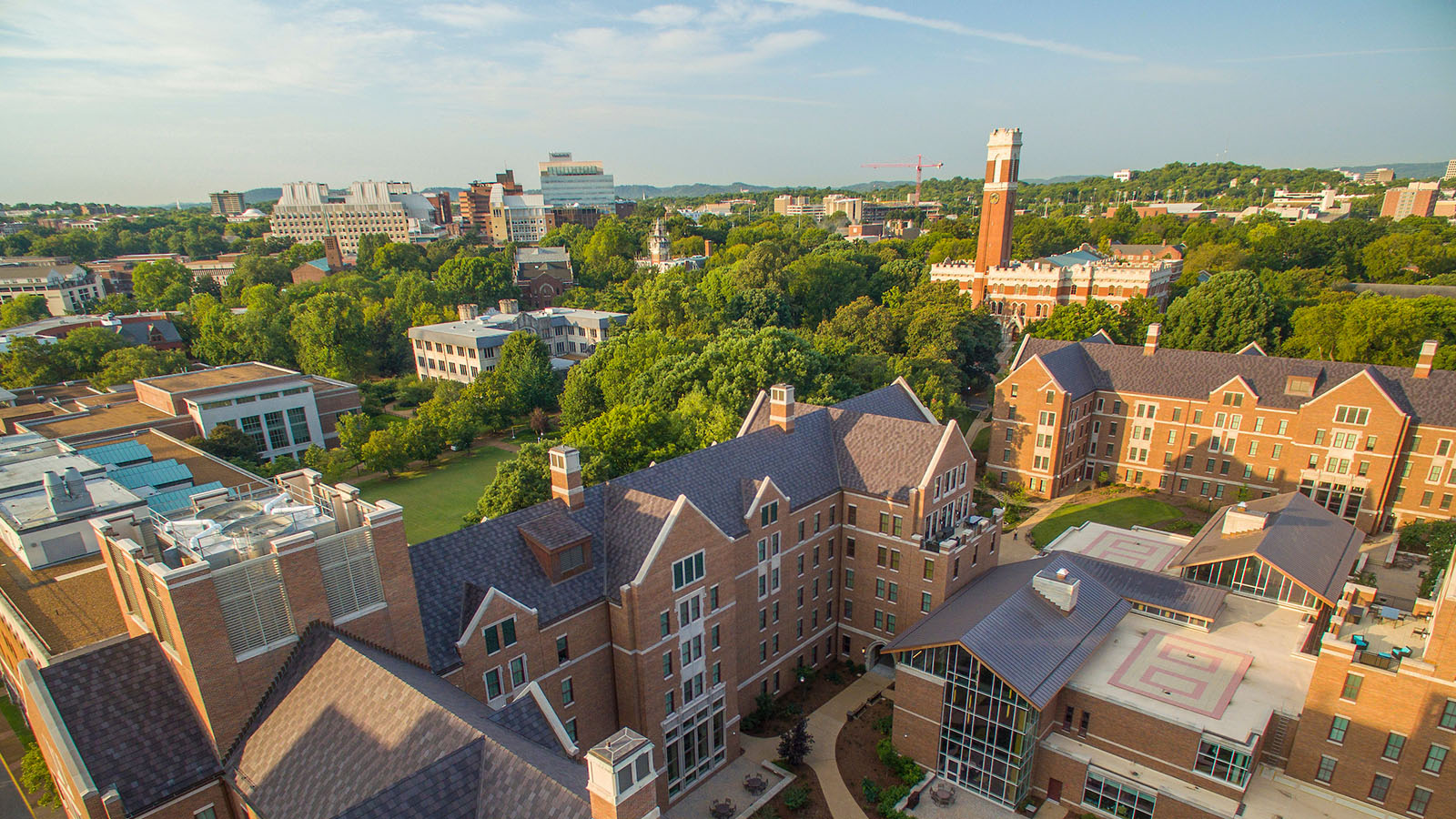
From its founding in 1873 as an institution devoted to “strengthening the ties which should exist between all sections of our common country,” Vanderbilt University has forged a tradition of academic excellence infused with a unique spirit of collaboration, innovation, and collegiality. Inspired by the Dare to Grow mission to bring out the best in humanity by pushing new ideas into the frontiers of discovery and challenging the limits of what’s possible and working diligently in the service of others. Vanderbilt’s closely connected park-like campus, set in the heart of the rapidly growing city of Nashville, Tennessee, is representative of the enduring bonds that unite us as One Vanderbilt community.
Facilities Sustainability intertwines the university’s mission and vision into its work by planning and creating an efficient and adaptive community and built environment to support the university today and for the next 150 years. Such commitment is rooted not only in the university’s founding devotion to strengthening community, but also in the interconnectedness of people, places, and the physical and academic environments the university impacts and influences. An adaptive and resilient approach allows the university to address pressing environmental impacts by preserving resources and minimizing potential negative impacts, while at the same time strengthening its capacity to withstand and recover quickly from disruptions and continue its mission of learning, discovery and service to its community.
Taking Action in Five Key Areas
-
Increase Green Spaces across Campus
FutureVU Land Use Plan
The FutureVU Land Use Plan includes long term campus-scale and neighborhood-scale transformative projects, endeavoring to establish legible connections within the campus and extending to surrounding communities. The FutureVU Guiding Principles guide all efforts with a strong emphasis on expanding the park-like setting, enhancing community spaces, and a triple-bottom lined approach to sustainability. Expansion and preservation of Vanderbilt’s arboretum remains a hallmark of the campus experience and a precedent in the Land Use Plan.
Landscape Master Plan
As a part of the FutureVU Land Use planning process, a set of campus planning guidelines were developed as a framework that establishes ground rules for continuing dialogue between planners, architects, engineers, the campus community and city/state authorities. These guidelines provide recommendations on architecture, sustainability, landscape and circulation. A Landscape Master Plan is currently in development that builds upon these guidelines and will provide a framework for a variety of categories: arboretum/trees, vegetation, hardscape, lighting, biking and pedestrian infrastructure, soil management, fencing, greenway, etc. The Landscape Master Plan incorporates land use guidelines as relevant and is tied to procurement policies and mobility/transportation strategies.
Storm Water Management Areas
Stormwater management practices are in place across campus. Stormwater management enhances community resilience by reducing flood risks and improving water quality. Effective stormwater management practices can capture and reuse rainwater, promote infiltration to recharge groundwater, and utilize green infrastructure like rain gardens and green roofs to absorb runoff. Examples of these practices include a cistern at The Engineering Science Building that collects stormwater from the roof for irrigation and a landscape with bioswales and a green roof to retain stormwater on site. Pervious pavers across campus assist in stormwater infiltration and reduce runoff. These types of stormwater management practices are present in many of our landscapes across campus.
Smart Irrigation
The WeatherTRAK smart irrigation system helps us use water efficiently by adjusting watering schedules based on local weather conditions. It uses real-time data like rainfall, temperature, and sunlight to determine when and how much water. The system can automatically skip watering after rain and sends alerts if it detects leaks or broken pipes. This ensures our landscapes stay healthy while conserving water.

-
Reduce Consumption and Waste
Zero Waste Study and Master Plan
- The Zero Waste Study and Master Plan was developed by an advisory committee to reduce waste generation and improve recycling.
- The Zero Waste Master Plan continues Vanderbilt’s forward progress to attain a higher standard of waste prevention, reduction, reuse and diversion.
- Based on past data, the Committee recommended that the university adopt the following two goals, along with two supporting actions:
Goal 1: Achieve Zero waste (90 percent diversion from landfill) by 2030
Goal 2: Achieve 30% waste generation reduction from 2017 levels by 2030
Supporting Actions:
- End institutional single-use plastic purchases except in laboratories* (action originally slated for 2025, currently under reevaluation); and
- Expand food waste collection to include all dining areas and residential halls by 2025. (action achieved)
- *Laboratories are exempt due to lack of available alternatives and safety concerns.
- Read the full Zero Waste Master Plan here.
Campus Recycling Program
In 1990, Vanderbilt University began actively working on a program to reduce waste for the University community. Formally established in 1992, the Vanderbilt University recycling program has evolved and continues to grow through the active involvement and participation of its student body, staff and faculty. Vanderbilt University Maintenance and Operations (VUMO) is now operationally responsible for the University’s Recycling Program, providing building recycling services to academic campus staff, students, residents, and managing a community recycling initiative at special events such as athletic games and move-out. Learn more about campus recycling.
Food Waste
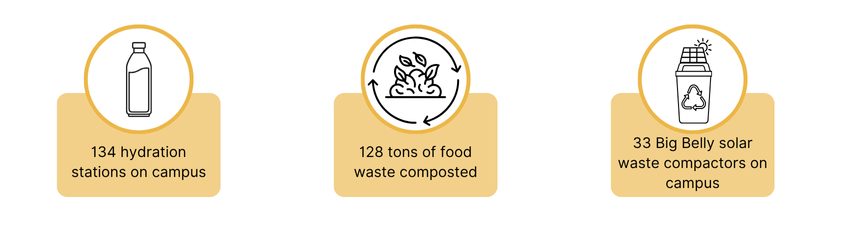
Through collaboration with Campus Dining, the university implemented food waste collection for composting at all major Dining facilities and expanded the program throughout campus. Additionally, Campus Dining implemented software and practices to reduce waste by avoiding overbuying and participating in food donation programs. Learn more about campus dining.
Reduce Single-Use Plastic
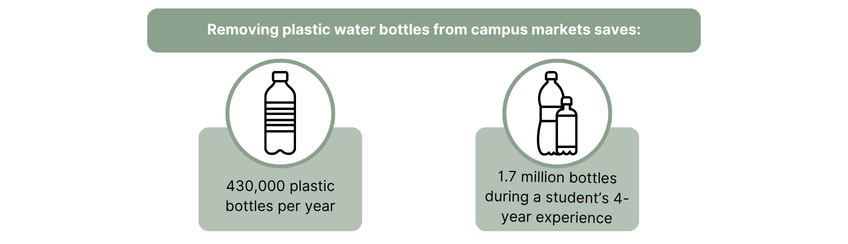
Reducing single-use plastic water bottles across markets and dining facilities across campus was a significant step in reducing waste. The university installed rapid water bottle filler stations in key locations across campus with efforts underway to install more. See a map of the rapid water bottle filler stations here.
Green Printing
The production of paper and the printing of publications use large amounts of natural resources (wood, water, energy, etc.) as well as potentially hazardous materials. Fortunately, many green printing options are now available to the Vanderbilt community through the VU Printing Services. These include post-consumer waste recycled-content papers, papers certified by the Forest Stewardship Council (FSC), vegetable-based inks, papers processed without chlorine, and products made with renewable energy. Learn more about green printing.
-
Investing in Sustainable and Resilient Infrastructure
Vanderbilt is designing a built environment that has the ability to prepare, adapt, and thrive when faced with inevitable changes. The Planning, Design, and Construction (PDC) team in partnership with our construction partners implements strategies and design practices to create buildings and landscapes that endure these changes.
Vanderbilt has been building facilities with sustainable and resilient features because it ensures environmentally responsible and efficient buildings that will last for years.
LEED
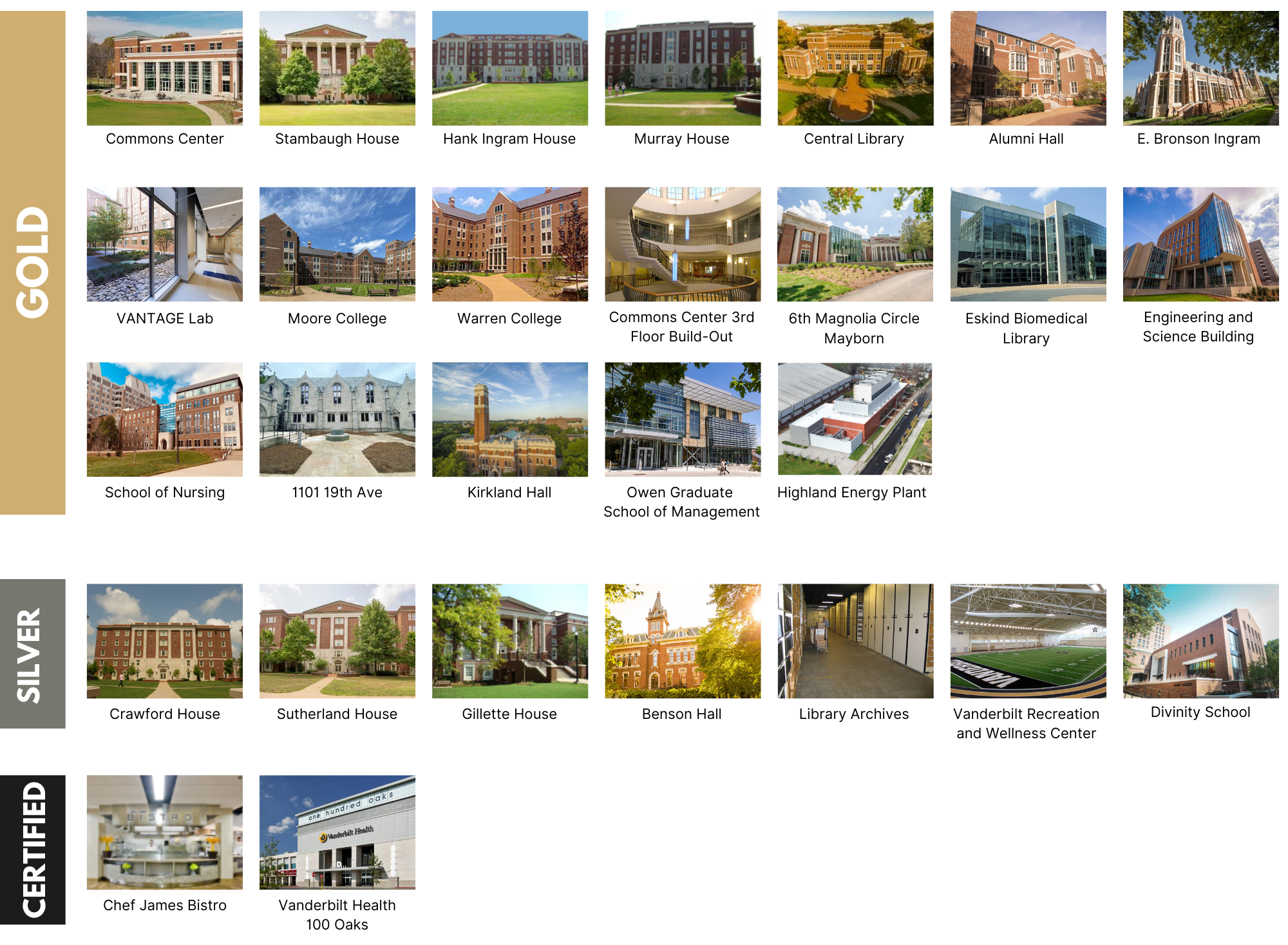
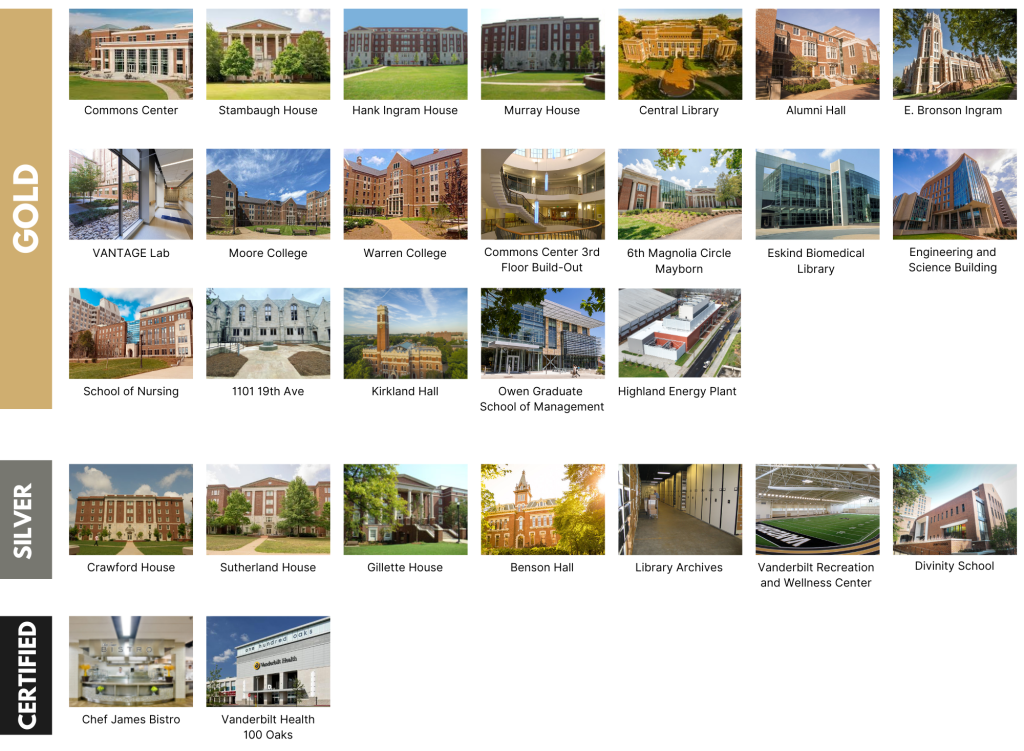
The U.S. Green Building Council’s Leadership in Energy and Environmental Design (LEED) Green Building Rating System is the nationally- accepted benchmark for the design, construction and operation of high- performance sustainable buildings. Organizations must apply for the certification, which is recognized as proof that a building is environmentally responsible, profitable and a healthy place to live and work. Vanderbilt University has a total of 28 LEED-Certified projects since 2007.
WELL
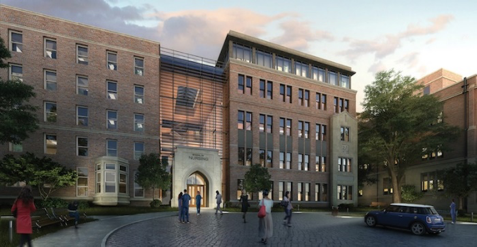 The WELL Building Standard is a performance-based system of measuring, certifying and monitoring features that affect human health and well-being in the built environment, including air quality, water, nourishment, light, fitness, comfort, and mind. Organizations must apply for certification, which certifies that the building is optimal for human health and well-being.
 WELL pilot: Nursing Health and well-being inform every part of Vanderbilt University School of Nursing’s building expansion, opening Jan 2019. The expansion achieved WELL Silver certification, which is garnered by meeting specific requirements in building design and implementing specific operational policies, such as housekeeping standards. This building is the first completed, ground-up structure in Nashville to carry the WELL designation.
Green Roofs
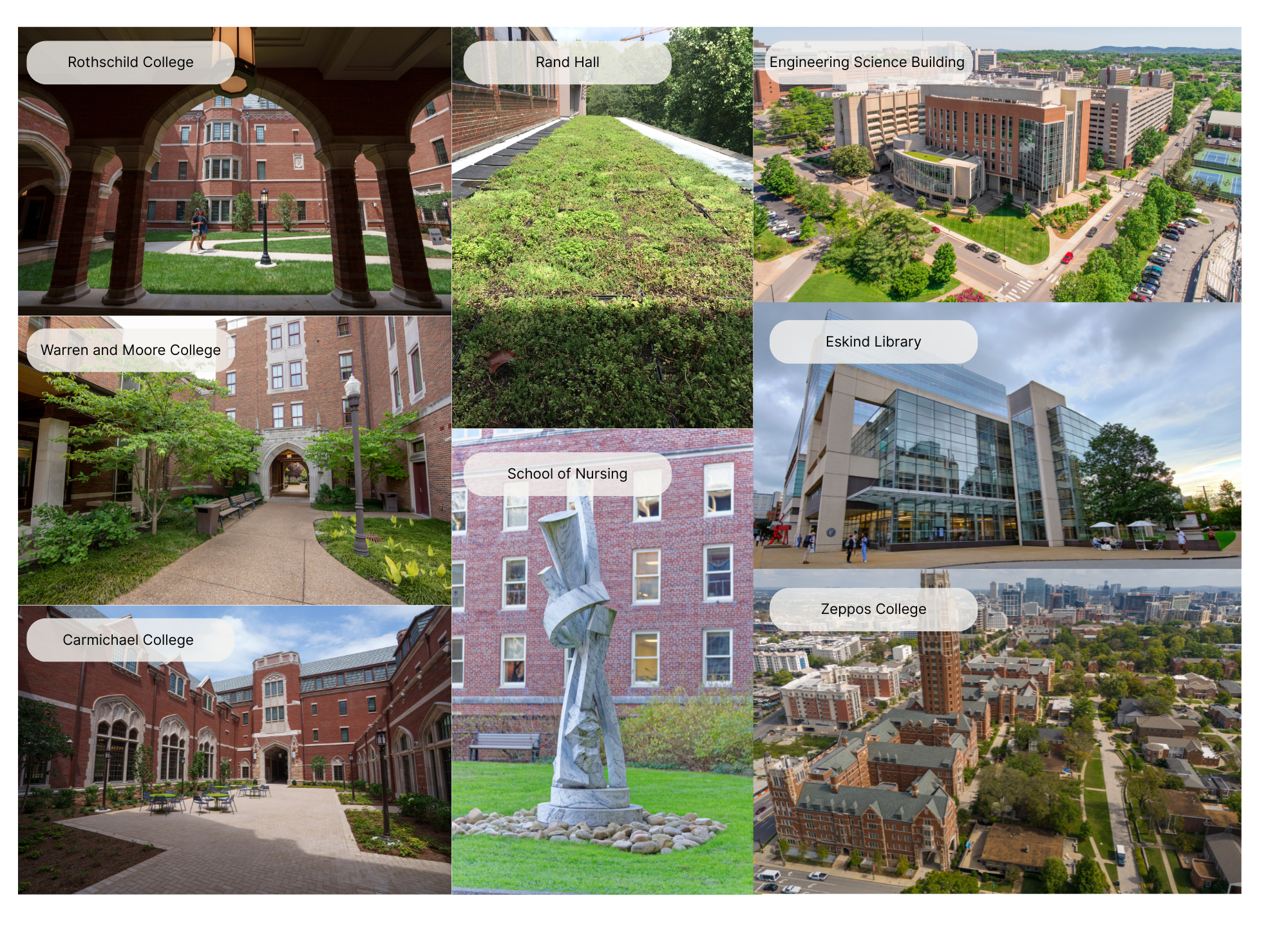
Green roofs are building roofs that are partially or completely covered with vegetation planted over a waterproofing membrane. Vanderbilt has eight vegetated roofs across campus, which provide multiple benefits including reduced energy use in buildings, reduced urban heat island effect, improved stormwater management, increased roof longevity, and improved aesthetics.
Many of the vegetated roofs at Vanderbilt are “hidden in plain sight” and act as plazas or lawns. What appears to be a green space for residents to enjoy is actually a green roof to the subterranean levels of the building.
Vegetated roofs: Rand Hall, Eskind Library, School of Nursing, Warren and Moore, Engineering and Science Building, Zeppos College, Rothschild College, and Carmichael College.
Water
Conserving water on campus preserves a valuable natural resource and lessens Vanderbilt’s environmental impact while saving the university thousands of dollars each year. VU is saving approximately 50 million gallons of water annually, or over 1,600,000 bathtubs, from bathroom retrofits and groundwater reuse projects completed on campus so far!