CSB Spotlight: Rachana Tomar, Stone Lab
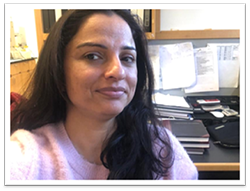
Rachana Tomar is a research assistant in the Stone lab. She spends her days unraveling the mysteries of aflatoxin B1 (AFB1) and its knack for causing mutations that can lead to cancer.
When she clocks out, Rachana trades her lab coat for road trips where the only mutations she’s concerned with are the ones in her travel itinerary!
Let’s meet Rachana …
What is the focus of your research?
I seek to understand the molecular mechanism underlying fungal derived carcinogen, aflatoxin B1 (AFB1) associated mutations. The genotoxicity of AFB1 is largely ascribed to the bulky, stable AFB1-Fapy dG adducts which induces G to T transversion. These mutations are more prevalent in certain trinucleotide sequences or hotspots-‘5-CGC-3’, 5’-CGG-3’ or 5’-GGC-3’ (where central “G” is the site of modification) than others. Several molecular level mechanisms, we are currently working upon, such as sequence wise differences- in the adduct levels, DNA repair efficiency, translesion DNA replication fidelity and adduct structures may synergistically contribute towards by which these AFB1-specific mutational signatures are manifested. A major goal in cancer research is to identify “mutagenic signatures” corresponding with exposures to specific environmental carcinogen. These establish the risk factors for disease before the tumor itself appears and provide biomarkers of exposure and windows for therapeutic intervention.
Following a site-specific AFB1-Fapy dG adduct preparation in different deoxy oligonucleotides with central trinucleotide sequences 5’-CGC -3’, 5’-AGC-3’ and 5’-TGC-3’, I found varied duplex thermal stability in these sequences given the fact that AFB1 intercalates towards 5’ side of modified guanine and base stacks between modified G:C and 5’ neighbor base-pair which leads to a significantly increased duplex stability. Higher the duplex stability of AFB1-modified DNA oligo, lower was the excision efficiency mediated by base excision repair (BER) enzyme, human NEIL1 DNA glycosylase that seemed to be modulated by 5’ neighbor base. Further, I am putting structural efforts to investigate how BER hNEIL1 glycosylase flips this bulky and stable adduct into the active site pocket and excises the DNA adduct. Another potential mechanism I am currently focusing on is how DNA replication occurs across AFB1-Fapy dG adduct following testing different translesion DNA synthesis (TLS) polymerases such as human polymerase h, z or k. Which specific polymerase/s is/are responsible for base misincorporation ultimately leading to G to T mutations and further extend/s the DNA past damaged site, still remain/s unknown. Using human DNA polymerase h, I observe sequence specific preference for the nucleotide incorporation opposite damaged base which may have implications in the AFB1-induced mutagenesis. Further biochemical and structural investigations using these TLS polymerases are underway.
What tools/techniques do you use?
I do chemical synthesis for preparing a site-specific DNA adduct in a deoxy oligonucleotide sequence for which length may vary from 11 to 46 mer as per the requirement of a specific experiment performed further; NMR spectroscopy to study sequence wise structural changes in the AFB1-Fapy dG adducted duplex DNA; X-ray crystallography to investigate protein-DNA/ protein-DNA-nucleotide complexes to provide insights into repair and translesion DNA synthesis processes; and in vitro biochemical assays to check repair and replication across site-specific damaged DNA. Recently, I have started preparing negatively stained grid samples for single particle screening through transmission electron microscopy to study human DNA polymerase mediated DNA lesion bypass which is not possible to study structurally through X-ray crystallography technique.
What was your path to this position?
Since I have entered a research position from my PhD degree program, I find myself more interested and committed in achieving research specific goals. I think it’s your interest, and of course, work progress, that lays down the path to your future research. My previous research experience and skills in the field of protein biophysics and structural biology helped me in getting a position here in the current lab, first as a postdoc and then to the Research Assistant Professor level where now I am actively working and contributing to the area of chemical biology of DNA damage. I would like to acknowledge the support of my supervisors and collaborators throughout my journey starting from doctoral tenure to the present position.
What is your favorite part of performing research within a lab?
I have been very enthusiastic and felt motivated to learn new skills or work on multiple projects because this gives me confidence and more understanding about model system to troubleshoot one specific problem through many ways. I have also enjoyed training and mentoring students in their projects over the years, as it inculcated a sense of how to become a good mentor with every interaction.
What do you think is the key to a cohesive lab environment?
I believe the responsibility to maintain a cohesive lab environment is more on shoulders of senior researchers or supervisor. One should always communicate shared lab responsibilities, research ethics and encourage to the researchers during scientific discussions to be able to run a lab in a more organized way and with more productive outcomes.
What are some fun activities you like to do outside the lab?
I like to take roadtrips to visit national/state parks or beaches or natural scenic places. I also love to watch documentaries and movies, or I listen to music to recharge myself. If I have free time on some days, then I also enjoy doing some physical activities.
Leave a Response
You must be logged in to post a comment