Pulliam, Grace, Feldman, Jacob I., Wallace, Mark T., Cutting, Laurie E., & Woynaroski, Tiffany G. (2025). “Associations between audiovisual integration and reading comprehension in autistic and non-autistic school-aged children.” Journal of Autism and Developmental Disorders. https://doi.org/10.1007/s10803-025-06960-3
Although reading difficulties are not considered a core feature of autism, autistic children often struggle with reading comprehension. Reading involves multiple senses, including translating print into speech sounds (decoding) and understanding words in context (language comprehension). This study tested whether the ability to combine what we see and hear—called audiovisual integration—might explain differences in reading comprehension by influencing decoding and language comprehension, in both autistic and non-autistic children.
We studied 50 autistic and 50 non-autistic school-aged children (8–17 years old), matched for age and sex. Children completed tests of reading comprehension, decoding, and language comprehension, as well as a task measuring audiovisual integration using the McGurk illusion. Statistical analyses showed that better audiovisual integration was linked to stronger reading comprehension, decoding, and language skills, with moderate-to-large effects. Further analyses revealed that audiovisual integration affected reading comprehension indirectly through its impact on decoding and language comprehension. These patterns were the same for both autistic and non-autistic children.
Overall, this study suggests that audiovisual integration plays an important role in reading and language development. It also highlights the potential for multisensory-based approaches to improve reading skills in all children. Future research should follow children over time and include more diverse participants to confirm and expand these findings.
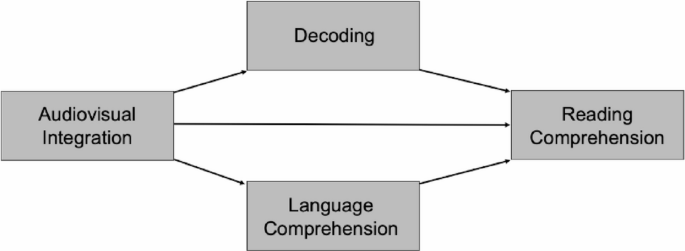
Fig.1. Conceptual Figure of Models Tested. Note. Depiction of the model tested in analyses. Audiovisual integration as indexed by the proportion of trials wherein participants reported perception of the McGurk illusion. Reading comprehension was indexed as an aggregate from the comprehension scaled score from the Gray Oral Reading Test, 5th edition (GORT; Wiederholt & Bryant, 2000) and the text comprehension scaled score of the Test of Reading Comprehension, 4th edition (TORC; Brown et al., 1978), following z-score transformation. Decoding was measured via an aggregate of (a) the fluency scaled score from the GORT, (b) the contextual fluency scaled score from the TORC, and (c) the sight word efficiency and phonemic decoding efficiency scaled scores from the Test of Word Reading Efficiency, 2nd edition (Torgesen et al., 1999) following z-score transformation. Language comprehension was indexed as an aggregate the receptive language standard score from the Clinical Evaluation of Language Fundamentals, 5th edition (Wiig et al., 2013), the standard score from the Receptive One-Word Picture Vocabulary Test, 4th edition (Martin & Brownell, 2011) and the receptive scaled score from the Vineland Adaptive Behavior Scales, 2nd edition (Sparrow et al., 2005) following z-score transformation