Undergraduate Research Spotlight: Lily Mae Cochell
Q: What inspired you to pursue undergraduate research at Vanderbilt?
A: I love learning through hands-on experience. After taking a neuroscience class my freshman year, I became fascinated by how research translates classroom concepts into real discoveries. That course opened my eyes to the complexity of the brain and the many questions are still unanswered in the field. I knew I wanted to contribute to the process and take what I’d learned in lectures and see it come to life through research. Pursuing undergraduate research at Vanderbilt allows me to build curiosity and answer questions while working alongside faculty who are pushing the boundaries of neuroscience and psychology.
Q: How did you get involved in research?
A: I found my lab through the neuroscience department at Vanderbilt, which maintains an ongoing list of labs looking for undergraduate researchers. I reviewed the list and identified several labs whose projects aligned with my interests and curiosity. I reached out to a few principal investigators and then interviewed with labs to learn more about their work and research. Through this process, I found a lab that was the perfect fit for my interests and goals, and that’s where I’m conducting research now.
Q: What is your research about, and what role do you play in the project?
A: I’m involved in two research projects in my lab that explore how language and the brain develop in early childhood. The first is my Honors Project for the Vanderbilt Psychology Department, where I analyze previously collected data on five-year-old children. This includes studying both their language abilities and brain activity using behavioral assessments and fMRI data. We are investigating what areas of the brain five-year-old children engage during morphologically processing. Currently, we are writing a manuscript based on our findings to submit for publication.
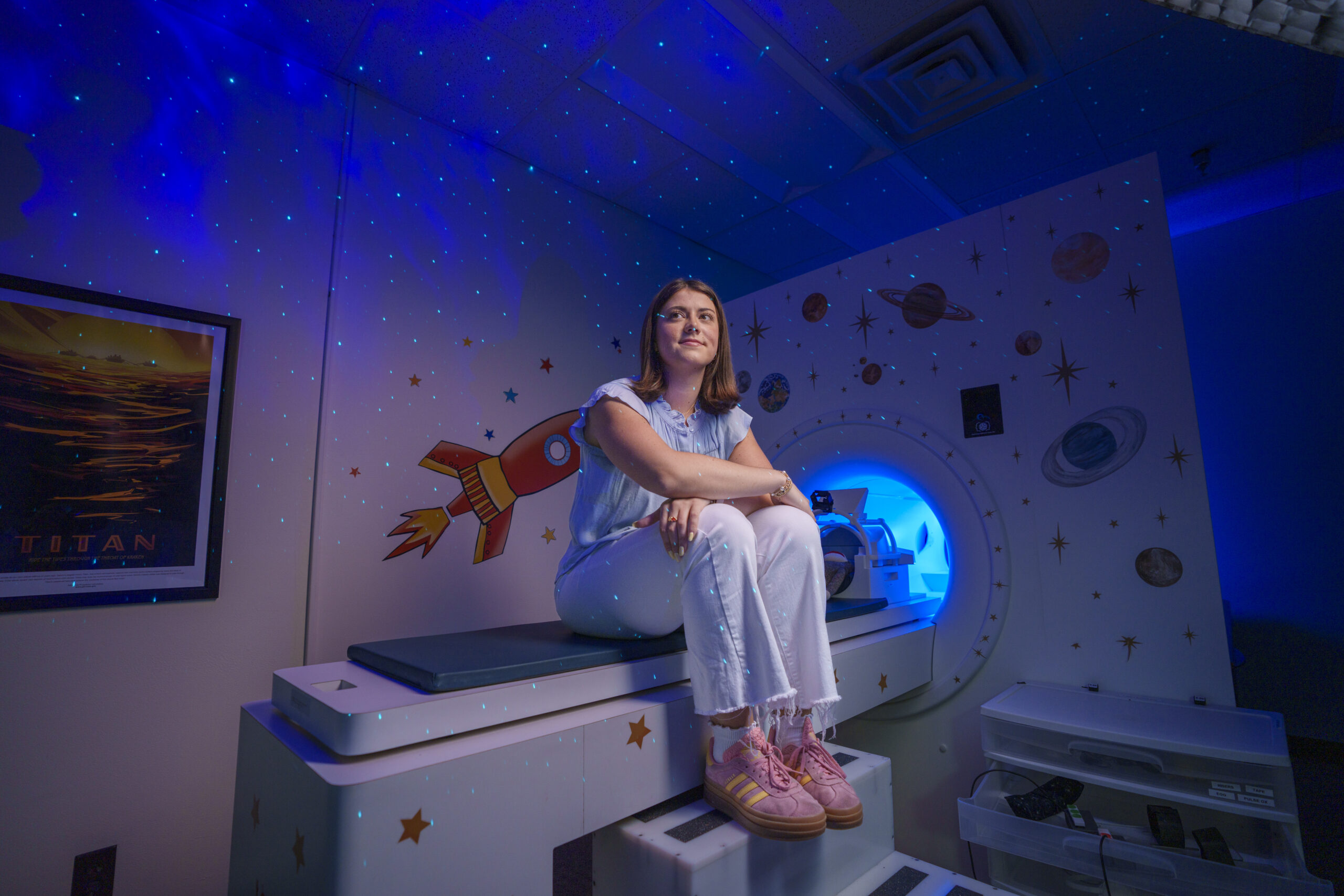
In addition, I work as a research assistant on a project examining how preschool-aged children (ages 3.5–5) develop language skills and how those skills relate to brain development. For this study, I help collect data by administering behavioral tests, assisting with fMRI scans, recruiting participants, and entering data. Through both projects, I’ve gained hands-on experience in studying the developing brain and a deeper appreciation for how early experiences shape language and cognition.
Q. What has made your undergraduate research experience meaningful thus far?
A: My undergraduate research experience has been especially meaningful because it allows me to apply what I learn in class to real scientific discovery. Seeing concepts from lectures come to life through data collection and analysis has deepened my understanding of neuroscience and human development. I’ve also found a strong sense of community within my lab. Working alongside fellow research assistants, graduate students, and postdoctoral researchers has taught me the value of collaboration and teamwork. The guidance and mentorship from my principal investigator has been especially impactful, helping me grow both as a researcher and as a learner.
Q. How has this experience shaped your academic or career goals?
A: My research experience has completely transformed my academic and career goals. When I first arrived at Vanderbilt, I wasn’t sure what I wanted to study or what career path I wanted to pursue. After spending a year in my lab, I discovered my passion for research, particularly in the field of neuropsychology. Through hands-on work and mentorship, I realized how much I enjoy investigating the connection between brain function and behavior. Without my undergraduate research experience, I might never have found this direction. After graduation, I hope to continue research as a post-baccalaureate research assistant and eventually pursue a Ph.D. in clinical psychology.
Q: What advice would you give to other students who are curious about getting involved in research?
A: Don’t be afraid to reach out to labs and express your interest in getting involved. Reach out early to labs as research positions can fill up quickly, so taking initiative can make a big difference. Even if you’re unsure exactly what area you want to study, be open to exploring new topics and learning through experience. Prioritize curiosity and growth over perfection; every task, big or small, contributes to your understanding of research.
