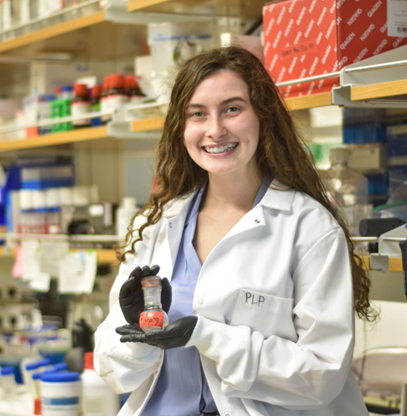
 Patricia Poley
Biomedical Engineering
Craig Duvall Research Group
Reactive oxygen species (ROS) are chemicals that contain oxygen and are chemically reactive and unstable due to their possession of an unpaired electron. Common ROS species in the body include hydrogen peroxide and superoxide anions. At low levels, ROS exist to aid in signaling between cells, influence pathways that control cellular growth and development, and allow immune cells to kill off foreign pathogens within the body in a controlled manner. However, in many inflammatory diseases, such as osteoarthritis (OA), inflammation can cause a generation of excess amounts of ROS that overpower the body’s innate antioxidant capabilities.
Osteoarthritis is a progressive, degenerative disease that affects synovial joints. Despite the considerable physical and economic burden of OA, there has yet to be a disease modifying osteoarthritis drug (DMOAD) that has successfully made it through clinical trials. One factor that can influence OA development and progression is the production of ROS that ultimately causes oxidative stress, pushing cells to become senescent or experience cell death. Current research is exploring how microparticles (MPs) can be used as sustained release systems to ensure local drug delivery to synovium and other joint tissues impacted by OA, however these polymeric systems typically use poly(lactic-co-glycolic acid) (PLGA), which have no inherent biological effect. Therefore, developing a system in which we can target both ROS generation and deliver therapeutic cargo is going to be imperative to developing a treatment for OA patients.
In the Duvall lab, we have several projects exploring how different polymers can be used to reduce ROS in various inflammatory disease states. My project is exploring how we can use antioxidant polysulfide microparticles to reduce ROS levels within a joint that experiences OA. I aim to improve the scavenging ability of previous antioxidant microparticles, which should hasten degradation, and increase synergy between antioxidant ability of the vehicle and therapeutic targeting of the cargo which will work to more effectively inhibit progression of OA than the previous system.
To formulate our antioxidant polymers into microparticles, I use an oil-in-water emulsion method. Characterization of the microparticles, including morphology and size, is done using the VINSE Scanning Electron Microscope (SEM)! With the SEM, I can determine if the particles are homogenous (similar shape and size for each particle), crystalline (stable enough to form 3D shapes without collapsing), and spherical (the shape we aim for with our emulsion method). In addition to the SEM, I can use Energy Dispersive X-Ray Spectroscopy (EDS) to visualize the chemical composition of the particles. Since our polymers, and subsequently the microparticles, contain sulfur atoms, these atoms should scavenge and become oxidized in the presence of ROS. To visualize this oxidation, we can use the SEM and EDS together to image the MPs to determine when degradation (morphological change) occurs and quantify the oxygen percentage of the particles. Together, this information can inform us of what the degradation timelines of our microparticles are – and help us visualize how various microparticles made from our polymer library may have different degradation timelines based on polymer composition. I’ve been a frequent user of the SEM/EDS throughout my time here at Vanderbilt, and I look forward to spending many more hours in the basement as I continue to develop my microparticle library to determine the best treatment for reducing ROS in arthritic joints!
 My VINSE Experience
I’ve attended two Nanoday symposiums since becoming a student here at Vanderbilt. My first year, I was an attendee and got to learn about exciting work being conducted by my peers and professors in multiple departments across campus. In my second year, I was able to present a poster and share my project and some recent findings with others. This was a really helpful way of getting asked questions about my project from individuals outside of my lab that can help me think of new perspectives for interpreting data or thinking of new experiments to try!
Earlier this year I volunteered during VINSE’s Friends and Family Day event. It was such a fun experience getting to talk to people of all ages about the SEM and how we use it here at Vanderbilt (and to see how many of them knew that bees have hair on their eyes)! Friends and Family Day was a great event to get members of the local community interested in nanoscale science and the work done here at VINSE/Vanderbilt, and I’m grateful to have been a part of it and look forward to the next one.
This summer I was also grateful to present my recent work to Vanderbilt students and visiting summer students during VINSE’s Nanoexchange. It was very helpful getting to discuss current challenges I’m facing in the lab and to get feedback and new ideas from students outside of my own lab. I also enjoyed getting to hear about other students’ work, play games related to VINSE equipment, and eat a really delicious breakfast while mingling with other students! I’m incredibly grateful for the VINSE staff who plan and execute these large events that help me develop as a researcher here at Vanderbilt!