Loberg, Matthew A.; Chen, Sheauchiann; Chen, Huachang; Wahoski, Claudia C.; Caroland, Kailey; Tigue, Megan L.; Hartmann, Heather A.; Gallant, Jean Nicolas; Phifer, Courtney J.; Ocampo, Andres A.; Wang, Dayle K.; Fankhauser, Reilly G.; Karunakaran, Kirti A.; Wu, Chiachin; Tarabichi, Maxime; Shaddy, Sophia M.; Netterville, James L.; Rohde, Sarah L.; Solórzano, Carmen C.; Bischoff, Lindsay A.; Baregamian, Naira; Murphy, Barbara A.; Choe, Jennifer Hsing; Wang, Jennifer Rui; Huang, Eric C.; Sheng, Quanhu; Kagohara, Luciane Tsukamoto; Jaffee, Elizabeth M.; Belcher, Ryan H.; Lau, Ken S.; Ye, Fei; Lee, Ethan; & Weiss, Vivian L. (2026). An integrated single-cell and spatial transcriptomic atlas of thyroid cancer progression identifies prognostic fibroblast subpopulations. JCI Insight, 11(1), e191990. https://doi.org/10.1172/jci.insight.191990
Most well-differentiated thyroid cancers (WDTC) respond well to treatment, but aggressive forms such as anaplastic thyroid carcinoma (ATC) are often deadly. To better understand how thyroid cancer develops and becomes more aggressive in both children and adults, we analyzed gene activity at the single-cell level in more than 423,000 cells collected from 81 tumor samples. We also used spatial transcriptomics to map where different tumor cells and surrounding support cells are located within 28 tumors, including rare tumors that contain both WDTC and ATC features, as well as pediatric diffuse sclerosing thyroid carcinomas. In addition, we examined gene expression patterns from five large thyroid cancer datasets to study supportive tissue, known as the tumor stroma.
Using these approaches, we identified a specific group of cancer-associated fibroblasts called POSTN-positive myofibroblasts (myCAFs) that are located very close to invading tumor cells. The presence of these cells is strongly linked to worse outcomes, including cancer spread to lymph nodes and overall disease progression. We also found a different type of fibroblast, called inflammatory CAFs, that are located farther from tumor cells and are more commonly found in inflamed thyroid tissue, such as in autoimmune thyroiditis. Together, these findings show how thyroid cancers evolve within their surrounding tissue and identify a fibroblast subtype that could help predict aggressive disease in both children and adults.
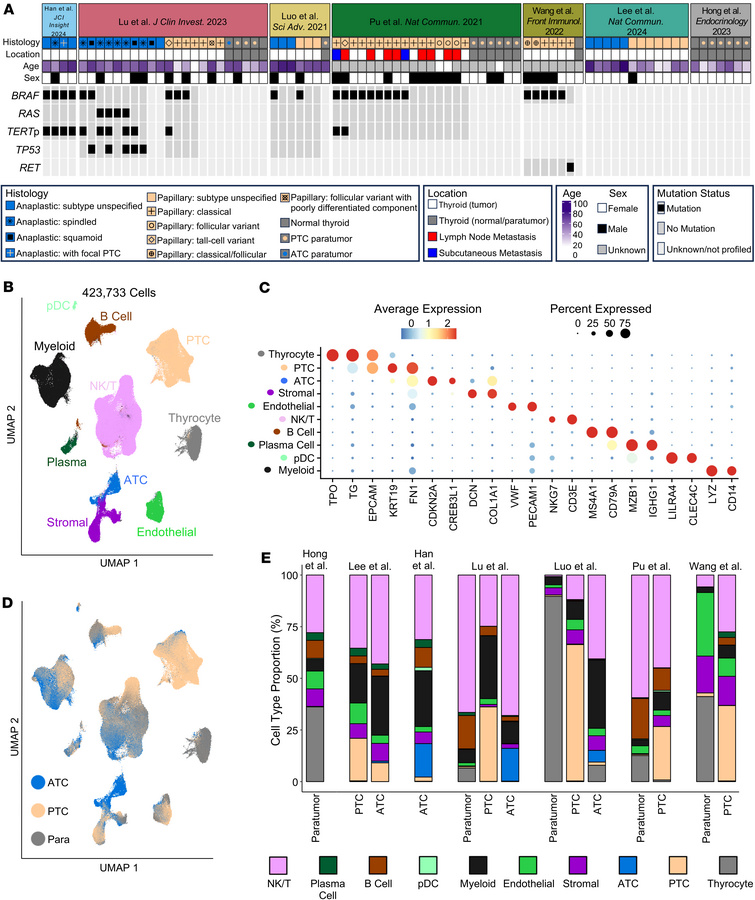
Figure 1
Integrated single-cell atlas of thyroid cancer progression.
(A) Oncoplot for thyroid cancer publicly available single-cell RNA-sequencing samples: Luo et al. (26), Pu et al. (27), Lu et al. (28), Han et al. (29), Hong et al. (30), Lee et al. (31), Wang et al. (32). (B) Uniform manifold approximation and projection (UMAP) plot depicting the single-cell atlas labeled by broad cell type. (C) Scaled dot plot showing canonical markers for broad populations from B. (D) UMAP colored by tumor histology with broad groupings of ATC (blue), PTC (light orange), or paratumor/normal (Para, gray). (E) Bar plots showing overall broad cell type composition for each paper in the single-cell atlas split by tumor histology group. pDC, plasmacytoid dendritic cell; NK/T, natural killer/T cell.