Xiong, Juming, Deng, Ruining, Yue, Jialin, Lu, Siqi, Guo, Junlin, Lionts, Marilyn, Yao, Tianyuan, Cui, Can, Zhu, Junchao, & Qu, Chongyu. (2025). ZeroReg3D: A zero-shot registration pipeline for 3D consecutive histopathology image reconstruction. Journal of Medical Imaging, 12(4), 44002. https://doi.org/10.1117/1.JMI.12.4.044002
Histological analysis, which examines tissue structure under a microscope, is essential for understanding both normal biology and disease. While recent methods have improved the alignment of 2D tissue images, they often struggle to preserve the true 3D structure of tissues, limiting their usefulness in research and clinical applications. Creating accurate 3D models from 2D slices is challenging because tissues can deform, slicing can introduce artifacts, imaging techniques vary, and lighting can be inconsistent. Deep learning methods have shown promise but usually need large amounts of training data and often don’t generalize well to new datasets. Non-deep-learning approaches are more generalizable but often less accurate.
To address these issues, we developed ZeroReg3D, a “zero-shot” registration pipeline that combines deep learning-based keypoint matching with traditional non-deep-learning registration techniques. This approach reduces tissue deformation and sectioning artifacts without requiring extensive training data.
Our evaluations show that ZeroReg3D improves 2D image alignment by about 10% compared to existing methods and produces high-quality 3D reconstructions from consecutive tissue sections. These results demonstrate that ZeroReg3D provides a reliable and accurate framework for reconstructing 3D tissue structure from 2D histological images.
In conclusion, ZeroReg3D successfully combines zero-shot deep learning with optimization-based registration to overcome challenges such as tissue deformation, slicing artifacts, staining differences, and uneven illumination, all without the need for retraining or fine-tuning.
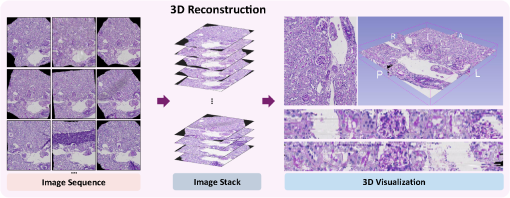
Fig. 1
Overview. This figure shows a reconstructed 3D volume after alignment. The image sequence was stacked and subjected to 3D visualization to provide a comprehensive view.