Yang, Hao, Acar, Ayberk, Xu, Keshuai, Deguet, Anton, Kazanzides, Peter, & Wu, Jieying. (2025). “An effectiveness study across baseline and learning-based force estimation methods on the da Vinci Research Kit Si system.” IEEE Transactions on Medical Robotics and Bionics. https://doi.org/10.1109/TMRB.2025.3589744
Robot-assisted minimally invasive surgery, such as with the da Vinci systems, improves precision and patient outcomes. However, older da Vinci systems [before da Vinci 5] did not have sensors to directly measure force, meaning surgeons could not feel what they were doing the way they can in traditional laparoscopy. In our previous work, we restored this sense of force using machine learning to estimate it on an open-source surgical robot platform, the da Vinci Research Kit [dVRK] Classic.
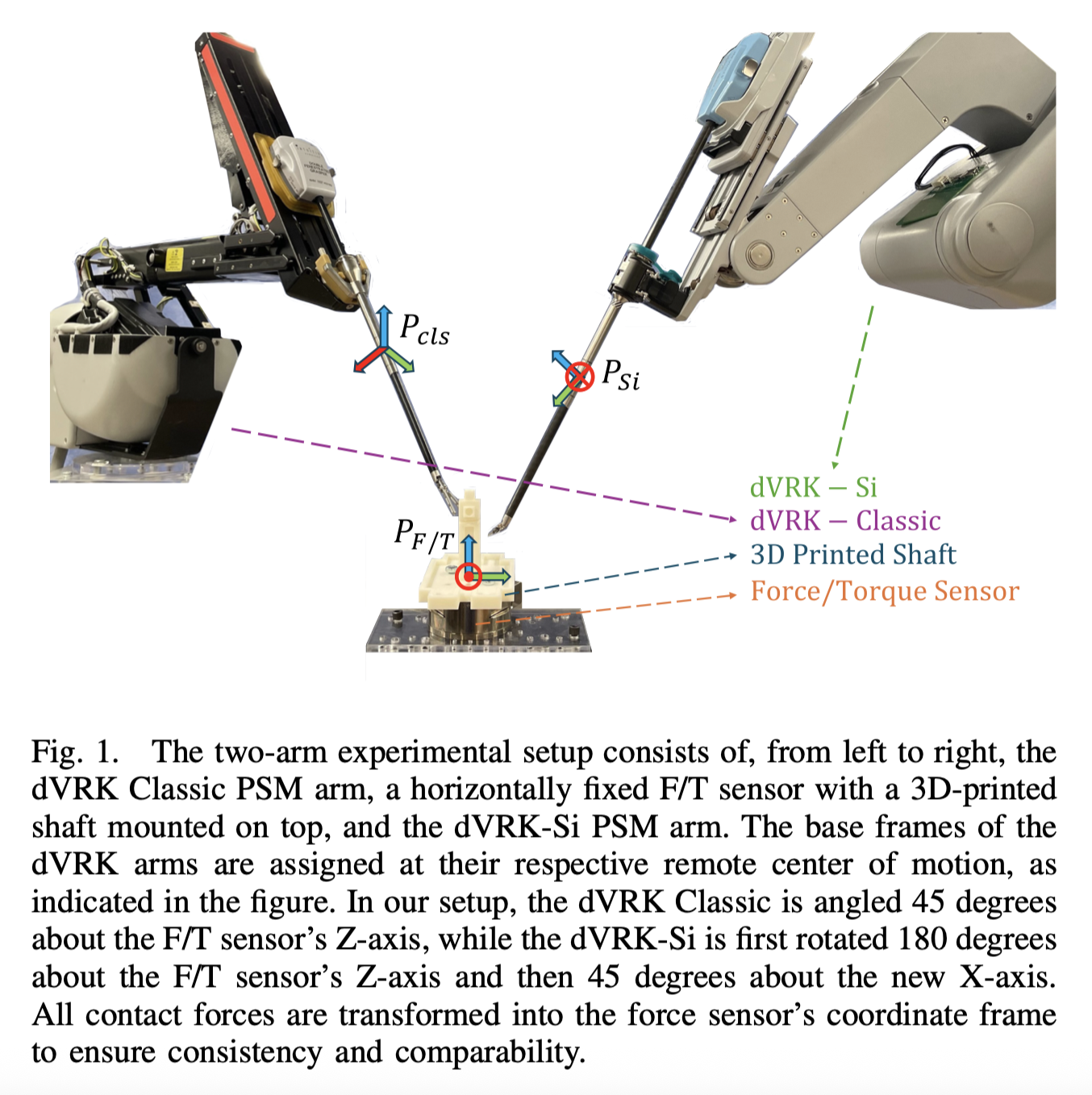
In this study, we extend that method to the newer dVRK-Si system. We also compared the performance of our learning-based algorithm with simpler baseline methods that make assumptions about the robot’s torque. The learning-based method performed better than the baselines on both systems, but the improvement was especially noticeable on the dVRK-Si. Despite this, force estimation on the dVRK-Si is less accurate than on the dVRK Classic, with errors two to three times higher.
Further analysis suggests that the dVRK-Si’s internal control system [PID control] is less optimal, likely because, unlike the Classic, the dVRK-Si is not mechanically balanced and has more complex internal dynamics. This work advances the understanding of learning-based force estimation and is the first to apply such techniques to the new dVRK-Si system.