Lu, Zhengyi, Liang, Hao, Lu, Ming, Wang, Xiao, Yan, Xinqiang, & Huo, Yuankai. (2025). “Fast-RF-Shimming: Accelerate RF shimming in 7T MRI using deep learning.” Meta-Radiology, 3(3), 100166. https://doi.org/10.1016/j.metrad.2025.100166
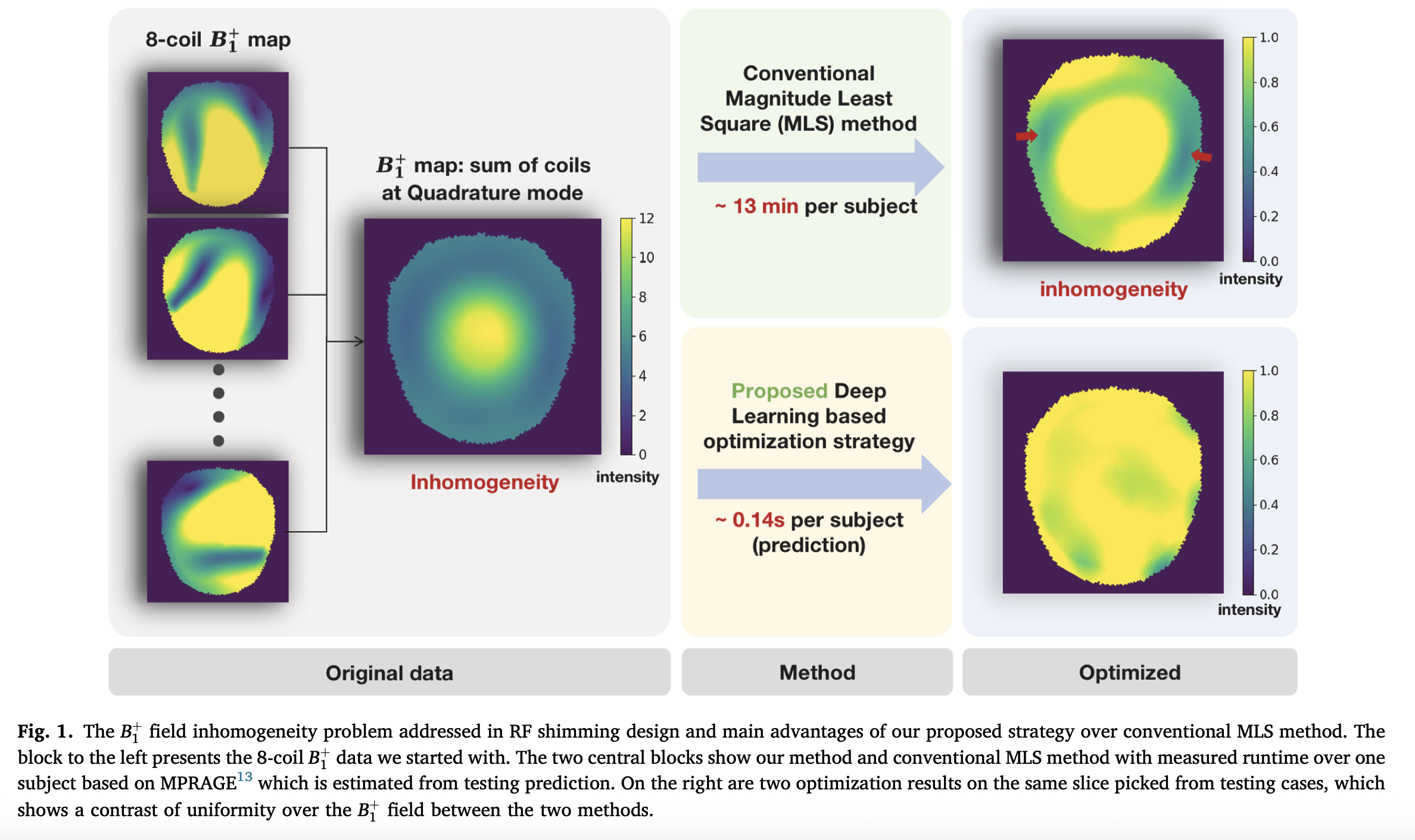
Ultrahigh field (UHF) Magnetic Resonance Imaging (MRI) provides much stronger signals than standard MRI, allowing for extremely detailed images that can help both doctors and researchers. However, using such high fields creates new problems. One of the biggest challenges is uneven radiofrequency (RF) fields, which can cause parts of the image to appear brighter or darker than they should. These irregularities reduce image quality and make it harder to use UHF MRI widely in clinical settings. Traditional methods, such as RF shimming with Magnitude Least Squares (MLS) optimization, can correct these uneven fields, but the process is very slow. Recently, machine learning methods have been explored to solve this problem faster, but they often require long training times, limited model complexity, and large amounts of data.
In this study, we present a new machine learning approach called Fast-RF-Shimming, which works about 5000 times faster than the traditional MLS method. First, we use a technique called Adaptive Moment Estimation (Adam) to calculate reference RF shimming weights from multi-channel field data. Then, we train a Residual Network (ResNet), a type of deep learning model, to directly predict the best RF shimming outputs. To improve accuracy, the model includes a confidence parameter in its training process. Finally, we add an optional step called the Non-uniformity Field Detector (NFD), which checks for extreme unevenness and corrects it.
When compared to the standard MLS method, Fast-RF-Shimming not only runs much faster but also produces more accurate results. These findings suggest that this new framework offers a promising and practical solution for overcoming long-standing image quality issues in ultrahigh field MRI.