Akpanoko, Celestine E.; Ashwin, T.S.; Biswas, Gautam. “The interplay of affective states and cognitive processes in an open-ended learning environment: A case study.” Computer-Supported Collaborative Learning Conference, CSCL (2024): 873-880. https://repository.isls.org//handle/1/11182
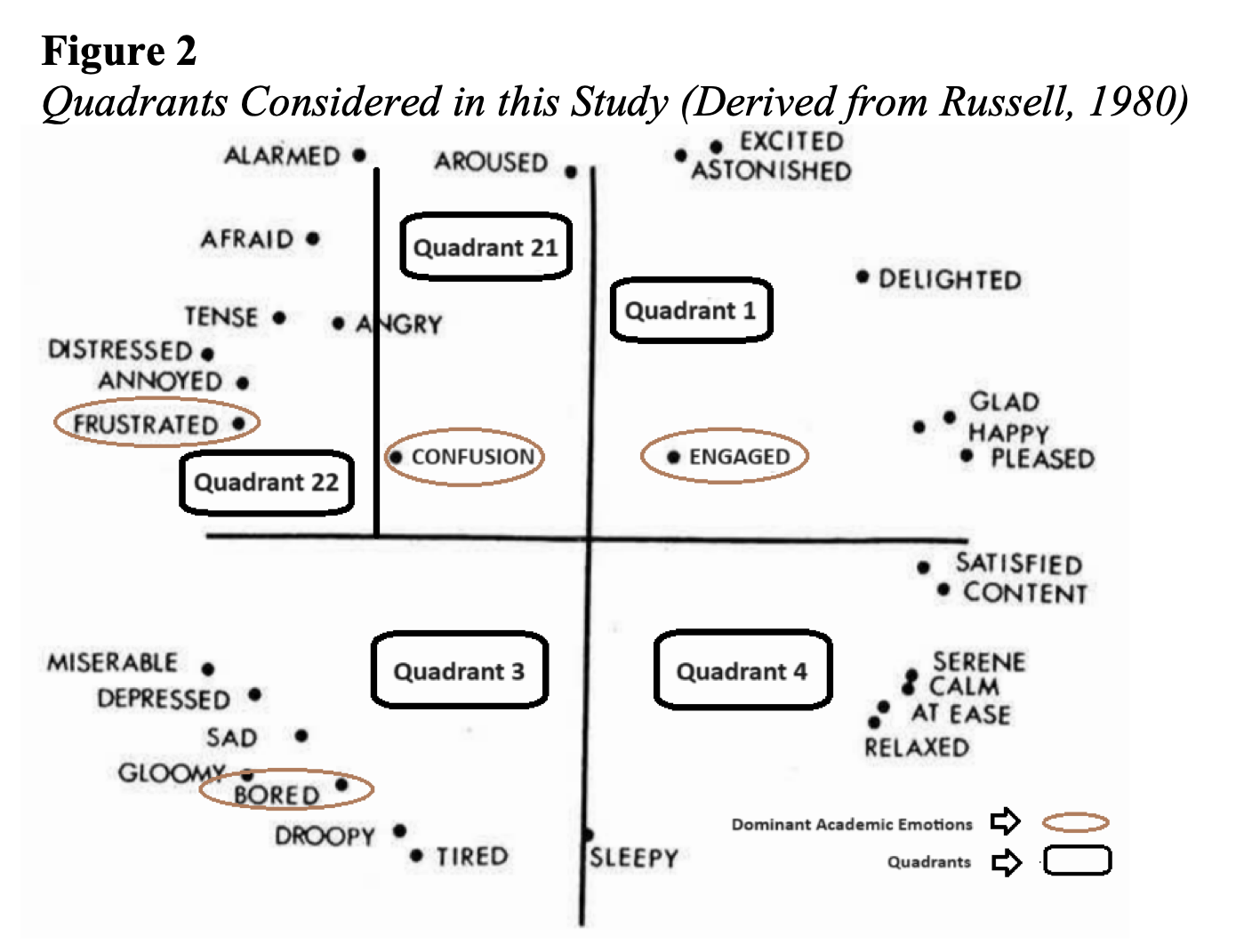
Emotions play an important role in how students learn, but there hasn’t been much research on how emotions and thinking processes are connected—especially when middle school students are working in Open-Ended Learning Environments (OELE), where there may be no single correct answer. This study explores how students’ emotions relate to their thinking and learning outcomes over time by analyzing continuous streams of data. Using a mix of methods, the researchers studied six students, looking at about 80 minutes of data for each one. The students’ emotional states were identified using a detailed method that measures how positive or negative (valence) and how intense (arousal) the feelings are, then groups them into emotional categories related to learning. The study uses a framework by D’Mello and Graesser to compare emotional and thinking patterns in students who were able to complete a map-building task with those who couldn’t. It also looks at how students’ emotions changed as they worked on the task over two different days, giving insight into how emotional states may be linked to success in learning tasks like map building.