Yue, Jialin; Yao, Tianyuan; Deng, Ruining; Lu, Siqi; Guo, Junlin; Liu, Quan; Xiong, Juming; Yin, Mengmeng; Yang, Haichun; Huo, Yuankai. “GloFinder: AI-empowered QuPath plugin for WSI-level glomerular detection, visualization, and curation.” Journal of Pathology Informatics 17 (2025): 100433. https://doi.org/10.1016/j.jpi.2025.100433.
Artificial intelligence (AI) has made it easier to automatically detect glomeruli—the tiny filtering units in the kidney—using high-resolution images of kidney tissue. But many of the existing AI tools are hard to use unless you have advanced programming skills, which makes them less useful for doctors and other healthcare professionals. On top of that, current tools are often trained on only one type of data and don’t let users adjust how confident the system needs to be before marking something as a glomerulus.
To solve these problems, we created GloFinder, a user-friendly tool that works as a plugin for the QuPath image viewer. With just one click, GloFinder can scan an entire kidney slide image and find glomeruli automatically. It also lets users review and edit the results directly on the screen.
GloFinder uses an advanced detection method called CircleNet, which represents glomeruli as circles to help the system find them more precisely. It was trained using around 160,000 manually labeled glomeruli to boost accuracy. To make the results even better, GloFinder uses a smart technique that combines results from several AI models, weighting their confidence levels to improve overall performance.
This tool is designed to make it easier for clinicians and researchers to analyze kidney images quickly and accurately—no programming required—making it a valuable resource for kidney disease research and diagnosis.
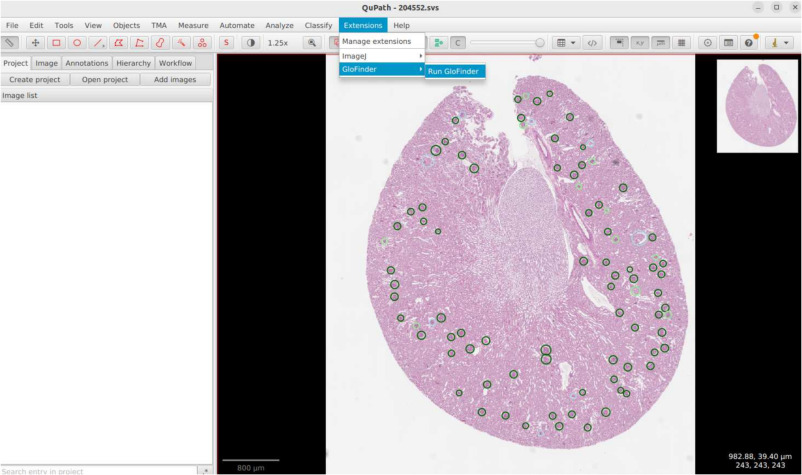
Fig. 1.
Glomerular detection results using the GloFinder plugin. Detected glomeruli are represented as circles with various colors indicating detection confidence.