Khan, Aimal; Yang, Hao; Habib, Daniel Roy Sadek; Ali, Danish; Wu, Jie Ying. “Development of a machine learning-based tension measurement method in robotic surgery.” Surgical Endoscopy (2025). https://doi.org/10.1007/s00464-025-11658-9.
Each year, over 300,000 people in the U.S. undergo colorectal surgery, and about 1 in 10 of these surgeries have a serious complication called an anastomotic leak, where the connection between two parts of the colon doesn’t heal properly. One of the main causes of these leaks is too much tension, or pulling, on the colon during surgery—but right now, surgeons mostly judge this tension by feel, which isn’t always reliable.
In this study, researchers tested a new, more accurate way to measure tension using robotic tools and artificial intelligence. They used a surgical robot and a machine learning algorithm to estimate how much force was being applied to sections of pig colon. They then compared the algorithm’s estimates to actual force measurements from a sensor.
The results were promising: the AI was able to estimate the tension with up to 88% accuracy, and its results were strongly in line with the actual sensor data. This is the first time tissue tension has been measured this way, using both robots and reported numbers.This approach could eventually help surgeons better measure tension during operations, leading to fewer complications and better outcomes for patients.
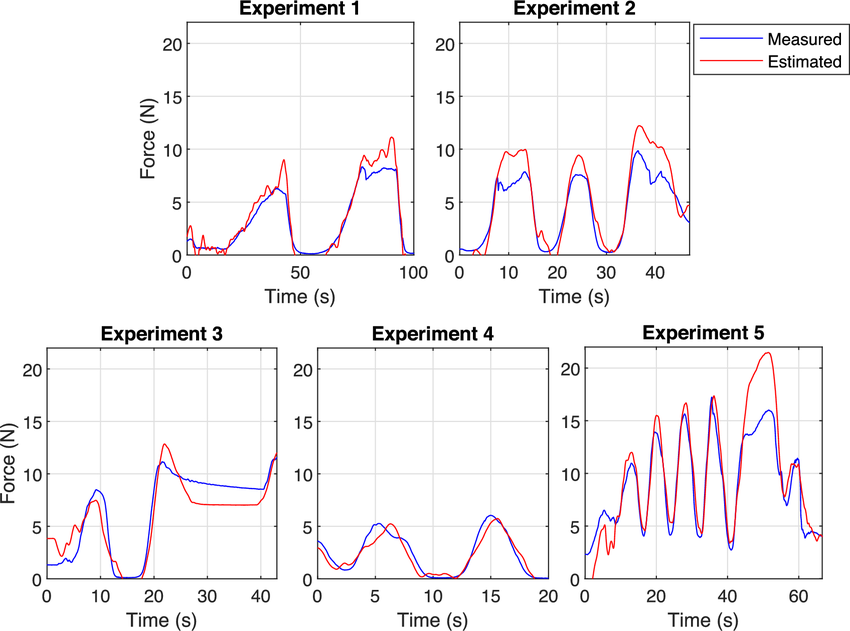
Figure 1
Measured and estimated forces over time for the best colon-pulling trials across five experiments. Note: Colons were pulled for different amounts of time in each experiment