From 1989-2006, the Center for Microgravity Research and Applications at Vanderbilt University conducted microgravity fluid physics research on Space-based platforms provided by the Space Shuttle and the International Space Station. The results of these investigations led to several peer-reviewed publications.
NASA career astronauts including payload commanders Bonnie Dunbarand Kathryn Thornton were trained by the Principal Investigator team to conduct experiments during the Microgravity Flights aboard the Space Shuttle.
Astronaut Bonnie J Dunbarconducting the Drop Physics experiments aboard Columbia STS-50 USML-1 Mission June-July 1992.
American NASA astronaut Kathryn C Thornton working on the Drop Physics Module (DPM) in the Space Shuttle Columbia during STS-73, 20th October to 5th November 1995. STS-73 is the second mission for the United States Microgravity Laboratory.
SPACE SHUTTLE: USML-1 Mission: 1992, USML-2 Mission: 1995
DROP PHYSICS INVESTIGATIONS
Principal Investigator Taylor G. Wang, Ph.D., Vanderbilt University, Nashville, TN, United States
Co-Investigators Amrutur V. Anilkumar, Ph.D., Vanderbilt University, Nashville, TN, United States
Chun P. Lee, PhD., Vanderbilt University, Nashville, TN, United States
Description
The United States Microgravity Laboratory (USML-1,2) was one of NASA’s science and technology programs that provided scientists an opportunity to research various scientific investigations in a weightlessness environment inside the Spacelab module.
It also provided demonstrations of new equipment to help prepare for advanced microgravity research and processing aboard the Space Station. The USML-1 & 2 flew in orbit for extended periods, providing greater opportunities for research in materials science, fluid dynamics, biotechnology (crystal growth), and combustion science.
The Drop Physics Module (DPM) was dedicated to the detailed study of the dynamics of fluid drops in microgravity: their equilibrium shapes, the dynamics of their flows, and their stable and chaotic behaviors. It also demonstrated a technique known as containerless processing. The DPM and microgravity combine to remove the effects of the container, such as chemical contamination and shape, on the sample being studied.
Sound waves, generating acoustic forces, were used to suspend a sample in microgravity and to hold a sample of free drops away from the walls of the experiment chamber, which isolated the sample from potentially harmful external influences. The DPM gave scientists the opportunity to test theories of classical fluid physics, which have not been confirmed by experiments conducted on Earth.
Peer-reviewed Publications
T. G. Wang, A.V. Anilkumar, C.P. Lee, and K.C. Lin, ‘Bifurcation of rotating liquid drops: results form USML-1 experiments in Space’, Journal of Fluid Mechanics276, 1994, pp. 389-403.
T. G. Wang, A.V. Anilkumar, C.P. Lee, and K.C. Lin, ‘Core centering of compound drops in capillary oscillations: observations on USML-1 experiments in Space’, Journal of Colloid and Interface Science 165, 1994, pp. 19-30.
T. G. Wang, A.V. Anilkumar, and C.P. Lee, ‘Oscillations of liquid drops: results of USML-1 experiments in Space’,Journal of Fluid Mechanics 308, 1996, pp. 1-14.
C.P. Lee, A.V. Anilkumar, A.B. Hmelo and T.G. Wang, ‘Equilibrium of liquid drops under the effects of rotation and acoustic flattening: results from USML-2 experiments in Space’, Journal of Fluid Mechanics 354, 1998, pp. 43-67.
A. V. Anilkumar, A.B. Hmelo, and T.G. Wang, ‘Core centering of immiscible compound drops in capillary oscillations: experimental observations,’ Journal of Colloid and Interface Science242, 2001, pp. 465-469.
Astronaut Bonnie J Dunbar conducting the Drop Physics experiments aboard Columbia STS-50 USML-1 Mission June-July 1992.

 It also provided demonstrations of new equipment to help prepare for advanced microgravity research and processing aboard the Space Station. The USML-1 & 2 flew in orbit for extended periods, providing greater opportunities for research in materials science, fluid dynamics, biotechnology (crystal growth), and combustion science.
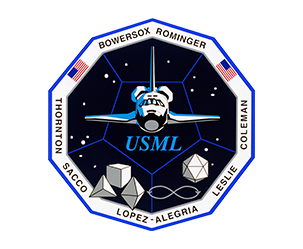 The Drop Physics Module (DPM) was dedicated to the detailed study of the dynamics of fluid drops in microgravity: their equilibrium shapes, the dynamics of their flows, and their stable and chaotic behaviors. It also demonstrated a technique known as containerless processing. The DPM and microgravity combine to remove the effects of the container, such as chemical contamination and shape, on the sample being studied.