>

Incorporating Generative AI in Course Design and Teaching Practices

Generative AI tools such as ChatGPT, Microsoft Copilot (formerly Bing Chat), Claude, LLaMA and others can be powerful tools for teaching and designing learning experiences for your students. When used appropriately, these tools can help develop course objectives, create activities, generate ideas for assessments and more. Harnessing the strengths of generative AI may help you perform certain teaching tasks more efficiently, giving you the opportunity to devote more time to other teaching activities. It may also help you to brainstorm ideas for new teaching materials or help you improve or modify existing materials. On this page, we describe some general strategies for using Generative AI to create meaningful learning experiences for students.


How can I use generative AI in course development and design?

While generative AI can be a powerful tool in your teaching toolbox, it may not always be the best or most appropriate tool. In some cases, using generative AI and revising the content it produces may be more time-consuming than using a more traditional method. Before using generative AI for a particular task, consider the following questions:

  • What are my current teaching needs and goals?
  • Where do my needs and goals intersect with the current strengths of generative AI?
  • How will I mitigate the current weaknesses of Artificial Intelligence when using generative AI and what ethical issues might I encounter?

In general, generative AI will be most useful to your teaching when your needs intersect with its strengths and when you can mitigate its weaknesses.
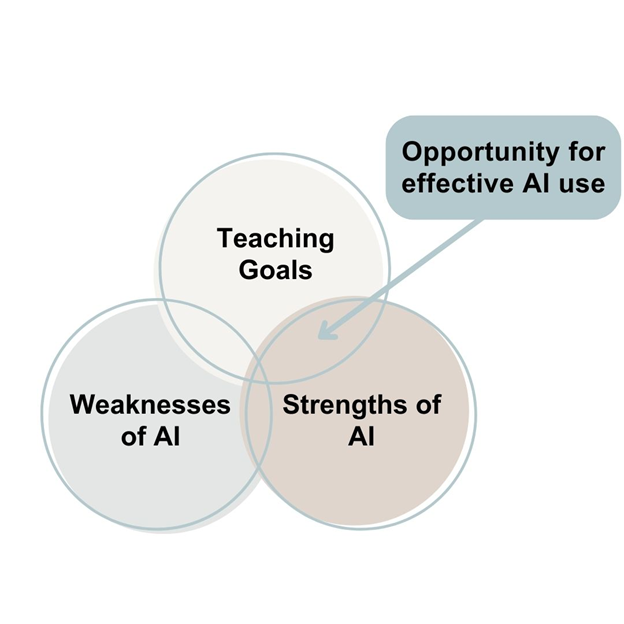
Venn diagram of teaching goals, AI weaknesses and AI strengths. Effective AI use can occur when AI strengths and teaching goals overlap.

Aligning teaching goals, effective pedagogy and generative AI use

When incorporating generative AI into your teaching, it can be helpful to connect the technology to effective pedagogical strategies. By starting with a specific strategy or goal in mind, this can help bring purpose and direction to your use of generative AI.

To get started, you might consider asking yourself one or more of the following questions:

How can I use generative AI to…


Navigating the strengths and weaknesses of generative AI

To determine when generative AI may help you achieve a particular instructional goal, you may want to consider its strengths and weaknesses:
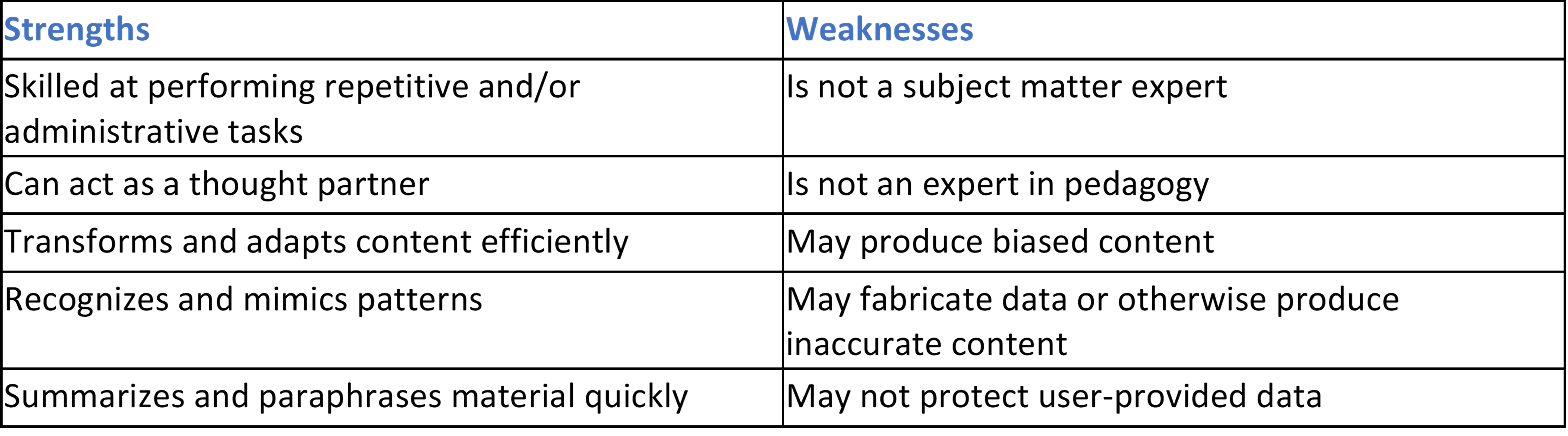
Strengths:   Skilled at performing repetitive and/or administrative tasks  Can act as a thought partner  Transforms and adapts content efficiently  Recognizes and mimics patterns  Summarizes and paraphrases material quickly  Weaknesses:   Is not a subject matter expert  Is not an expert in pedagogy  May produce biased content  May fabricate data or or otherwise produce inaccurate content  May not protect user-provided data

In some cases, your teaching needs may not align with the strengths of generative AI. For example, while you may need additional help with providing qualitative feedback on student writing, generative AI may not have the subject matter expertise to provide accurate feedback. Moreover, many generative AI programs have unknown privacy and data usage policies; as such, entering student data into certain generative AI programs may violate student privacy protections such as FERPA. For more guidance on navigating the strengths and weaknesses of generative AI, see our Tips on Using Generative AI page.


Four strategies for using generative AI in course design and development

Once you have a clear goal in mind and have considered the strengths and weaknesses of using generative AI to achieve this goal, you’ll want to consider how you will you use generative AI to get meaningful output. In this section, we share examples of four input prompt patterns that may help meet your teaching goals and needs. Prompt patterns are essentially strategies that help you to tailor the type and style of input you receive from a generative AI program. You can use them like a template or a formula, using pre-scripted phrases and adding in specific details when required. This section provides the format of a suggested pattern along with example prompts that demonstrate how you might use the pattern in your teaching. For more information on prompt patterns, visit our Prompt Patterns page and Vanderbilt University Professor of Computer Science Jules Whites’ free, self-paced Prompt Engineering course.

When using these four strategies, it is worth remembering that using these patterns may be just a part of your interaction with generative AI. For example, you may want to provide feedback on the outputs, refine your prompt, or request additional information. Remember that many generative AI programs allow you to incorporate and introduce new information to the program. For more tailored responses, you may want to provide information related to your course, such as excerpts from your syllabus, an assignment prompt, or a list of course objectives. For more information on how to introduce new information to a LLM, see this video:

Introducing New Information to the Large Language Model
  • Ensuring clarity with the persona pattern

    When using generative AI, you can ask it to respond from a particular point of view. This strategy can help you elicit more relevant feedback and information and may also help you to see a point of view you might not immediately consider. This strategy is most useful when it would be helpful to roleplay a situation or consider how a specific audience might react to a situation or resource.

    To elicit this type of feedback, you can prompt generative AI using the “persona pattern.” To use this pattern, your prompt should make the following fundamental contextual statements:

    • Act as Persona X
    • Perform task Y

    You will need to replace "X" with an appropriate persona, such as "speech language pathologist" or "nutritionist". You will then need to specify a task for the persona to perform.¹

    For example, you might use the following prompts to aid in course design:

    • Act as a first-year university student enrolled in my introductory-level Chemistry course. I will provide you with information from my course, and you will tell me what pieces of information are unclear.
    • Act as an expert in Bloom’s Taxonomy. I will provide you with a course objective, and you will give me three suggestions for how I can revise it to align with Bloom’s Taxonomy.

    When determining how (or if) you will use this prompt pattern, you may want to consider the following questions:

    • What kind of perspective would be useful in developing a certain aspect of my course?
    • What kind of information will I need to provide to ensure that the output is as relevant as possible?
    • What might be missing from the response? How will I evaluate the effectiveness of the response?
  • Increasing course cohesion with the recipe pattern

    When designing course materials, there may be times when you want to use generative AI to help you divide a large task or goal into several smaller tasks. The Recipe Pattern is a useful prompt that can help break a task down into smaller steps. This can be useful when:

    • You have a course objective that you want to break down into smaller weekly objectives.
    • You want to chunk an assignment into smaller tasks.
    • You want to make sure your course objectives, activities, and assessments align.
    • You want to take a topic and generate ideas for a lesson plan.

    To use this pattern, your prompt should make the following fundamental contextual statements:

    • I would like to achieve X
    • I know that I need to perform steps A, B, C
    • Provide a complete sequence of steps for me
    • Fill in any missing steps
    • (Optional) Identify any unnecessary steps¹

    For example, you might use the following prompts to aid in course design:

    • I would like my students to be able to write a Policy Brief. I know that I need to teach them to write a “Scope of the Problem” section and “Policy Alternatives” section. Provide a complete sequence of steps for me. Fill in any missing steps.
    • I would like my students to use commas appropriately. I know that I need to teach them the basic rules of comma use, and I know that I need to have activities for them to complete. Provide a complete sequence of steps for me. Fill in any missing steps.

    When determining how (or if) you will use this prompt pattern, you may want to consider the following questions:

    • What kinds of tasks do I currently find overwhelming? When will breaking a task into smaller chunks help me the most?
    • What kind of information will I need to provide to ensure that the output is as relevant as possible?
    • What steps might be missing from this response? How will I evaluate the effectiveness of the response?
  • Adjusting course materials with the template pattern

    When designing course materials, there may be times when you want to use generative AI to help you adjust course materials to fit a particular structure. The Template Pattern is a useful prompt that can be used to format outputs to fit a template. This can be useful when:

    • You have information written that you want to reformat into a new structure.
    • You have minor adjustments that you want to make to existing course materials.
    • You want to create new course materials that follow a formulaic structure.

    To use this pattern, your prompt should make the following fundamental contextual statements:

    • I am going to provide a template for your output
    • X is my placeholder for content
    • Try to fit the output into one or more of the placeholders that I list
    • Please preserve the formatting and overall template that I provide
    • This is the template: PATTERN with PLACEHOLDERS

    You will need to replace "X" with an appropriate placeholder, such as "CAPITALIZED WORDS" or "". You will then need to specify a pattern to fill in, such as "Dear " or "NAME, TITLE, COMPANY".

    Examples:

    • Create a list of due dates for the major assignments in my course that meets on Mondays, Wednesdays, and Fridays. Use the due dates I provided from Fall 2022 and adapt them to the academic calendar for Fall 2023 that I provided. Assignments cannot be due on a holiday. I am going to provide a template for your output. CAPITALIZED WORDS are my placeholders for content. Try to fit the output into one or more of the placeholders that I list. Please preserve the formatting and overall template that I provide. This is the template: DAY OF THE WEEK, DATE, ASSIGNMENT DUE.
    • Please create a rubric based on the assignment prompt I just shared. I am going to provide a template for your output. CAPITALIZED WORDS are my placeholders for content. Try to fit the output into one or more of the placeholders that I list. Please preserve the formatting and overall template that I provide. This is the template: Criteria: DESCRIPTION OF CRITERIA. Meets Expectations: DESCRIPTION OF WORK THAT MEETS EXPECTATIONS. Meets some expectations: DESCRIPTION OF WORK THAT MEETS SOME EXPECTATIONS. Does not meet expectations: DESCRIPTION OF WORK THAT DOES NOT MEET EXPECTATIONS.
    • Please create a study guide for my students based on the course topics and student learning outcomes I have provided you with. I am going to provide a template for your output. are my placeholders for content. Try to fit the output into one or more of the placeholders that I list. Please preserve the formatting and overall template that I provide. Topic <name of topic>: <related Student Learning Outcome(s)>, <decision of this topic>, <guiding self-assessment question(s) related to this topic>¹

    To get the most out of this pattern, you will likely want to provide excerpts of course materials and other relevant information before providing the template prompt. It is also worth noting that the generative AI program may only provide a few examples that follow your template, and you may need to prompt it one or more times to continue the task until it has generated all of the information you need.

    When determining how (or if) you will use this prompt pattern, you may want to consider the following questions:

    • What kinds of tasks do I currently spend a lot of time formatting?
    • What kind of information will I need to provide prior to using the template pattern to ensure that the output is relevant to my course and my standards?
    • What kind of information from this template will I need to revise or add additional information to that draws from my subject matter expertise? In what circumstances might this template provide less reliable information?
  • Increasing active learning and student engagement with the gameplay pattern

    When designing course materials, there may be times when you want to use generative AI to create more opportunities for active learning. The Gameplay Pattern is a useful prompt that can be used to create interactive games. This can be useful when:

    • You want to review key content topics.
    • You want students to practice recalling information.
    • You want to target the “remember” and “understand” learning processes.
    • You have a particular game or game-based software in mind, but you don’t want to generate content from scratch.

    To use this pattern, your prompt should make the following fundamental contextual statements:

    • Create a game for me around X OR we are going to play an X game
    • One or more fundamental rules of the game

    You will need to replace "X" with an appropriate game topic, such as "math" or "cave exploration game to discover a lost language". You will then need to provide rules for the game, such as "describe what is in the cave and give me a list of actions that I can take" or "ask me questions related to fractions and increase my score every time I get one right."1

    Examples:

    • Create a game for me to practice using the Spanish verbs “ser” and “estar” to describe people. Provide a fill-in-the-blank sentence in Spanish and a list of four answers, where only one answer is correct.
      • Note: With this example, you could then input the generated outputs into a game-based platform such as Kahoot to maximize student participation and engagement
    • Create a Jeopardy-style game for my students to review the key terms that I provided from the first unit of my Chemistry course. Each category should focus on a different topic, and the questions should get increasingly difficult in each category. Provide me with the first list of categories, point values, clues and answers.
      • Note: With this example, you could then input the generated outputs into a Jeopardy board. To create your board, you could use an online Jeopardy board generator, a Jeopardy board PowerPoint template, or even prompt the generative AI for step-by-step directions on creating a Jeopardy board in PowerPoint.

    These are just a few examples of the types of games that are possible. If you’re struggling to come up with ideas, you might consider using generative AI to brainstorm. For example, you might use the following prompt to generate ideas: “give me ideas of active learning games I can use to review _______ with my students.”

    When determining how (or if) you will use this prompt pattern, you may want to consider the following questions:

    • What types of learning am I trying to develop in my students? To what extent is the game I am asking for a good fit for this type of learning?
    • What kinds of technology tools can help me implement these games for my students?
    • What kind of information will I need to provide to ensure that the output is as relevant as possible?
    • What types of information may be missing from the activities these games generate? How will I evaluate and supplement the generated outputs?

Example 1: Creating Tailored Assignments and Readings

Suppose you are teaching a course where you require your students to respond to several relevant hypothetical situations for an upcoming lesson. You have thirty-five students and are hoping to use generative AI to create unique scenarios for each student. You might use these questions to generate the following answers:

  • What is my purpose and goal in using generative AI?

    I want to create a different and unique written situation for each student I have in class, but I don’t have the time to think of and manually type out 35 different options.

  • Who is my audience?

    Students in my course. I want students to each have a unique experience so they can formulate their own approach to each situation and then share their decisions with the class later. In order to avoid repetition and to provide many unique experiences, I want different scenarios for each student.

  • What kind of information will I be sharing with generative AI?

    I will be sharing basic public information about the course I’m teaching along with the subject matter that this assignment is about.

  • What specific information or product do I want to get from generative AI?

    I want to end up with different examples of hypothetical situations that match the topic I am teaching. I want each example to be detailed enough to get students started, but open-ended enough for them to draw their own conclusions and plan their own approach to addressing this situation.

  • How will I prompt AI in a way that generates the output I want?

    I know I want hypothetical scenarios that match the topic that we are discussing in class, and I do have certain requirements that should and should not be included. I will draft a prompt that asks for plausible scenarios of my topic and the content I do and do not want included. I also know that generative AI tools can only provide so much text output at one time, so I will start with my basic prompt, then ask it to produce multiple examples again and again until I have my total of 35 scenarios.

    Review Prompt Patterns

  • How will I revise and review the output that AI generates?

    After I try my first prompt, I will evaluate the output to see if it matches what I want. If it does, then I will prompt the generative AI to create more examples by saying “Please generate 5 more.” If it does not match what I want, I will ask it to adjust its output to include or remove information as needed.

By following these steps, you decide that you can use generative AI to create these scenarios. You formulate a prompt to list the information you want the tool to include in the scenarios as well as what information you do not want. You are aware of limitations on the amount of text generative AI tools can produce at one time, so you have a plan on how to create many scenarios through multiple prompts.

Example 2: Using generative AI to create visuals for a presentation

Suppose you are preparing a conference presentation, and you want to include visuals that accompany some of your slides. You wonder if generative AI is a good option for this task. You might use these questions to generate the following answers:

  • What is my purpose and goal in using generative AI?

    I want to include relevant images in my presentation. I often struggle to find images that are relevant to my research, so I often lack visuals or have to take photos or create custom graphics myself.

  • Who is my audience?

    I am presenting to colleagues in my field. In my experience, my colleagues are fairly open to the use of generative AI, although there are some folks in my field who have concerns about its use. I know that my colleagues expect me to cite my use of generative AI, and I will also include a verbal disclosure and explanation for my colleagues who are more skeptical about the use of these tools. I typically use MLA style, so I will follow their citation practices for generative AI.

  • What kind of information will I be sharing with generative AI?

    I am presenting research that I haven’t published yet, so I don’t want to share my argument with generative AI. Instead of sharing excerpts from my conference presentation to create a visual, I will write a prompt that explains the type of image that I want.

  • What specific information or product do I want to get from generative AI?

    I’m hoping to get some unique, clip-art style images. I know that some of the visuals I need for my presentation will be fairly easy to find free images or images in the public domain with a quick Google search, so I will primarily use generative AI to create unique images that I cannot easily find online or in place of images that may require licensing to use.

  • How will I prompt AI in a way that generates the output I want?

    I know that I specifically want clip-art style images, so I will be sure to include that information in my prompt. I want to include images of professionals from different academic disciplines. I will be specific in my prompting, since I know that generative AI programs may overrepresent certain demographics.

    Review Prompt Patterns

  • How will I revise and review the output that AI generates?

    Since I am asking for images of professionals, I know there is a chance for biased outputs, especially in relation to representations of gender, race, and ethnicity. When reviewing the outputs, I plan to pay close attention to these possible biases.

By following these steps, you decide to use generative AI to produce images that you cannot easily find online. You also decide not to disclose the main takeaways of your research in your prompts, to use detailed, specific prompts, and to be wary of potential biased outputs related to representations of gender, race, and ethnicity. You also have a plan in place for disclosing your generative AI use during your presentation.

Example 3: Navigating the ethics of incorporating generative AI in grading

Suppose you are teaching a course where you require your students to write a ten-page essay. You have thirty-five students and are wondering if generative AI could help you grade more efficiently. You might use these questions to generate the following answers:

  • What is my purpose and goal in using generative AI?

    I want to spend less time on grading while still giving my students meaningful, action-oriented feedback. I tend to spend a lot of time revising my feedback because I am afraid it is too direct and may make students feel intimidated.

  • Who is my audience?

    My students don’t seem to have strong feelings about the use of generative AI, but I would like to model practical and responsible uses of these tools. As such, when I give students their feedback, I want to disclose how and why I used generative AI.

  • What kind of information will I be sharing with generative AI?

    My student’s essays are protected by FERPA, and I don’t have access to a generative AI program that guarantees that this privacy is respected. My prompts, however, aren’t FERPA protected. In addition to privacy concerns, I’m also hesitant to share student writing with generative AI because it is ill-suited for evaluating the factual information in student essays.

  • What specific information or product do I want to get from generative AI?

    I would like AI to help me generate a rubric based on my essay assignment. I also know I can be blunt, so I want generative AI to help me take an evaluative statement like “your tone is too informal” and make it more growth oriented.

  • How will I prompt AI in a way that generates the output I want?

    I’m not sure how generative AI will do if I prompt it to write a rubric based on my prompt. I’ll try that first, but if I don’t get helpful output, I may make my prompt more specific by adding information about the categories I want the rubric to include and the type and number of descriptions I want for each rubric item. I don’t think that there are major opportunities for biases when creating the rubric, although if I ask it to help me generate and revise my comments, there are chances that some of the adjectives it uses may have negative connotations for certain students.

    Review Prompt Patterns

  • How will I revise and review the output that AI generates?

    I know I want to review each rubric item to make sure it correlates with the assignment and that the generative AI hasn’t added additional criteria that may not be in my assignment. I also know I have some concerns about negative connotations my students could have in the language of certain adjectives or phrases that the generative AI may suggest, so I want to be sure to keep an eye out for that as I revise.

By following these steps, you realize that you can’t ask the software to grade your students for you, but you can help maximize your time by using generative AI to create a rubric for your essays. You also decide that you will use generative AI to help you brainstorm more growth-oriented language for student comments. As you work with generative AI, you know that you want to pay attention to potential factual errors or fabrications that may emerge.


  1. The descriptions of prompt patterns in the 'Four Strategies for Using AI in Course Design and Development' are taken from readings provided in Vanderbilt University Professor of Computer Science Jules White’s Prompt Engineering course on Coursera and are reproduced here with his permission.

    Additionally, we consulted the following works in the development of this webpage. For additional perspectives on these topics, we encourage you to review the sources linked above.