Congratulations to Greg Berumen Sánchez! Greg’s article “Proteomics in Practice: A Case Study Highlighting Tandem Mass Tag-Based MS for Quantitative Profiling of Extracellular Vesicles and Application to Irradiated Fibroblasts” has been selected as a VINSE spotlight publication.
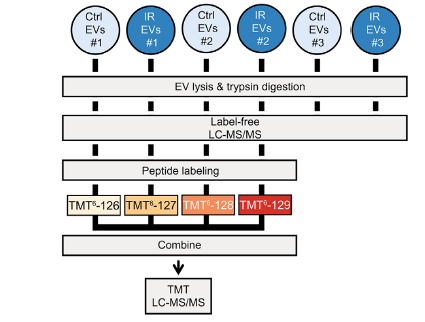
In this Proteomics case study, the team presents a practical tandem mass tag (TMT) mass spectrometry workflow for comprehensive, quantitative profiling of extracellular vesicles (EVs), nanoscale mediators of intercellular communication that are also promising biomarker sources but are challenging to characterize due to low yield, heterogeneity, and technical variability. A key contribution of the work is a direct comparison of TMT-based quantification with label-free quantification, highlighting how methodological choices can influence EV proteomics outcomes and offering actionable guidance for designing EV studies that allow for reliable and appropriate biological interpretation. Applying the TMT workflow to EVs released by human fibroblasts following ionizing radiation, the authors identify an EV proteomic signature that reflects irradiated cellular origins and suggests potential functional roles for fibroblast-derived EVs in radiation-associated remodeling. This impactful work was partly made possible by a VINSE Pilot Award for advanced characterization of EVs.
Overall, this study demonstrates how multiplexed TMT-based MS can help overcome common barriers in EV research, enabling more robust discovery in EV biology and supporting translational efforts in biomarker development.
Authors: Greg Berumen Sánchez, Purvi Patel, Kristie Lindsey Rose, Marjan Rafat
Abstract: Extracellular vesicles (EVs) are critical mediators of intercellular communication, and valuable sources of biomarkers for diagnostic and therapeutic applications. However, the complexity and heterogeneity of EVs present significant challenges for their proteomic characterization. Major challenges of EV samples include low yield, technical variability, and the need for sensitive and high throughput quantification approaches. In this study, we implement a tandem mass tag (TMT)–based MS workflow for comprehensive, quantitative proteomic profiling of isolated EVs. Through comparison with label-free quantitation (LFQ), we highlight the potential pitfalls and limitations of methodological choices in EV proteomic analyses. Our study integrates standard EV isolation with robust TMT labeling and high-resolution MS, providing insights into practical EV analysis. Utilizing this approach, we profiled EVs isolated from human fibroblasts treated with ionizing radiation. The TMT workflow uncovered an EV proteomic signature reflective of the cellular origins and potential functional roles of irradiated fibroblasts, compared to the LFQ workflow. Our case study underscores the potential of TMT-based MS to overcome common barriers in EV proteomics, facilitating new discoveries in EV biology and advancing their application in biomarker development and translational research.
Proteomics, 16159861, 2025.
——> Read full article