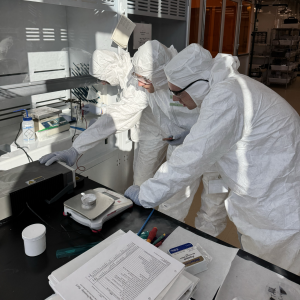
 The Nanoscale Innovation and Making course challenged Vanderbilt students to solve large problems using nanoscience. Students from majors such as computer science, engineering, and economics participated, resulting in a diverse array of product prototype ideas. Students in this hands-on course applied nanotechnology, entrepreneurship, and business strategy in both the classroom and the VINSE cleanroom and analytical labs. The course focused on identifying pain points that nanotechnology products could address, developing prototype plans, and testing and refining their concepts. It concluded with students presenting their products to investors and entrepreneurs.
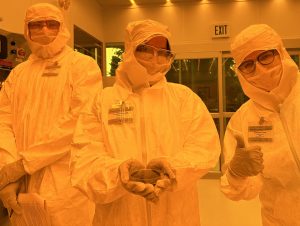 Nanoscale Innovation and Making has no specific content prerequisites. This year, student-created prototypes included a peel-and-stick coating that changes a window’s tint with the push of a button, flexible solar cells, and a nanoparticle solution for capturing PFAS (fluorinated hydrocarbons) like those in non-stick cookware. Students reported that they gained a “better understanding of how engineering and entrepreneurship overlap and how to be successful in both,” during their 16 hours in the VINSE facilities. Their favorite part was “learning about different tools and possible applications of these in the industry,” and that overall the course was “one of my favorite courses I’ve ever taken”.
This year’s course was led by Vanderbilt I-CORPS faculty Dr. Charleson Bell, Dr. Mark Hilton, and Ms. Deanna Meador; Dr. Kevin Galloway and Dr. David Owen, the Wond’ry; Dr. Chris Harris, CTTC; Dr. Philippe Fauchet, School of Engineering; Ms. Nadia Merritt, Science and Engineering Library; and Dr. Christina McGahan, VINSE.
This course was made possible through the support of the Clark Scholars Program, funded by the A. James & Alice B. Clark Foundation. The Clark Scholars Program at the School of Engineering enables talented undergraduate students to become engineering pioneers who reflect the character, passion, and vision of the program’s namesake.