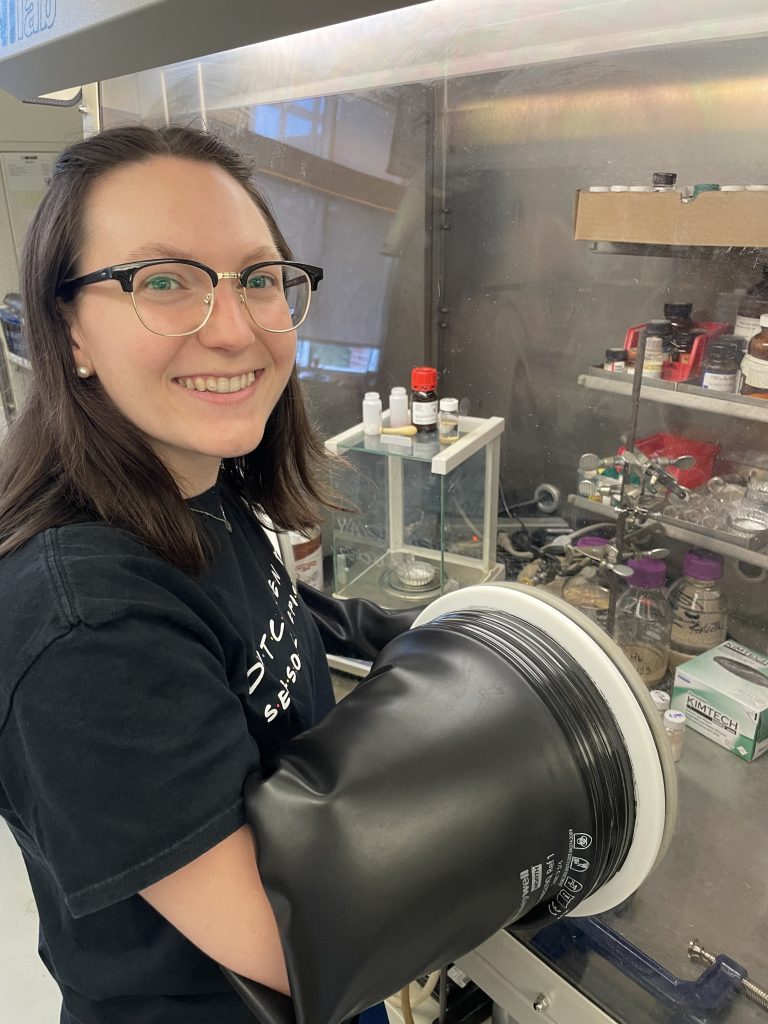
 Emily Rouse
Graduate Student, Chemistry
Tim Hanusa Research Group
One of the primary synthetic techniques used in the Hanusa group is solventless synthesis, specifically, mechanochemistry. Mechanochemistry involves driving chemical reactions through the application of mechanical force. This approach offers a sustainable alternative to conventional synthesis by minimizing or completely eliminating the need for solvents. Additionally, these reactions often proceed at room temperature and require significantly shorter reaction times than their solution counterparts. In our group, the most exciting outcomes occur when the desired product is obtained exclusively under solvent-free conditions, or when the products differ significantly from those produced via solvothermal methods. These differences can provide unique insights into reaction mechanisms and open new synthetic possibilities.
We have two different mills for carrying out these reactions in the Hanusa lab. The first is a mixer mill, which utilizes small cylindrical metal jars containing ball bearings. These bearings are rapidly shaken back and forth, generating impact and frictional force that facilitate the reaction. The second is a planetary ball mill, which allows for larger gram-scale reactions. These jars are spun in a manner that generates a centrifugal force of the balls against reactants, causing the reaction to proceed. Some other ways to perform mechanochemical reactions can be with twin screw extruders, resonant acoustic mixing (RAM), or something as simple as a mortar and pestle.
Alongside our work in mechanochemistry, our group also focuses heavily on allyl ligand chemistry. The allyl ligand ([C3H5]–) is a compact, highly flexible group that coordinates with metals in various con-formations. When used in its simple, unsubstituted forms, metal allyl compounds are often extremely un-stable and easily decomposed. Fortunately, the effective size of the allyl ligand can be increased with the use of bulky substituents, such as trimethylsilyl (–SiMe3, TMS) and triphenylsily (–SiPh3, TPS) groups, and metal complexes containing such substituted ligands can display remarkably improved handling properties.
Part of the project I have worked on is developing a family of sterically encumbered allyl ligands that can be readily deprotonated and metalated to form isolable allyl salts. The most notable of these being the lithium salt of an allyl with triphenylsilyl groups. By combining these bulky allyl salts with various metal halides under solvent-free conditions, I have synthesized a series of novel organometallic complexes characterized through 1H and 13C NMR spectroscopy. Synthesis and characterization have been the largest obstacles thus far but there are possibilities for further investigation. These ligands can enforce lower coordination numbers on the metals to which they are bonded, thereby enhancing their stoichiometric and catalytic activities.
My VINSE story
I became familiar with VINSE during my first year at Vanderbilt while rotating in the Macdonald and Cliffel labs. At the time, I was aware of the incredible facilities available, but I never expected that I would have the opportunity to use them since I had little experience with the instruments or cleanroom techniques. Through these lab rotations, however, I was introduced to advanced microscopy techniques, including scanning electron microscopy (SEM) and transmission electron microscopy (TEM). These were exciting tools to learn and operate – so exciting that I still have the first TEM images I captured of CuS nanoparticles saved on my phone.
Service and outreach have always been important to me, so when I heard about the opportunity to become a VINSE NanoGuide, I didn’t hesitate to sign up. For the past two years, I’ve been volunteering to lead the blackberry solar cell lab, where high school students create dye-sensitized solar cells using berry juice. Although my current research does not frequently require the use of VINSE facilities, serving as a NanoGuide has enabled me to stay connected to the center in a meaningful and fulfilling way.
Through this role, I’ve gained not only a deeper understanding of nanoscience and instrumentation, but also valuable experience in science communication. As a graduate student, I regularly discuss my research with other chemists and professors, but communicating science to younger, less experienced students presents a different and equally important challenge. It’s a skill to convey technical concepts into clear, engaging explanations, and one that I’ve worked to develop through this outreach. There’s nothing more rewarding than seeing the moment of understanding light up a student’s face when a concept clicks. The moments when what they learned during the pre-lab discussion suddenly make sense during the hands-on portion of the experiment, something that also sparked my interest in science when I was in grade school.
I’m excited to continue this work in a new capacity as the VINSE outreach TA for the blackberry solar cell labs this coming year. I see this as an opportunity not only to mentor new NanoGuides and help shape their experience, but also to expand the program’s reach. I hope to continue to build strong connections with local schools and educators while positively impacting young students. Ultimately, I see science outreach as an essential part of being a researcher – one that ensures the next generation of scientists feels welcomed, inspired, and empowered to explore the world of STEM.