 Şahpar Nil Özer
Undergraduate Student, Mechanical Engineering & Economics
Cornelius Vanderbilt Scholar
As an undergraduate at Vanderbilt University, I’ve built my academic path around the intersection of mechanical engineering, economics, and nanoscience, a combination that reflects my curiosity about both how the world works and how innovations move from the lab to real-world impact. Coming to Vanderbilt as a Cornelius Vanderbilt Scholar from Turkey, I sought opportunities to immerse myself in research early on, talking to multiple labs and joining student clubs across disciplines from biomedical to aerospace engineering before finding a home in nanoscale science.
My research journey began with projects as varied as ionized gas kinematics in galaxies at UC Santa Cruz and aerospace optimization at Istanbul Technical University, but I was drawn to the hands-on creativity of microfabrication and the problem-solving mindset required in nanotechnology. At Vanderbilt, I joined the Bellan Lab for Advanced Materials, where I worked as a research assistant for a project on developing a tissue engineering model to study the interface between neurons and vasculature. This project allowed me to explore how engineered tissues can replicate and reveal complex biological systems, blending my engineering background with my passion for innovation that can directly benefit human health.
Alongside my lab work, I took classes from Prof. Li from Vanderbilt’s Nanoscale Transport Phenomena Laboratory, which deepened my understanding of how nanoscale processes drive thermal and mass transport. Those classes opened my eyes to how fundamental nanoscale principles could inform not just tissue engineering, but a wider range of technologies including 2D materials and nanoscale electronics and they continue to shape the way I think about my future research.
 My connection with VINSE (Vanderbilt Institute of Nanoscale Science and Engineering) began with an interest in understanding nanoscale processes not just as a student researcher, but as someone eager to contribute to the community. Joining the VINSE Tech Crew has been a defining experience. Through this role, I’ve trained and become certified on cleanroom equipment, supported many researchers with setup and troubleshooting, and had the rewarding opportunity to volunteer at outreach events. Sharing the excitement of nanotechnology with people of all ages, I’ve witnessed firsthand how nanotech education amazes and inspires from young children discovering the tiniest scales of the world to adults appreciating the potential of nanoscale science.
This summer, I worked on a project under the mentorship of Dr. Christina McGahan to develop and fabricate reusable graphene devices, aiming to make advanced nanoscale tools more accessible to students and inspire researchers to integrate incredible materials like graphene into their work. Dr. McGahan’s guidance went far beyond the technical aspects of this project; her mentorship shaped my experience in the cleanroom, encouraged me to think creatively, and showed me how VINSE can be a place to learn and grow not just academically, but personally as well.
Graphene, a single layer of carbon atoms arranged in a hexagonal lattice, is renowned for its exceptional electrical, thermal, and mechanical properties and is being explored across numerous fields, including flexible electronics, sensors, energy storage, and biomedical devices. Throughout the project, I gained hands-on experience with the full fabrication workflow: growing monolayer graphene in the cleanroom furnace, characterizing it using Raman spectroscopy to verify quality, and fabricating electrodes with photolithography, metal deposition, and liftoff techniques. This comprehensive approach deepened my understanding of nanoscale fabrication challenges and solutions, while highlighting how such advanced materials can be translated into practical, reusable devices for education and research.
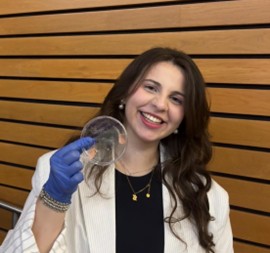 VINSE has given me the chance to be at the intersection of cutting-edge science and collaborative support, where every day in the cleanroom is both a challenge and an opportunity to learn. More importantly, VINSE helped me realize my potential by connecting all my previous experiences, often without me even realizing it, and providing the perfect environment to pursue my diverse interests without compromise. Rather than forcing me to choose between fields, VINSE has supported my passion for interdisciplinary science, offering the tools, resources, and community to explore mechanical engineering, nanoscience, and entrepreneurship simultaneously.
Looking forward, I hope to continue using my research experiences at VINSE and beyond, from graphene device fabrication to the ideas sparked in Prof. Li’s classes and McGahan’s mentorship, to build bridges between engineering innovation and entrepreneurial solutions, ultimately contributing to the creation of technologies that shape industries and improve lives.