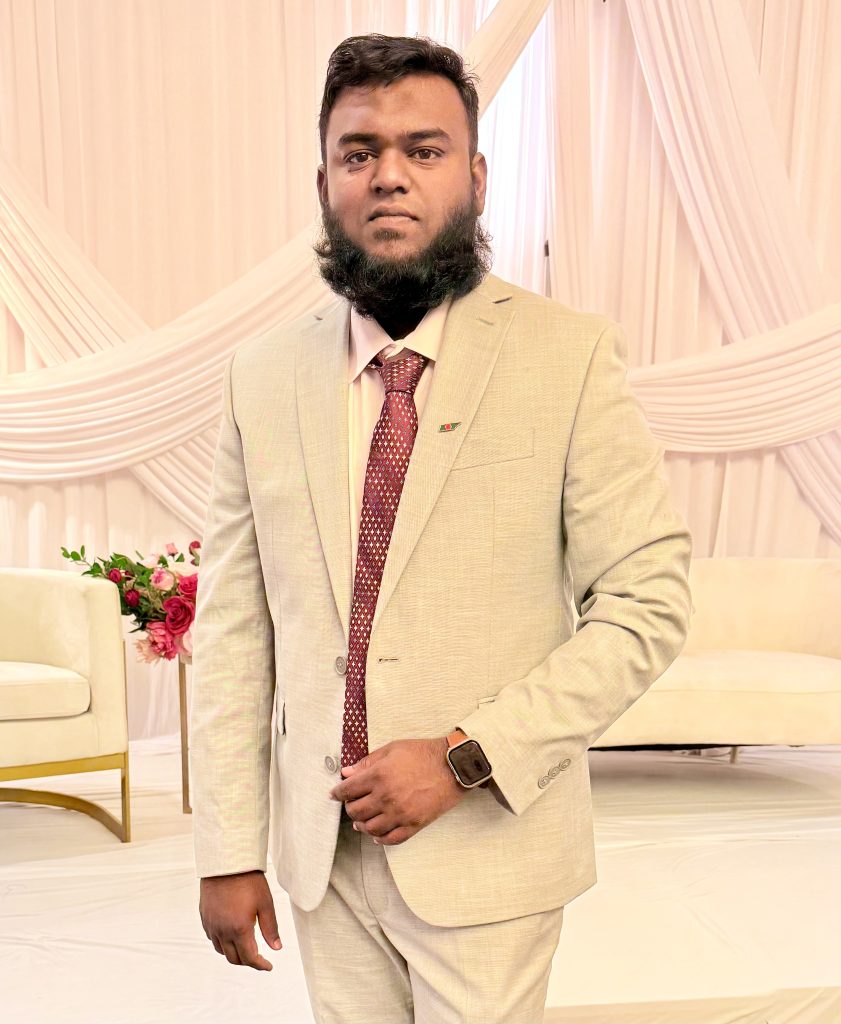
 Sk Md Ali Zaker Shawon
Graduate Student, Chemical & Biomolecular Engineering
Shihong Lin Research Group
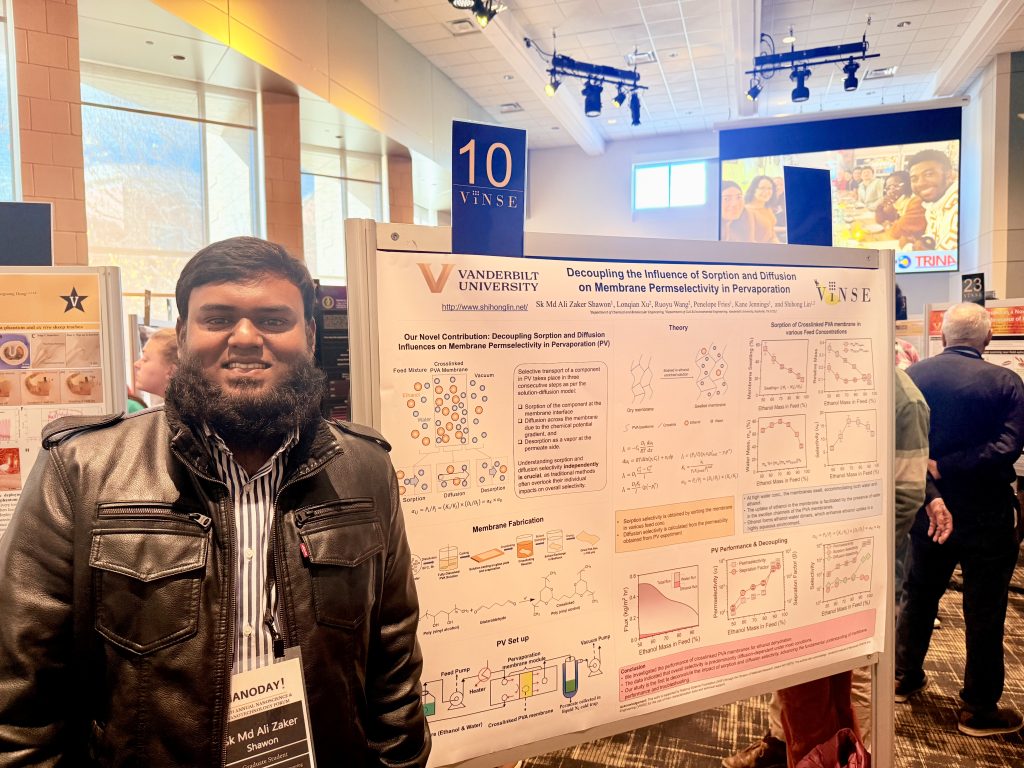
As a Ph.D. candidate in Chemical Engineering at Vanderbilt University, my research in the Lin Research Group advances membrane and electrochemical separation technologies to enable more sustainable chemical processes. I develop high-performance pervaporation membranes for organic solvent dehydration that achieve superior energy efficiency compared to traditional distillation methods, which currently consume substantial energy across chemical industries. My research combines systematic membrane fabrication with fundamental transport studies, extending solution-diffusion theory to predict flux and selectivity in organic solvent dehydration systems. Through experimental validation and theoretical modeling, this work enables the design of membranes tailored for specific industrial applications, offering significant cost savings and environmental benefits for solvent-intensive manufacturing processes.
 Expanding into electrochemical separations, I engineer modified Prussian blue analogue electrodes for capacitive deionization applications, focusing on selective recovery of critical resources from wastewater streams. My work targets ammonium ion recovery to address the dual challenge of preventing eutrophication and harmful algal blooms while transforming this pollutant into valuable fertilizer precursors, thereby closing the nutrient loop and reducing reliance on energy-intensive Haber-Bosch production. Additionally, I focus on lithium extraction from alternative water sources to support the rapidly growing battery industry, as lithium demand is projected to increase dramatically with the global transition to electric vehicles and renewable energy storage systems. This electrochemical approach offers a sustainable pathway to recover valuable resources that would otherwise contribute to environmental degradation, while simultaneously addressing critical material supply challenges for clean energy technologies.
Together, these research endeavors represent a comprehensive approach to reimagining separation processes as drivers of sustainability rather than merely energy-intensive necessities. By developing both membrane and electrochemical technologies, my work contributes to a paradigm shift where industrial processes become more efficient while simultaneously addressing resource scarcity and environmental protection. This dual focus on energy reduction and resource recovery aligns with global sustainability goals, offering practical solutions that can help industries transition toward circular economy principles while meeting the growing demands of clean energy infrastructure. The fundamental insights gained from this research extend beyond specific applications, contributing to the broader scientific understanding of separation phenomena and providing a foundation for next-generation technologies that harmonize industrial productivity with environmental stewardship.
VINSE Experience and Impact
My research has been significantly enhanced through my engagement with the Vanderbilt Institute of Nanoscale Science and Engineering (VINSE), where I have developed expertise in advanced nanomaterials synthesis and characterization techniques. In VINSE’s state-of-the-art cleanroom facilities, accessed during my 2D nanomaterials course, I mastered chemical vapor deposition (CVD) growth, mechanical exfoliation, and in-situ device fabrication of 2D materials, skills that have proven invaluable for creating high-performance separation membranes and electrodes. Leveraging VINSE’s comprehensive characterization suite, including thermogravimetric analysis, profilometry, atomic force microscopy, and scanning electron microscopy, I have been able to establish critical structure-property relationships by correlating membrane morphology and surface chemistry with separation performance metrics. These insights have been pivotal in validating material design hypotheses and optimizing both pervaporation membrane performance and capacitive deionization electrode functionality. The collaborative environment and access to cutting-edge instrumentation at VINSE have not only accelerated my research progress but also equipped me with the multidisciplinary expertise necessary to translate fundamental nanoscale insights into practical solutions for sustainable separation technologies.