DISSERTATION DEFENSE
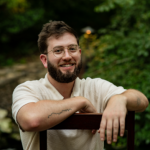
Kellen Arnold, Interdisciplinary Materials Science
*Under the supervision of Sharon Weiss
“Integrated Photonics for Intense Light-matter Interaction and Applications in Aerospace”
05.20.25 | 12:30PM | ESB 044 | Zoom: 965 0203 9030 Passcode: 069821
Over the last several decades, the technological revolution into a digital age has opened doors to endless possibilities that seemed previously unimaginable. Today, artificial intelligence, deep learning, and the internet of things have impacted almost everything we interact with including medicine, business, cybersecurity, and social media. In lockstep, the global demand for digital information increases exponentially each year, necessitating broadband, power efficient methods for computing and data transfer. Silicon photonics is poised to address these challenges, where a seamless pairing of optical components alongside electrical integrated circuits on semiconductor chips provides light-speed signaling, compactness, and low power consumption – all while maintaining compatibility with mature silicon CMOS manufacturing techniques.
This thesis presentation highlights my efforts to (1) develop advanced component-level design techniques for realizing high-performance integrated photonics and (2) advance novel photonics applications for state-of-the-art photonic integrated circuits, namely in the space environment. I investigate subwavelength, nanostructured features in optically engineered devices called photonic crystals, which are useful for modulators, sensors, photonic quantum computers, and nano-optical traps. By designing these structures for fabrication in a commercial foundry setting, we experimentally realize the smallest scalable photonic features to-date that promise highly sensitive, efficient devices designed in silicon. I also report on packaging and characterization techniques I have developed that are widely applicable to studying integrated photonics devices and systems in a repeatable, robust fashion while also enabling experiment portability outside of specialized laser labs and into a wide variety of test environments (e.g., thermal chambers, microscopes, radiation sources, in vacuum, etc.). Finally, I examine radiation reliability physics and performance susceptibilities for integrated photonics operating in harsh conditions, especially the radiation-rich environment in space.