Lyu, Zhongming; Wang, Yusheng; Ge, Ruijian; Wang, Darren; Bacchetta, Matthew D.; Demarest, Caitlin T.; Maldonado, Fabien; & Dong, Xiaoguang. (2026). Soft artificial ciliary brush with integrated haptic feedback for efficient airway mucus cleaning. Advanced Intelligent Systems. https://doi.org/10.1002/aisy.202501236
Mucus buildup is a serious problem in diseases such as cystic fibrosis and chronic obstructive pulmonary disease, where thick mucus can block airways and make breathing and drug delivery difficult. It can also clog medical devices placed in the airway, such as stents and breathing tubes. Current methods mainly rely on suction, which often does not work well on thick mucus and can damage delicate airway tissue. This study describes a new mucus cleaning catheter that combines gentle suction with a rotating brush made of soft, hair-like structures that mimic natural cilia. These soft cilia help gather and pull thick mucus into the suction openings, allowing it to be removed more effectively. The device also includes a sensing system that provides real-time feedback to help prevent tissue injury. Tests in airway models, animal lungs, airway stents, and breathing tubes showed that the catheter can remove mucus efficiently, even in thin layers, while causing minimal tissue damage. Compared with standard bronchoscopes that rely on suction alone, this approach cleared mucus faster and more safely, suggesting it could improve airway care for patients with excessive mucus buildup.
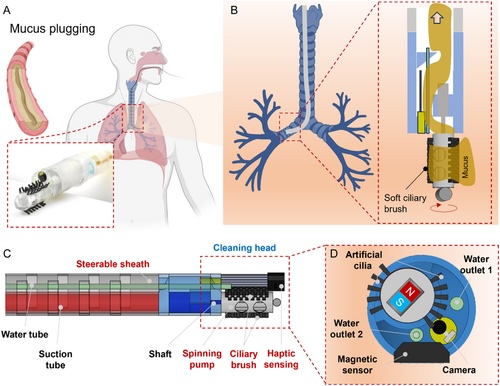
Figure 1
Concept and overall design of the mucus-cleaning catheter integrating soft artificial cilia and haptic feedback. A) Schematic illustration of the steerable catheter system designed for mucus removal in airway environments. Created by biorender.com. B) Illustration of the soft ciliary brush and spinning pump for cleaning mucus inside the airway. Created by biorender.com. C) 3D rendering of the fully assembled mucus-cleaning device integrating the proposed cleaning head. The outer diameter of the catheter is 8 mm as a proof-of-concept demonstration and can be scaled down to 6 mm. The catheter body with a length of 50 mm is made of thermoplastic polyurethane (TPU), while the sheath with notched features is fabricated from Elastic 50 A (Formlabs Inc.). D) Side view of the cleaning head with the integrated artificial cilia, the magnetic marker and sensor for sensing contact for providing haptic feedback.