Remedios, Lucas W.; Cho, Chloe; Schwartz, Trent M.; Su, Dingjie; Rudravaram, Gaurav; Gao, Chenyu; Krishnan, Aravind R.; Saunders, Adam M.; Kim, Michael E.; Bao, Shunxing; Powers, Alvin C.; Landman, Bennett Allan; & Virostko, John M. (2025). Data-driven abdominal phenotypes of type 2 diabetes in lean, overweight, and obese cohorts from computed tomography. Journal of Medical Imaging, 12(6), 64006. https://doi.org/10.1117/1.JMI.12.6.064006
Although high body mass index, or BMI, is a known risk factor for type 2 diabetes, the disease also occurs in some lean adults and is absent in some people with obesity, suggesting that detailed body composition may better explain risk than BMI alone. In this study, researchers used artificial intelligence and computed tomography, or CT, imaging to analyze abdominal body composition in 1,728 patients from Vanderbilt University Medical Center. Using an automated segmentation tool called TotalSegmentator, each CT scan was converted into 88 measurements describing the size, shape, and fat content of abdominal organs, skeletal muscle, and fat depots. A random forest machine learning model was trained to predict type 2 diabetes, and SHapley Additive exPlanations, known as SHAP, were used to identify which measurements increased or reduced diabetes risk. The analysis was performed in the full cohort and separately in lean, overweight, and obese groups. The model showed moderate accuracy, with an area under the curve between 0.72 and 0.74, and revealed similar diabetes related patterns across all weight groups. These patterns included fatty skeletal muscle, greater visceral and subcutaneous fat, older age, and a smaller or fat-infiltrated pancreas. Logistic regression confirmed that most of the top predictors were independently associated with diabetes. Further analysis clustered patients based on shared model decision patterns and uncovered distinct abdominal phenotypes enriched for type 2 diabetes within each BMI group. Overall, the findings suggest that the abdominal tissue characteristics driving type 2 diabetes are largely consistent across weight classes, with fatty skeletal muscle emerging as the strongest indicator of disease in both lean and obese individuals.
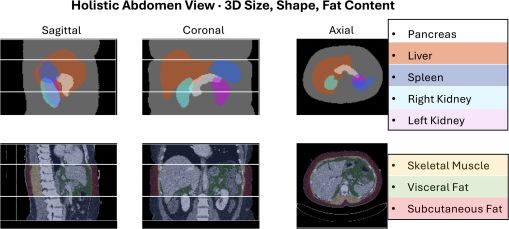
Fig. 1
AI-driven body composition analysis of large imaging datasets opens new avenues for data-driven discovery of abdominal phenotypes linked to metabolic risk, particularly by identifying which quantitative measurements, and which combinations of those measurements, most effectively distinguish individuals with type 2 diabetes from control patients. The anatomical labels shown reflect the maximum anatomical granularity provided by our selected segmentation model. Skeletal muscle and fat depots were cropped between the L2 and T10 vertebrae to enable consistent comparisons across diverse patients.