Castellano, Tonnar; Wang, Tingchen; Nolan, Emma; Wu, Yiyang; Zhang, Mengna; Clifton, Michelle; Janve, Vaibhav A.; Durant, Alaina; Regelson, Alexandra N.; Cody, Karly A.; Harrison, Theresa M.; Engelman, Corinne D.; Jagust, William J.; Albert, Marilyn S.S.; Johnson, Sterling C.; Resnick, Susan M.; Sperling, Reisa Anne; Bilgel, Murat S.; Saykin, Andrew J.; Vardarajan, Badri Narayan; Mayeux, Richard P.; Betthauser, Tobey James; Bennett, David Alan; Schneider, Julie A.; de Jager, Philip Lawrence; Menon, Vilas; Tosun, Duygu; Mormino, Elizabeth C.; Archer, Derek B.; Dumitrescu, Logan C.; Hohman, Timothy J.; & Koran, Mary Ellen Irene. (2025). APOE, ABCA7, and RASGEF1C are associated with earlier onset of amyloid deposition from more than 4000 harmonized positron emission tomography images. Alzheimer’s and Dementia, 21(12), e71006. https://doi.org/10.1002/alz.71006
New methods can estimate the age at which amyloid buildup first begins in the brain, known as estimated amyloid onset age or EAOA, using amyloid positron emission tomography, a brain imaging technique that detects amyloid plaques linked to Alzheimer’s disease. This study examined the genetic factors that influence EAOA to better understand the earliest biological changes in Alzheimer’s disease. Using harmonized amyloid PET data from 4,216 participants, researchers performed genome-wide survival analyses, tissue-specific gene expression studies, and genetic covariance analyses. They found that genetic variants in apolipoprotein E, or APOE, as well as ABCA7 and RASGEF1C, were linked to earlier amyloid onset. Individuals with the APOE ε4 ε4 and ε3 ε4 genotypes developed amyloid buildup about 6.3 and 5 years earlier than those with the ε3 ε3 genotype, while the ε2 variant appeared protective against early onset. A specific genetic variant called rs4147929, which affects how much ABCA7 is expressed in the brain, was associated with amyloid onset occurring about 4 years earlier and with lower ABCA7 expression, which in turn was linked to greater amyloid pathology seen at autopsy. The study also found shared genetic risk between earlier amyloid onset and several immune-related diseases. Together, these findings highlight APOE, ABCA7, and RASGEF1C as important genetic contributors to early amyloid accumulation and suggest potential biological targets for intervention at the earliest stages of Alzheimer’s disease.
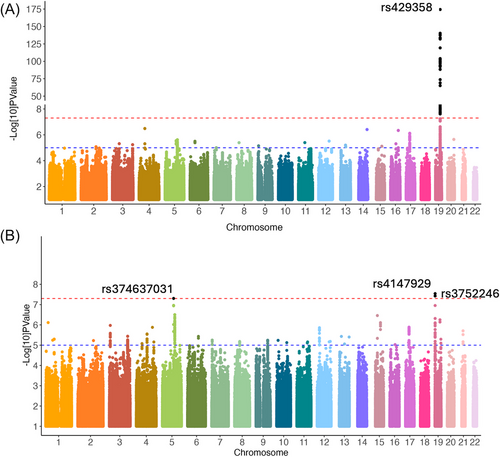
FIGURE 1
A, Genome-wide survival analysis without APOE covariate. The APOE loci was the only significant loci (top SNV: rs429538; HR = 3.17, p = 6.56 × 10−175). A priori significance (5 × 10⁻⁸) is indicated by the red line. B, Genome-wide survival analysis with APOE ε2 and ε4 status included as covariates. Three loci passed significance rs4147929 (HR = 1.31, p = 2.87 × 10⁻⁸, minor allele = A, major allele = G, BP = 1063444), rs3752246 (HR = 1.31, p = 3.76 × 10⁻⁸, minor allele = C, major allele = G, BP = 1056493), and rs374637031 (HR = 1.57, p = 4.95 × 10⁻⁸, minor allele = A, major allele = G, BP = 106714314). rs4147929 is intronic in ABCA7 on chromosome 19 while rs3752246 is a missense variant in ABCA7. rs374637031 was not found in any SNV databases. A priori significance (5 × 10⁻⁸) is indicated by the red line. APOE, apolipoprotein E; BP, base pair; HR, hazard ratio; SNV, single nucleotide variant.