December 2025

Friends,
As we close out 2025, I find myself listening to the fireworks of the season and hearing something deeper than celebration alone. I hear reflection. I hear momentum. And I hear possibility.This has unmistakably been a year of AI. Artificial intelligence is changing what it means to be a professor, an academic, a scholar, a citizen, a scientist, and even an artist. The boundaries between these roles are shifting, sometimes uncomfortably, often creatively, and almost always faster than we expect.
VALIANT sits at the heart of many of these conversations. I am deeply appreciative of the vibrant, welcoming, and intellectually generous community that has formed around this work. It is a community that creates opportunity not only for technical growth, but for growth as individuals and as an institution.
As I look at the early numbers, VALIANT already encompasses scholars from eight of Vanderbilt’s eleven colleges, along with partners across a growing Tennessee AI Valley. Across our state, we are seeing rapid advances in quantum and high performance computing, energy, and high tech sciences spanning academia, government, and the private sector. Taken together, these trends point to immense opportunities to expand our impact and deepen our value to society.
Many of you have heard me talk about ideas for translating our work beyond traditional academic pathways. This includes spinning out technologies into new companies, partnering with established organizations, and exploring new models of engagement both large and small. These are uncertain times. They are times of real change, and at moments, real unease. But in stormy seas, there are also chances to make meaningful differences.
Emerging opportunities are not meant to replace the traditional measures of academic success. This year alone, our community contributed to more than five hundred traditional scientific publications. Rather, the opportunity before us is to go beyond those accomplishments and ask deep questions about how we matter… how do we deliver value to society not only through papers, but through information, structure, training, and durable partnerships?
From my own disciplinary vantage point, the transformation has been striking. Problems I once believed would define my entire career are now being addressed within undergraduate classroom projects. We are fundamentally changing the scale at which reasoning is possible with medical imaging data. That scale is not only about the number of datasets or the breadth of problems we can approach, but also the depth and specificity with which we can reason about them.
I felt this shift vividly last month while walking the exhibit halls at the Radiological Society of North America meeting. I saw ideas that once would have lived only as doctoral theses now embodied as real products and real companies. The distance between research and impact is shrinking, and with that comes both responsibility and opportunity.
I do not know exactly what 2026 will hold. What I do know is that I am grateful to be on this journey with you. I am excited by the potential ahead, and motivated by the shared goal that has always guided this community: to improve the human condition and to take on the grand challenges that truly matter.
Thank you for the energy, creativity, and trust you bring to VALIANT. I look forward to what we will build together in the year ahead.
Bennett
Preventing What Once Seemed Unstoppable

At Vanderbilt, bold goals begin with empathy. For neurogeneticist and VALIANT AI Fellow Veronique Belzil, that goal is as ambitious as it is personal: to prevent amyotrophic lateral sclerosis (ALS).
“Curing ALS would be wonderful,” she says. “But my real dream is to stop it before it starts.”
That conviction drives Belzil’s work as Director of the Vanderbilt ALS Research Center, the first program of its kind in Tennessee. Built entirely around human-based, translational science, the center aims to close the gap between the clinic and the lab. “ALS is a human disease,” she says. “We want our research to stay as close to the human experience as possible.”
Her team’s approach is structured around four complementary branches: patient biorepositories, computational biology, stem cell and organoid modeling, and community partnership. Using patient-derived cells, they grow motor neurons and “mini-brains” to recreate the biology of disease in the lab. These models are paired with patient samples collected before and after death and with cutting-edge tools—AI, machine learning, and single-cell sequencing—to uncover molecular fingerprints that reveal who is most at risk.
“About 90 to 95 percent of ALS cases are sporadic,” Belzil explains. “There’s rarely a clear family history. We want to identify the biological footprint left behind by genetics, environment, and life exposure—so we can detect risk before symptoms appear.”
Belzil’s own journey to this mission began outside the lab. Originally trained in psychology, she redirected her career after her husband’s uncle passed away from ALS. “It became a life mission,” she recalls. “I went back to school, earned a Ph.D. in neuroscience, and never looked back.”
From Montreal to the Mayo Clinic to Nashville, her research has evolved alongside a rapidly advancing field. “The first ALS gene was discovered in 1993,” she notes. “For years, progress was slow. But since 2007, new sequencing and profiling technologies have changed everything. Now we can finally imagine prevention.”
Belzil also sees the future in collaboration—particularly across disciplines. “We need people from computer science, engineering, imaging, and psychology. What we’ve been doing for decades hasn’t been enough. It’s time to think differently.”
She adds, there’s no better place to do that than Vanderbilt. “People here are genuinely kind and eager to help,” she says. “We need that spirit to get out of our silos—and finally solve this.”
Those ready to explore can find opportunities at https://www.vumc.org/neurology/vanderbilt-als-research-center
VALIANT Ventures
- VALIANT AI Scholar Junlin Guo, an ECE PhD student, has been selected to receive the prestigious Tarkington Family Scholarship in recognition of his work in AI-driven archaeology under the mentorship of Professors Yuankai Huo and Steve Wernke.
- AI Scholar Elyssa McMaster received a Vanderbilt Kennedy Center travel award to attend the SPIE Medical Imaging Conference.
VALIANT Reach Exchange Leads to International Research Publication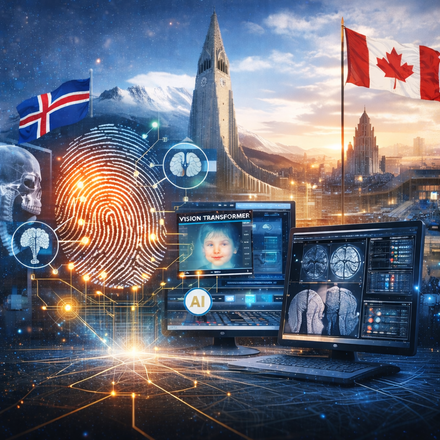
This work emerged from Lionts’ four-week research visit to the University of Iceland through VALIANT Reach, a reciprocal international exchange program designed to catalyze durable research collaborations by pairing Vanderbilt trainees with partner institutions abroad. In its inaugural year in 2025, VALIANT Reach supported exchanges with universities in Iceland and Canada, strengthening international partnerships and generating tangible collaborative research outcomes for trainees and faculty.
VALIANT Member Yuankai Huo Advances Transatlantic AI Collaboration with University of Liverpool
 VALIANT AI Fellow Dr. Yuankai Huo visited the University of Liverpool to deepen transatlantic collaboration in medical imaging AI. As part of this effort, Vanderbilt University and the University of Liverpool announced the inaugural recipients of their new Joint Research Seed Grant program.
One of the awarded projects, “Launching the Vanderbilt–Liverpool Eye-AI Working Group: A Transatlantic Collaboration in Multimodal Medical Imaging AI,” is led by Yuankai Huo, Assistant Professor of Computer Science at Vanderbilt, and Yalin Zheng, Professor of AI in Healthcare at Liverpool. The seed grant program supports innovative faculty collaborations designed to grow into sustained research partnerships and external funding.
The Vanderbilt–Liverpool Joint Research Seed Grant program originated from a meeting between university leaders in Manchester, England, where a shared discussion of Nashville’s and Liverpool’s musical heritage led to the recognition of overlapping academic strengths in music, health, national security, and AI. Each institution has committed matching funds to support the three-year program, developed jointly by Vanderbilt’s Office of the Provost, Office of the Vice Provost for Research and Innovation, and the Curb Center.
VALIANT Reach Returns
Resume Update
 AI Scholars, look for an e-mail asking if you would like to update your information. We are rolling out the 2026 resume book and piloting new ways to highlight your excellence for awards, fellowships, and more. Questions, suggestions? Drop us a line at valiant@vanderbilt.edu.
BrainHack Vanderbilt 2026: Build, Learn, Lead
Alchemists’ Corner
- Post-transcriptional modifications on tRNA fragments confer functional changes to high-density lipoproteins in atherosclerosis
- Knowledge distillation and dataset distillation of large language models: emerging trends, challenges, and future directions
- A Scoping Review on Conversational Memory and Characteristics of Conversations in Alzheimer’s Disease
- A practical prescription for magnetic resonance microscopy in a horizontal bore magnet
- Biomedical data repositories require governance for artificial intelligence/machine learning applications at every step
- Calibration of binary population synthesis models using white dwarf binaries from APOGEE, GALEX, and Gaia
- Evaluating cell AI foundation models in kidney pathology with human-in-the-loop enrichment
- TOI-7166 b: A habitable zone mini-Neptune planet around a nearby low-mass star
- Noninvasive assessment of liver inflammation in metabolic dysfunction associated steatohepatitis using MR cytometry
- Validation of normal reference ranges in cardiac magnetic resonance imaging: The Multi-Ethnic Study of Atherosclerosis
- Bridging the gap: addressing NACC’s evolving cognition batteries across UDS versions
- A decade of transit photometry for K2-19: Revised system architecture
- Widespread gray and white matter microstructural alterations in dual cognitive–motor deficit
- Student and instructor perceptions of data science integration into science and engineering courses
- Measuring the Environmental Impact of MRI and CT: A Life Cycle Assessment
- The Hidden Impact of Radiography and Fluoroscopy—An Environmental Life Cycle Assessment
- Harmonizing Diagnostic Ultrasound Practice with Environmental Sustainability: A Life Cycle Assessment of Diagnostic Ultrasound in a Single Adult University Hospital
- Confirmation of four hot Jupiters detected by TESS using follow-up spectroscopy from MaHPS at Wendelstein together with NEID and TRES
- Investigating the Relations between Students’ Affective States and the Coherence in their Activities in Open-Ended Learning Environments
valiant@vanderbilt.edu | https://vanderbilt.edu/valiant | @VandyValiant | LinkedIN