Singh, K., An, Y., Schilling, K. G., & Benjamini, D. (2025). Widespread gray and white matter microstructural alterations in dual cognitive–motor deficit. Alzheimer’s and Dementia: Diagnosis, Assessment and Disease Monitoring, 17(4), e70204. https://doi.org/10.1002/dad2.70204
As people age, having both thinking problems and movement problems at the same time—a pattern called a dual cognitive–motor deficit—is known to strongly increase the risk of developing dementia. However, it has not been clear how this combined deficit affects the brain’s structure, especially in vulnerable gray matter regions that are important for memory and movement. This study set out to better understand these brain changes.
The researchers studied 582 adults between the ages of 36 and 90 and grouped them into four categories: those with both cognitive and motor deficits, those with only cognitive deficits, those with only motor deficits, and a control group with neither. They examined brain tissue using advanced MRI techniques, including diffusion tensor imaging and mean apparent propagator imaging, which are well suited for detecting subtle microstructural changes in gray matter and white matter. In total, they analyzed 27 brain regions related to temporal (memory-related) and motor functions, as well as key white matter pathways.
The results showed that people with a dual cognitive–motor deficit had widespread microstructural changes in the brain. These alterations were not seen in individuals who had only cognitive deficits or only motor deficits once rigorous statistical corrections were applied. The observed changes are thought to reflect lower cellular density in temporal gray matter, reduced organization of nerve fibers, and possible loss of myelin in white matter tracts.
Together, these findings suggest that having combined cognitive and motor difficulties is linked to distinct and measurable changes in brain microstructure. Understanding these changes may help explain why this group is at particularly high risk for dementia and could support the development of earlier interventions aimed at slowing brain aging and delaying neurodegeneration.
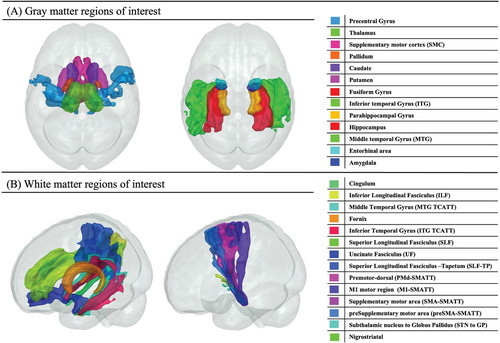
FIGURE 1
Investigated regions of interest. Three-dimensional rendering of (A) temporal meta-ROIs and motor-related GM regions, and (B) associated WM tracts. A total of 27 ROIs were investigated in the current study. GM, gray matter; ROIs, regions of interest; WM, white matter.