Barkaoui, K., Pozuelos, F. J., Rackham, B. V., Burgasser, A. J., Triaud, A. H. M. J., Serra-Ricart, M., Timmermans, M., Yalçinkaya, S., Soubkiou, A., Stassun, K. G., Collins, K. A., Amado, P. J., Baştürk, Ö., Burdanov, A. Yu., Davis, Y. T., de Wit, J., Demory, B.-O., Deveny, S. J., Dransfield, G., Ducrot, E., Gillon, M., Chew, Y. G. M., Hooton, M. J., Hörne, K. D., Howell, S. B., Muñoz, C. J., Jehin, E., Jenkins, J. M., Littlefield, C., Martín, E. L., Niraula, P., Pedersen, P. P., Queloz, D., Scott, M. G., Sefako, R. R., Shporer, A., Stockdale, C. J., Softich, E. R., Sota, A., Tofflemire, B. M., Şimşir, Ö., Varas, R., Lang, F. Z., & Zúniga-Fernández, S. S. (2025). TOI-7166 b: A habitable zone mini-Neptune planet around a nearby low-mass star. Monthly Notices of the Royal Astronomical Society, 544(2), 2637–2652. https://doi.org/10.1093/mnras/staf1807
We report the discovery and confirmation of a new exoplanet, called TOI-7166 b, that orbits a nearby, small, cool star. The planet was confirmed by combining observations from NASA’s Transiting Exoplanet Survey Satellite (TESS) with very precise brightness measurements from ground-based telescopes taken in multiple colors. These data were supported by additional information from spectroscopy, high-contrast imaging, archival images, and statistical tests to rule out false signals. The host star is an M4-type red dwarf located about 35 parsecs from the Sun and has a relatively small mass and radius compared with the Sun.
TOI-7166 b completes one orbit every 12.9 days. This places it near the inner edge of the star’s Habitable Zone, the region where temperatures could allow liquid water to exist under the right conditions. Based on how much energy it receives from its star (its insolation flux), the planet’s estimated equilibrium temperature is about K, assuming it reflects no light (a zero Bond albedo). Because the host star is relatively bright, TOI-7166 b is well suited for follow-up studies using the radial velocity method, which can measure the planet’s mass and overall density.
In addition, the combination of the star’s strong infrared brightness and the planet’s size relative to the star makes TOI-7166 b an excellent candidate for transmission spectroscopy with the James Webb Space Telescope. These observations could reveal details about the planet’s atmosphere, including its composition, making TOI-7166 b a particularly valuable target for future studies of potentially habitable worlds around low-mass stars.
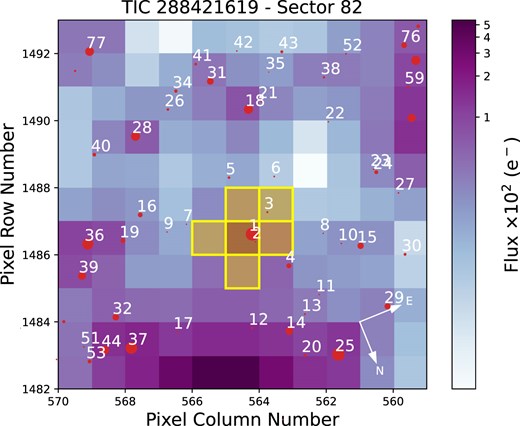
Figure 1.
TESS target pixel file image of TOI-7166 observed in Sectors 82 made by tpfplotter (A. Aller et al. 2020). Red dots show the location of Gaia DR3 sources and the yellow shaded regions show the photometric apertures used for photometric measurements extraction.