Rubio, A. C., Breivik, K., Badenes, C., El-Badry, K., Anguiano, B., Linck, E., Majewski, S. R., & Stassun, K. G. (2025). Calibration of binary population synthesis models using white dwarf binaries from APOGEE, GALEX, and Gaia. Astronomy and Astrophysics, 704, A6. https://doi.org/10.1051/0004-6361/202555600
This study looks at how pairs of stars (binary systems) exchange mass over time and how this process shapes their final outcomes. In many binary systems, material can flow from one star to the other, but this mass transfer can be either stable or unstable, and in some cases the two stars briefly share a common envelope of gas. These processes are complex, so astronomers often use fast computer models called binary population synthesis codes, which simplify the physics by using adjustable parameters to describe how stable mass transfer is, how efficiently mass is accreted, and how effectively a common envelope is ejected. The goal of this work is to better determine realistic values for these uncertain parameters by comparing model predictions with real astronomical observations.
Binary systems made up of a white dwarf and a main-sequence star are especially useful for this purpose because they can form through different evolutionary paths: stable mass transfer, unstable mass transfer with a common-envelope phase, or even with little interaction at all. These different histories leave clear signatures in today’s systems, such as their orbital periods and stellar masses. The authors use the APOGEE–GALEX–Gaia Catalog (AGGC), which contains over 500 such binaries with well-measured radial velocities, as a benchmark. They compare the observed distribution of the maximum change in radial velocity (ΔRVₘₐₓ) with simulated populations generated using COSMIC, a publicly available binary population synthesis code. In the simulations, they vary how stable mass transfer is at different giant-star stages, how efficiently stars eject their envelopes during common-envelope phases, and how much mass is retained during stable transfer.
The comparison shows that the observed data favor models in which a larger fraction of systems undergo stable mass transfer when the donor star is on the first ascent of the giant branch, as well as models where common-envelope ejection is very efficient. For the smaller number of systems where white dwarf masses can be estimated, the results slightly favor nonconservative stable mass transfer, meaning some mass is lost from the system rather than fully accreted. Because COSMIC and similar models link envelope ejection efficiency and envelope binding energy together, the finding of high ejection efficiency may imply either that extra energy sources, such as recombination energy in the envelope, help expel it, or that the envelope is less tightly bound than previously assumed. The authors note that future datasets, including upcoming Gaia releases and observations from the LISA mission, will allow even stronger tests of these models across a wider range of binary systems.
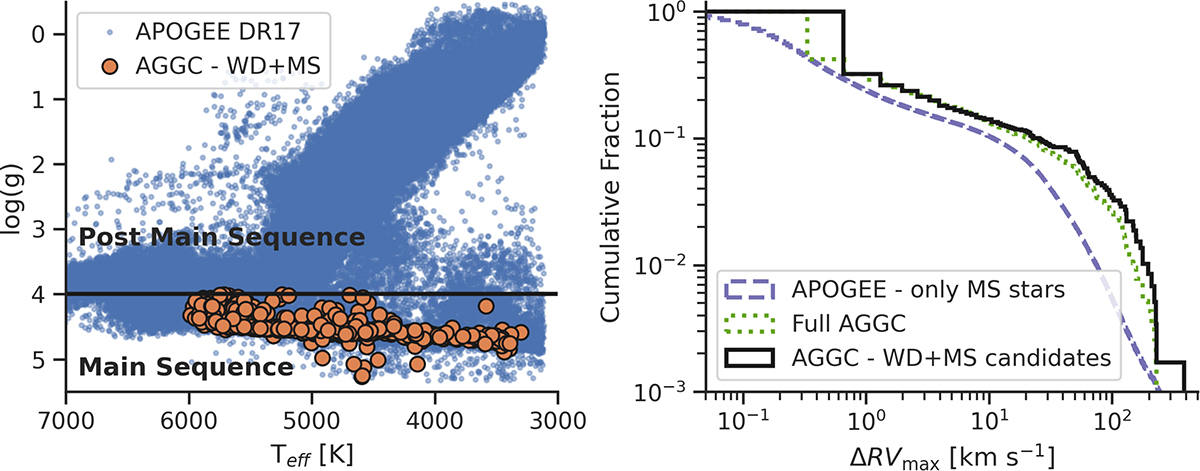
Fig 1.
Overview of the WD binaries in the APOGEE-Gaia-Galex catalog (AGGC). The left panel shows the full APOGEE dataset in blue and the companions of WDs in orange. The right panel shows the ΔRVmax distribution for different cuts in the data: MS+MS binaries from the full APOGEE dataset in blue, all WD binaries in the AGGC in green, and WD+MS binaries in black. The full APOGEE dataset contains 455796 targets; the MS binaries in that sample number 151266. The full AGGC has 1157 candidate WD binaries, while the WD+MS systems number 588.