Lee, M. L., Choi, S., Mukherjee, S., Scollard, P., Nakano, C., Gibbons, L. E., Culhane, J. E., Gauthreaux, K. M., Chan, K. C. G., Biber, S. A., Stephens, K. A., Kukull, W. A., Trittschuh, E. H., Mez, J. B., Saykin, A. J., Turner, S., Archer, D. B., Durant, A., Dumitrescu, L. C., Hohman, T. J., & Crane, P. K. (2025). Bridging the gap: addressing NACC’s evolving cognition batteries across UDS versions. Alzheimer’s and Dementia, 21(11), e70832. https://doi.org/10.1002/alz.70832
The Uniform Data Set (UDS) is a large, standardized collection of clinical and cognitive data used in Alzheimer’s disease research. In version 3 of the UDS, the neuropsychological test battery was updated, replacing several tests that had been used in earlier versions (UDS 1 and 2). Because these changes make it difficult to directly compare cognitive performance over time, this study focused on validating new cognitive domain scores—specifically for memory, executive functioning, and language—that were designed to be comparable across all UDS versions.
To do this, the researchers developed and evaluated co-calibrated and harmonized domain scores, which adjust results from different test versions onto a common scale. These scores were compared with a more traditional statistical approach called equipercentile equating using a smaller group of participants who had completed tests from both UDS eras. The researchers also examined whether the harmonized scores showed expected relationships with brain MRI measures and with APOE genotype, a genetic factor known to be associated with Alzheimer’s disease risk, across different UDS versions.
The study included nearly 50,000 participants, with about one quarter having data from both the earlier and later UDS versions. The co-calibrated domain scores closely matched results from the traditional equating method. Importantly, the harmonized scores showed meaningful and statistically significant associations with brain imaging findings and APOE genotype, supporting their biological and clinical validity. At the same time, the study found clear differences in raw domain scores across UDS versions, underscoring the need for harmonization.
Overall, this work shows that co-calibrated and harmonized cognitive domain scores make it possible to compare memory, executive function, and language performance across different versions of the UDS. These scores help preserve long-term continuity in Alzheimer’s research and are now publicly available through the National Alzheimer’s Coordinating Center.
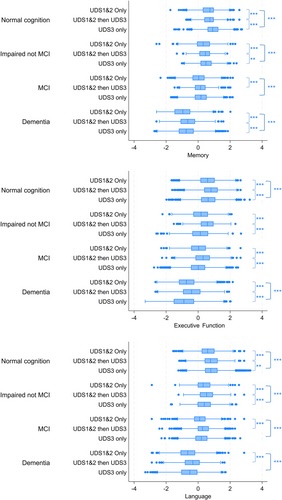
FIGURE 2
Co-calibrated scores at enrollment, grouped by dementia diagnosis and UDS span era. *p < 0.05; **p < 0.001; ***p < 0.0001.