Tanguay, A. F. N., Clough, S., McCurdy, R. A., Padilla, V.-G., Lord, K. M., Brown-Schmidt, S., & Duff, M. C. (2025). A Scoping Review on Conversational Memory and Characteristics of Conversations in Alzheimer’s Disease. Journal of Speech, Language, and Hearing Research, 68(12), 5870–5909. https://doi.org/10.1044/2025_JSLHR-24-00780
Alzheimer’s disease (AD), especially in its late-onset form, often impairs episodic memory—the ability to remember past events or learn new information. Most research on memory in AD relies on laboratory tasks, like recalling word lists or short stories, but it is unclear how well these tasks reflect everyday memory challenges, such as remembering conversations. This review aimed to summarize what is known about conversational memory in AD, which refers to memory for what is said during conversations one participates in or overhears, including the content of utterances and their corresponding responses.
Following scoping review guidelines, the authors screened 8,351 records across multiple databases and retained 121 studies on conversation and three specifically on conversational memory in people with AD. None of the studies directly examined memory for spontaneous conversations. Most studies did report some contextual details of conversations, like how structured the interaction was or the number and type of conversational partners, but often left out important factors such as hearing or vision status (missing in 67% of studies) and diagnostic details (missing in 33%). Research primarily focused on verbal behaviors, including repetitions, disfluencies, and ambiguous statements, while only 29% addressed nonverbal behaviors such as gestures, facial expressions, or eye gaze.
Overall, the review highlights a major gap in understanding conversational memory in AD. Studying this type of memory could be important for helping individuals maintain independence, participate effectively in healthcare decisions, and preserve social well-being. The authors suggest that future research should explore conversational memory in more depth and provide guidance for designing studies that can capture this everyday cognitive function.
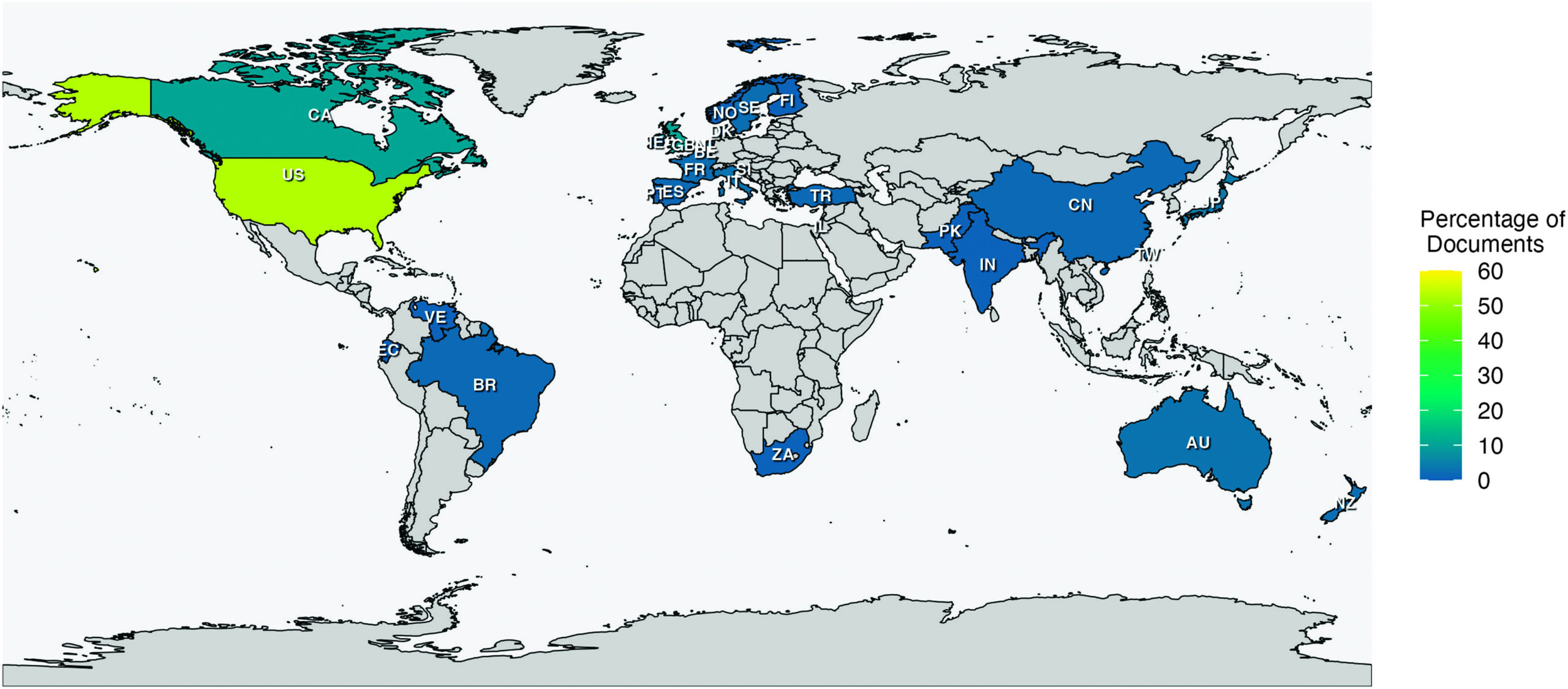
Figure 2. Percentage of reports on conversation with an affiliation to a country. Reports may be affiliated to more than one country, and two reports did not include the country of affiliation. Therefore, the total percentage does not equal 100%. Countries represented in affiliations are as follows: AU = Australia, BE = Belgium, BR = Brazil, CA = Canada, CN = China, DK = Denmark, EC = Ecuador, FI = Finland, FR = France, IN = India, IE = Ireland, IL = Israel, IT = Italy, JP = Japan, NL = Netherlands, NZ = New Zealand, NO = Norway, PK = Pakistan, PT = Portugal, SI = Slovenia, ZA = South Africa, ES = Spain, SE = Sweden, TW = Taiwan, TR = Turkey, GB = United Kingdom, US = United States of America, VE = Venezuela. All other countries are displayed in gray. This figure was prepared using the WorldMapR package (Annicchiarico, 2024).