Almenara, J. M., Mardling, R. A., Leleu, A., Díaz, R. F., Bonfils, X., Jiang, I. G., Yeh, L., Yang, M., Stassun, K. G., A-Thano, N., Edwards, B., Bouchy, F., Bourrier, V., Deline, A., Ehrenreich, D., Fontanet, E., Forveille, T., Jenkins, J. M., Kwok, L. K. W., Lendl, M. A., Psaridi, A., Udry, S. D., Venturini, J., & Winn, J. N. (2025). A decade of transit photometry for K2-19: Revised system architecture. Astronomy and Astrophysics, 703, A167. https://doi.org/10.1051/0004-6361/202556436
The star K2-19 is known to host two Neptune-sized planets that orbit very close to each other in a precise gravitational pattern called a 3:2 resonance, meaning their orbital periods are tightly linked. Because of this interaction, the planets do not pass in front of their star at perfectly regular intervals, producing strong variations in transit timing that carry information about their masses and orbits. Earlier studies, based on about 3 years of data, estimated relatively large planetary masses and unexpectedly high orbital eccentricities, or deviations from circular orbits. These high eccentricities were difficult to explain with standard models of planet formation, which motivated a new analysis using a much longer observational record.
In this study, we analyzed 10 years of transit observations using a detailed photodynamical model that accounts for the planets’ mutual gravitational effects. The longer data set confirms the earlier mass estimates for both planets, but significantly revises their orbital shapes. Instead of highly elongated orbits, the planets are now found to have much lower eccentricities, which are more in line with what is expected from conventional planet formation theories, although the orbits are still not perfectly circular. We show that the previously reported high eccentricities were driven by a single problematic transit observation taken during twilight, where observational effects caused the start of the transit to be misidentified, leading to a timing error of about 12 minutes.
Using data that span multiple long-term interaction cycles between the planets, we also applied a simpler analytical approach based on Fourier analysis of the transit-timing variations. This method reproduced the planet mass estimates to within about 2% of the full photodynamical results and did so without being sensitive to the exact eccentricities. In addition, we report evidence for a possible third planet located farther out in the system. Finally, updated modeling of the internal structure of the inner planet, K2-19 b, suggests a metal content consistent with formation through core accretion, the standard process thought to build most planets.
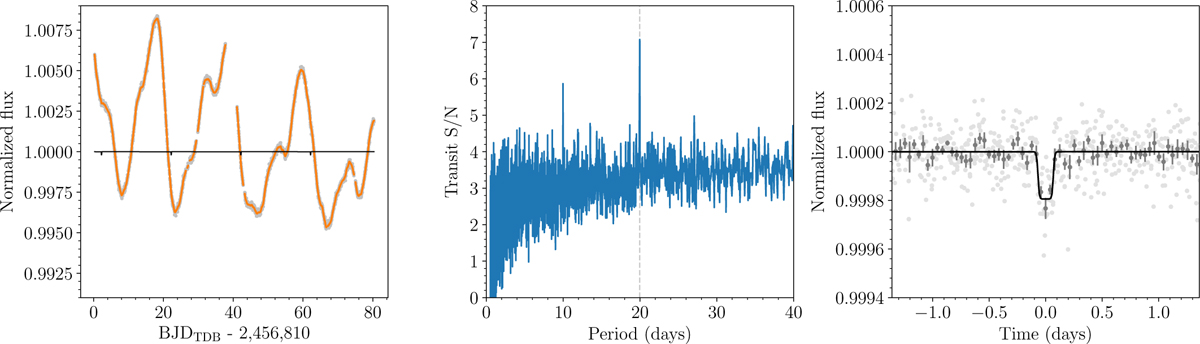
Fig. 1
Detection of the candidate planet e. Left: gray data points represent the K2 data without the transits of planets b, c, and d. The orange data points show the mean GP model. The black light curve indicates the four transits we found. Center: periodogram of the nuance algorithm. Right: phased light curve without the noise model (gray points), binned (dark gray), and transit model (black line).