Kripalani, Sunil B., Stolldorf, Deonni P., Sachs, Anna L., Barrett, Jennifer B., Anders, Shilo H., Novak, Laurie Lovett., Liu, Dandan., Miller, Joseph B., Kea, Bory., Schlotterbeck, Isaac., & Storrow, Alan B. (2025). Study protocol for the design, implementation, and evaluation of the STRATIFY clinical decision support tool for emergency department disposition of patients with heart failure. Implementation Science Communications, 6(1), 107. https://doi.org/10.1186/s43058-025-00779-w
Clinicians in the emergency department (ED) often have to make difficult, time-sensitive decisions with limited information. Clinical decision support (CDS) tools built into the electronic health record can help by providing evidence-based guidance, but in practice these tools are not widely used in the ED because of many workflow and implementation barriers. One area where CDS tools could be especially useful is in caring for patients with acute exacerbation of heart failure (AHF)—a common and expensive condition that often leads to hospital admission, even when some patients may actually be safe to go home.
To address this, we developed STRATIFY, a validated risk prediction model that identifies AHF patients who are at low risk for serious problems in the next 30 days and may be good candidates for discharge from the ED. This article describes a multi-center study focused on bringing STRATIFY into real-world clinical practice using a CDS tool.
The study has three main goals:
- create a CDS-based implementation process for STRATIFY that is shaped by input from stakeholders such as clinicians, patients, and caregivers;
- develop new statistical methods to solve data problems that arise when using predictive models in real time in the ED, such as how to handle missing information without compromising risk estimates; and
- test both the implementation and effectiveness of the STRATIFY CDS atseven EDs, examining how well it supports decisions about admitting or discharging AHF patients.
To do this, the study uses a multi-level implementation strategy tailored to each site. This includes surveys, on-site visits, virtual interviews, small-group discussions with patients and caregivers, and iterative user-centered design to refine the STRATIFY tool. Effectiveness will be evaluated using an interrupted time-series design, measuring changes in ED decisions (admission vs. discharge) and monitoring for any adverse outcomes. The study will also assess how acceptable, usable, and sustainable the STRATIFY CDS is, using surveys and electronic health record data.
Overall, this work aims to demonstrate how a thoughtfully designed, stakeholder-informed CDS process can help close the gap between research evidence and everyday clinical practice in the emergency department.
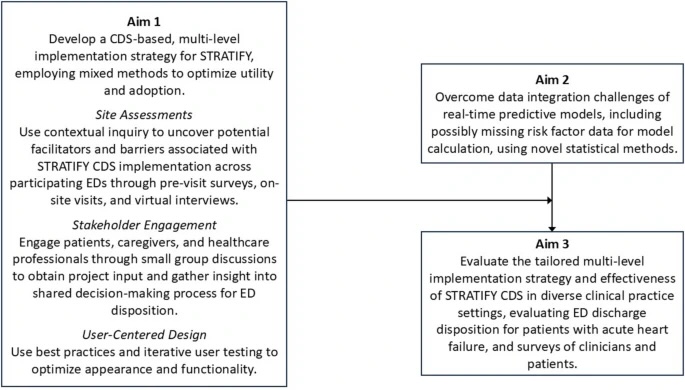
Fig. 1
Summary schema of study