Hughes, Natasha C., Qian, Helen., Doss, Derek J., Makhoul, Ghassan S., Zargari, Michael., Zhao, Zixiang., Singh, Balbir., Wang, Zhengyang., Fulton, Jenna N., Johnson, Graham W., Li, Rui., Dawant, Benoît M., Englot, Dario J., Constantinidis, Christos., Williams Roberson, Shawniqua., & Bick, Sarah Kathleen B. (2025). Reward circuit local field potential modulations precede risk taking. Brain, 148(11), 3958-3972. https://doi.org/10.1093/brain/awaf107
Risk-taking behavior is a feature of many neuropsychiatric disorders, yet effective treatments are limited because we still don’t fully understand what is happening in the brain when people make risky choices. Scientists know that certain “reward circuitry” regions—such as the amygdala, orbitofrontal cortex, insula, and anterior cingulate—are involved, but the specific electrical activity that predicts risk-taking in these areas has not been well studied in humans. Identifying local field potential (LFP) frequency patterns linked to risk-taking could help guide future therapies.
In this study, eleven patients with hard-to-treat epilepsy, who already had stereotactic EEG electrodes implanted for medical reasons, took part in an experiment measuring brain activity in these reward-related regions. Each person played a simple gambling game in which they guessed whether a hidden playing card would be lower or higher than a visible one, choosing to bet either $5 or $20. While they made these decisions, researchers recorded their local field potentials—electrical signals generated by groups of neurons. The team used statistical models to look for specific changes in oscillatory power (brainwave activity across different frequencies) related to reward prediction error, which is the difference between expected and actual outcomes. They also calculated a “risk-taking value” for each trial based on the card number and the size of the bet, and identified which oscillatory patterns were linked to riskier choices.
The results showed clear time-frequency patterns associated with reward prediction error signals in both the amygdala and the orbitofrontal cortex, with several strong clusters of activity in each region. Risky choices themselves were predicted by increased oscillatory power in the theta-to-beta frequency range in the orbitofrontal cortex during card presentation, and by increased high-beta power in the insula. Further analysis pinpointed these signals to the lateral orbitofrontal cortex and the posterior insula. Activity in one insula cluster linked to risky decisions was also connected to a theta-alpha reward prediction error signal in the orbitofrontal cortex. Additionally, an amygdala reward prediction error signal was associated with how often participants chose the higher bet, and a lateral orbitofrontal cortex signal predicted high bets specifically in risky situations.
Overall, the study identifies distinct electrical activity patterns in key reward-related brain regions that predict when a person is about to make a risky decision. These oscillatory signatures could eventually serve as biomarkers—measurable indicators that help guide new treatments, including closed-loop neuromodulation, for disorders in which risk-taking becomes harmful.
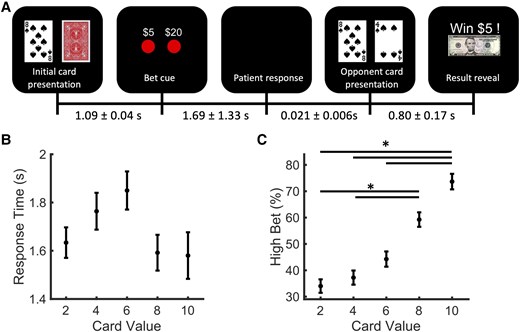
Figure 1
Gambling task and behavioural data. (A) Behavioural task events and timing between events in seconds (mean ± standard deviation). (B) Mean response time (time from bet cue presentation to patient response) for each patient card number. Error bars represent standard error. (C) Mean per cent of trials on which subjects bet high ($20) for each patient card number. Asterisk indicates P < 0.05. Error bars represent standard error.