Medan, Ilija., Dwelly, Tom., Covey, Kevin R., Zari, Eleonora., Blanton, Michael R., Carlberg, Joleen K., Chojnowski, Drew D., Ji, Alexander P., Shen, Yue., Donor, John., Sánchez-Gallego, José Ramón., Morrison, Sean S., Ibarra-Medel, Héctor J., Sayres, Conor., & Stassun, Keivan Guadalupe. [2025]. Procedures for Constraining Robotic Fiber Positioning for Highly Multiplexed Spectroscopic Surveys: The Case of FPS for SDSS-V. Astronomical Journal, 170(5), 267. https://doi.org/10.3847/1538-3881/ae03b2
Planning a large astronomical survey requires figuring out how to observe the sky in a way that produces the best possible data. This becomes especially challenging when a survey has many different scientific goals and needs to observe a wide variety of objects. The Sloan Digital Sky Survey V [SDSS-V] fits this description, especially now that it uses the Focal Plane System [FPS]—a robotic system that precisely places optical fibers to collect light for its spectrographs. The FPS increases efficiency and expands the number and types of targets the survey can observe, but it also introduces new constraints: each fiber must be positioned carefully so that multiple science programs can observe their targets at the same time without interfering with one another.
These fiber-placement constraints depend on properties of the targets themselves, such as their type, brightness, and how close they are to other objects in the same field of view. They also depend on the scientific purpose of each observation and the expected sky conditions. In this work, we describe the SDSS-V data collection scenarios, which are sets of parameters that define how fibers can be arranged for different observational needs. These parameters were determined through previous experience and new tests conducted specifically for SDSS-V, all of which we outline here. Together, they create a framework that allows SDSS-V to plan observations algorithmically—maximizing scientific output while ensuring high data quality throughout the survey.
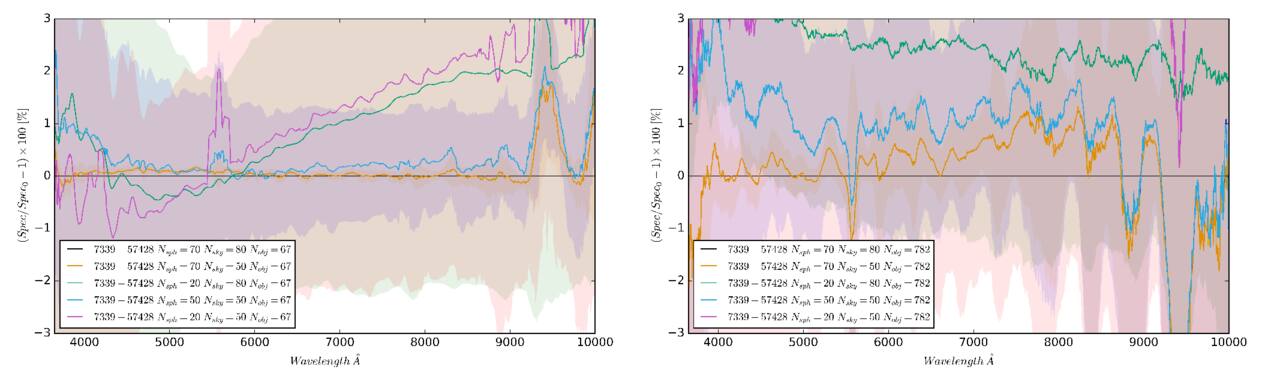
Figure 1. Comparison of the reduced spectrum of an object [Spec] when using the number of standards [Nsph] and skies [Nsky] in the legend relative to the spectrum of the object when using all of the calibrators [Spec0]. The sample shown is for plate-MJD 7339–57428. The left panel is for the 67 brightest galaxies [mr < 20] on the plate and the right panel is the faintest galaxies [mr > 20].