October 2025
Friends,
As we head into this season of candy, costumes, and celebration, I hope you take a moment to reflect on what makes this time so special: connection. Halloween gives us a rare invitation to knock on doors, say hello, and exchange kindness (and maybe a few chocolate bars). It’s one of my favorite times of year—when neighbors who rarely cross paths share a laugh, a compliment, or a moment of surprise.At VALIANT, we’re leaning all the way in. Across our 17 labs and 55 Fellows, the team has organized an epic five-mile saunter through campus—visiting every building that hosts a VALIANT lab. Trick-or-treat stations, games, and camaraderie await along the route. For those brave souls who complete the full trek (and truly get their steps in), we’ll have limited-edition VALIANT socks, pizza, and friendship waiting in Featheringill Hall’s AI Lounge. Details below—come join the fun!
Beyond the candy and costumes, Halloween is also about trying on new roles. Every year, my family debates—quite passionately—our theme for the season. This year, we landed on cats: a CAT excavator, a CATer, a CATastrophe, a CATchphrase, a CATaylst, and me—a CATerpillar, specifically The Very Hungry Caterpillar from Eric Carle’s beloved story. That tiny caterpillar devours everything in sight, learning and growing until it finally rests on one perfect green leaf—transforming into something new.
I see that as a metaphor for where we are in translational AI. We’ve raced through waves of innovation—new fields, demos, IPOs, and ventures—but to reach the next stage, we need to pause and ground ourselves. That “one nice green leaf” is rigorous data, fundamental science, and ethical, human-centered design. It’s what allows our chaotic energy to crystallize into something truly beautiful: AI that makes a lasting, positive impact.
Finally, I want to circle back to connection. In our labs and projects, we’re often deep in the trenches of tasks, deliverables, and deadlines. These are vital—but context matters too. I was recently chatting with a Vanderbilt alum curious about AI’s future. After discussing the usual models and methods, he surprised me by asking, “So, what are you reading these days?” That question shifted everything. We found common ground in fiction, not algorithms—and it sparked a richer, more human exchange.
So, as you scroll through this issue or stroll through our campus trick-or-treat, I encourage you to ask different kinds of questions. Beyond the hottest GitHub repo or the latest conference talk, ask someone what story has inspired them lately—on the page, on screen, or in spirit. You might just find a new thread of connection that strengthens everything we do.
From all of us at VALIANT—have a joyful, curious, and candy-filled Halloween.
And remember: Just do stuff, and have fun.
Bennett
Bridging Brain Maps Between Nashville and Sherbrooke
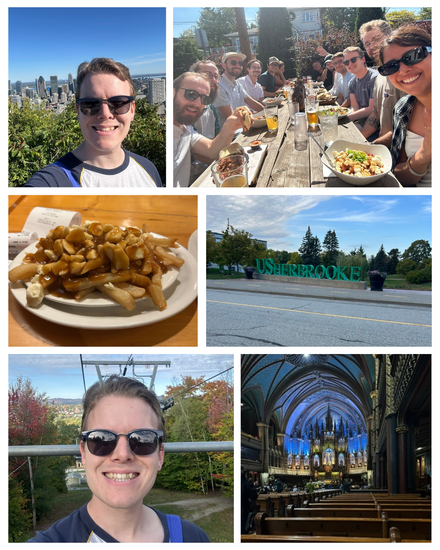 When PhD student Adam Saunders packed his bags for Quebec, he wasn’t just crossing borders—he was bridging worlds of science and software. Through the VALIANT Reach Exchange Program, Adam spent nearly a month at SCIL at the Université de Sherbrooke, a global leader in diffusion MRI tractography and open-source neuroimaging software.
Working with François Rheault, a former MASI postdoc, Adam immersed himself in the lab’s collaborative coding culture. The Sherbrooke team maintains major community tools such as SCILPy and NF-Neuro, platforms that streamline large-scale MRI data processing with precision and reproducibility. “I learned there’s a better way to write code,” Adam reflected. “A little more effort on usability makes it so much easier for others to build on your work.”
Beyond software, the exchange strengthened ties between VALIANT and Sherbrooke’s neuroimaging community. Adam’s work on organizing the FITBIR traumatic brain injury dataset opened new collaborative opportunities. “They’d tried to use that dataset before but found it too messy,” he said. “When I showed them how we’d cleaned and structured it, they immediately saw new research possibilities. It was exciting to realize our work here could help accelerate theirs.”
The visit also reshaped how Adam thinks about collaboration. “Their lab works a lot like a large open-source project,” he explained. “Professors handle merges, students open pull requests, and everyone reviews code together—it’s structured, respectful, and scalable. It made me think differently about how we can grow VALIANT’s own tools in that same spirit.”
Outside the lab, Adam embraced the beauty and culture of Quebec—hiking Mont Bellevue, visiting Mont Royal, and sampling every variety of poutine he could find. “It was humbling and inspiring,” he said. “I hope someone from Sherbrooke visits Nashville next.”
Mapping the Past to Shape Tomorrow
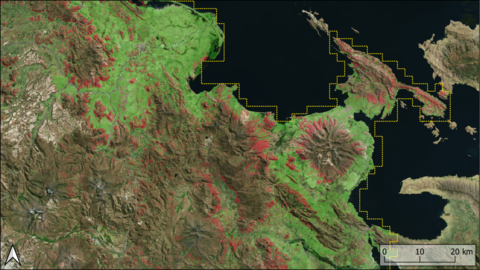
At VALIANT, discovery thrives where disciplines meet. Archaeologist Steven Wernke has found that intersection in an unlikely place—between pickaxes and pixels. Working with VALIANT AI Fellow Yuankai Huo, Wernke is training machines to see what centuries of human eyes have missed: the faint traces of ancient settlements scattered across the Andes.
“If we only use pickaxes and trowels, we’re very limited in what we can understand about the past,” Wernke says. “Machine learning lets us open the aperture way up.”
The team’s AI models classify ruins and agricultural fields to generate maps that show “a true distribution of archaeological features visible from overhead imagery.” By integrating data from across regions, they are “coming to continental-scale views of the archaeological planet.”
For Wernke, this AI-assisted effort isn’t a substitute for field-based studies—it’s about helping to put field research in a broader perspective. “This is purely additive,” he says. “It’s a new layer of information that helps us see patterns of sustainability, adaptation, and resilience.”
The work also reveals deep parallels with modern challenges. “Because we’re looking at very long time spans,” he explains, “we can see what has endured—what’s sustainable—and what isn’t. The archaeological record is, in a way, a record of survivorship across centuries.”
That perspective is shared by a growing community of students and collaborators. “We have undergrads, grads, and postdocs working together across seven universities,” Wernke says. “The more hands on deck, the better. You learn remote sensing, GIS, teamwork—and the art of discovery.”
Those ready to explore can find opportunities at wernkelab.org.
VALIANT Ventures
- Yuankai Huo joined Bradley Malin and others as a panelist at the ADVANCE Fall 2025 Symposium, sharing insights on “AI at the Bench.”
- November 4 – Naomi Smith: AI and Aesthetic Alienation
Join Naomi Smith (University of the Sunshine Coast) as she explores how AI reshapes creativity and meaning in contemporary culture through her talk “AI and Aesthetic Alienation: The Image and Creativity in Contemporary Culture.” - November 18 – Jeff Sebo: Moral Status and AI Welfare
Jeff Sebo (New York University) discusses the ethical dimensions of AI consciousness and responsibility in “Moral Status and AI Welfare,” probing what moral consideration artificial systems may deserve. - The highlight of spooky season at Vanderbilt is back by popular demand! Join VALIANT Attempt on Friday, October 31st at 11:00 AM in the AI Lounge near FGH 385 for Trick-or-Treat!
- Don’t miss Tianyuan Yao’s defense session on Monday, November 3 (10:00 AM – 12:00 PM, FGH 349A).
Language Meets Mind
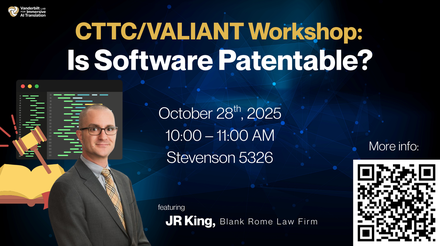
Is Software Patentable?
Discovery in Motion
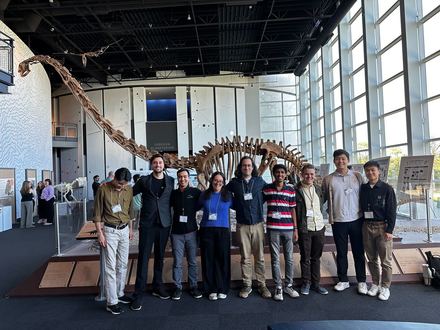 The MASI Lab joined colleagues from across Vanderbilt at the VUIIS Retreat, held at the Adventure Science Center, to share research highlights, spark new collaborations, and celebrate the spirit of scientific exploration beneath the dinosaurs.
Thanks to Our Librarian Champions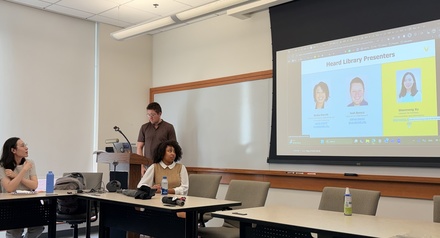
Picture the Future!
 The VALIANT Attempt is launching a 2026 Calendar Competition—showcase your creativity through drawings, photos, AI-generated art, or scientific visualizations for a chance to be featured and celebrated at Gallery Night. Submit your entry by November 19 here!
Valiant-jobs
Alchemists’ Corner
- Sensitivity of quantitative diffusion MRI tractography and microstructure to anisotropic spatial sampling
- Explainable artificial intelligence identifies and localizes left ventricular scar in hypertrophic cardiomyopathy using 12-Lead electrocardiogram
- PHASE: Personalized Head-based Automatic Simulation for Electromagnetic properties in 7T MRI
- Embedding Sustainability into the Imaging and Care of Patients with Cancer
- Histology-Based Virtual RNA Inference Identifies Pathways Associated With Metastasis Risk in Colorectal Cancer
- In vivo mapping of infant brain microstructure with neurite orientation dispersion and density imaging
- A Galactic Interloper: A Study of the Camelopardis OB1 Association’s Clusters and Its Visitor from the Perseus Arm
- AI-Driven Clinical Decision Support to Reduce Hospital-Acquired Venous Thromboembolism: A Trial Protocol
- TOI-1438: A rare system with two short-period sub-Neptunes and a tentative long-period Jupiter-like planet orbiting a K0V star
- Calibration of multisite raters for prospective visual reads of amyloid PET scans
- Discovery of the pre-main-sequence eclipsing binary MML 48
- FUMES. IV. Optical and Far-ultraviolet Spectra of a Flare on the M Dwarf GJ 4334
- FocalSV enables target region–based structural variant assembly and refinement using single-molecule long-read sequencing data
- Atmospheric parameters and chemical abundances of young stars with APOGEE – I. Orion star-forming region
- Pitfalls of defacing whole-head MRI: re-identification risk with diffusion models and compromised research potential
- DeepPhysioRecon: Tracing peripheral physiology in low frequency fMRI dynamics
- TurboID-Mediated Profiling of Glioblastoma-Derived Extracellular Vesicle Cargo Proteins
- The SPACE Program I. The featureless spectrum of HD 86226 c challenges sub-Neptune atmosphere trends
- Five-year change in sleep duration and incident Alzheimer’s Disease and Related Dementias among lower-income older adults
- Assessing the clinical utility of biomarkers using the intervention probability curve (IPC)

valiant@vanderbilt.edu | https://vanderbilt.edu/valiant | @VandyValiant | LinkedIN