Northrup, Benjamin E.; Hanneman, Kate A.; Lichter, Katie E.; Rockall, Andrea G.; Zigmund, Beth; D’Anna, Gennaro; Zhang, Zhuoli; Osborne, Joseph R.; Silva, Genevieve S.; Waeldner, Kathleen; Omary, Reed A. (2025). Embedding Sustainability into the Imaging and Care of Patients with Cancer. Radiology: Imaging Cancer, 7(6), e250054. https://doi.org/10.1148/rycan.250054
As climate change becomes more serious, it’s important to consider how healthcare, including cancer care, affects the environment. Imaging tests and image-guided procedures—such as CT scans, MRIs, and targeted treatments—play a major role in diagnosing and managing cancer. These technologies have improved patient outcomes, but they also produce carbon emissions and medical waste. This review looks at how cancer imaging and related treatments impact the environment, discusses what sustainable cancer care could look like, and suggests practical ways to reduce the environmental footprint of cancer care while continuing to provide high-quality treatment.
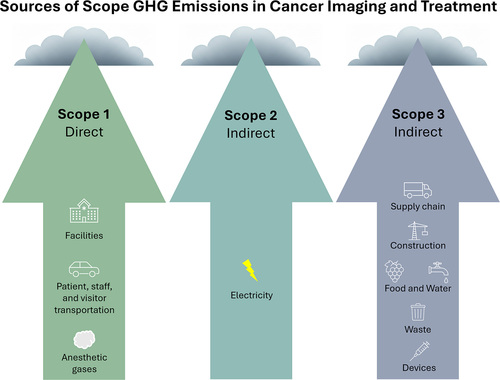
Figure 1: Sources of greenhouse gas (GHG) emissions in cancer imaging categorized by scope. Scope 1 includes direct emissions, those from sources that an organization owns or controls directly. Scope 2 includes indirect emissions, those that come from where an organization’s energy is produced. Scope 3 includes all sources not covered in scope 1 or 2, including those created by an organization’s value chain.