López-Valdivia, Ricardo; Adame, Lucía; Román-Zúñiga, Carlos G.; Hernández, Jesus V.; Śanchez, Edilberto; Herrnández-Aburto, Itzarel; Fernández-Trincado, José G.; Zagala Lagunas, Eduardo; Carigi, Leticia; Méndez-Delgado, José Eduardo; Kounkel, Marina A.; Serna, Javier M.; Lane, Richard R.; Stassun, Keivan Guadalupe; Villanova, Sandro; Kim, Jinyoung Serena; Wolk, Scott J.; Stringfellow, Guy S.; Tan, Jonathan C.; Roman-Lopes, Alexandre; Rojas-Ayala, Bárbara; Pandey, Rakesh. (2025). Atmospheric parameters and chemical abundances of young stars with APOGEE – I. Orion star-forming region. Monthly Notices of the Royal Astronomical Society, 543(1), 420-434. https://doi.org/10.1093/mnras/staf1445
This study investigates the atmospheres and chemical makeup of young stars in the Orion complex, one of the most active nearby regions of star formation. The research focuses on G-, K-, and M-type stars, which range in temperature from about 6,500 to 3,100 K. Using infrared spectra from the APOGEE-2 survey, scientists analyzed 548 young stars across different parts of Orion (Orion A, Orion B, Orion OB1, and σ Ori) with the TONALLI analysis code to determine their atmospheric properties, such as temperature, surface gravity, and composition.
For 340 stars that rotate relatively slowly (with speeds below ~30 km/s), the team measured the abundances of several chemical elements—carbon (C), magnesium (Mg), silicon (Si), potassium (K), titanium (Ti), and iron (Fe)—by studying 19 specific atomic lines using MARCS model atmospheres and the BACCHUS analysis tool. To avoid contamination from surrounding dust and gas, stars showing infrared excess (a sign of circumstellar material) were excluded using data from 2MASS and WISE.
The results show that all stars in the Orion complex have slightly lower-than-solar elemental abundances ([X/H]), and that these values are consistent across all four regions—indicating that Orion is chemically homogeneous. The team also found that the average ratio of certain elements to iron ([α/Fe], derived from Mg, Si, and Ti) is about 0.10 dex lower than that of nearby, older main-sequence stars, in agreement with predictions from Galactic chemical evolution models. In addition, the average carbon abundance matches previous measurements from the Orion Nebula’s ionized gas.
This work lays the foundation for future studies of faster-rotating stars and those with surrounding disks, providing new insights into how young stars form and how the chemical composition of the Milky Way has evolved over time.
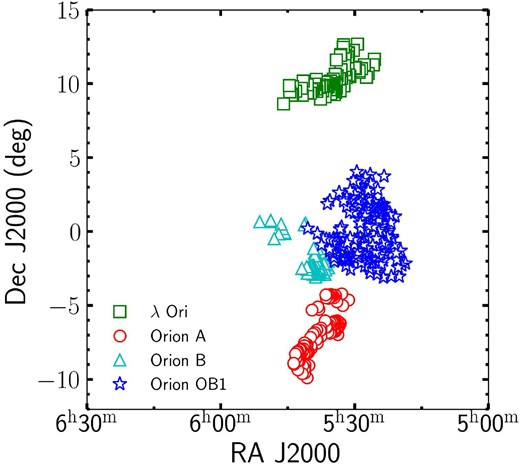
Figure 1.
Spatial distribution of the 559 young stars located in the Orion star-forming region analysed in this work.