September 2025
Friends,
Every two weeks I meet new scholars and fellows while reviewing the VALIANT  applications—virtually at first, and later in person—who are eager to embark on their own translational AI journey. Our community is full of brilliant, creative people, and we’re fortunate to keep welcoming new scholars and fellows into the fold. From the transformative NIH K awards to more than twenty peer-reviewed articles in print this month, the pace of high-profile innovation continues to amaze. Our scholars arrive full of questions, one of the most common being: “What do I need to do to get a paper?”
It’s a fair question, and one that speaks to ambition. But I think we sometimes misunderstand what a paper really is. A paper is not a victory lap or a trophy. It is a gift—knowledge distilled and shared with others. Every setback on the way there offers us the chance to refine our hypotheses, sharpen our tools, and deepen our understanding. If every algorithm worked perfectly the first time everytime, we wouldn’t be doing science. In translational AI—a young field where approaches are still being tested and boundaries still being drawn—the real advance comes not just in what works, but in why some ideas work, and why some don’t.
I often remind myself of three great types of papers. The first proposes a new theoretical lens or optimality criterion. The second creates an empirical system that does something no one has done before—or does it substantially better. And the third, often overlooked but equally important, explains why a method is effective and brings clarity to the state of the art. One of my doctoral mentors even celebrated this spirit through the “Hairball Award”—given not to the most cited paper, but to the bold idea that branched off from the wavefront of knowledge and opened a fresh way of thinking.
So let’s remember: the true currency of our field isn’t the PDF itself, but the teachable moment it represents. That might take the form of a journal article or conference paper, but it might also be a GitHub repository, a vibrant scientific discussion online, or a workshop conversation that sparks new insight. Each is a way of teaching, learning, and carrying knowledge forward.
This summer, I’ve seen that spirit alive in our AI Scholars—learning from each other, from fellows, from guest lecturers, and from faculty alike. We’ll carry that momentum into my upcoming Studio in AI course this spring, where formal lectures meet hands-on mentorship and peer learning in dynamic spaces like FGH 203 and our high tech GPU-teaching environments.
As we look ahead to our academic retreats and the conversations they will bring, I’m grateful for the opportunity to continue building connections across Nashville and beyond. These are times to break the mold, to think differently, and in so doing, to reshape how we approach AI and society. I look forward to the road ahead, and to hearing from—and learning with—all of you.
Best wishes,
AI Courses Spring 2025
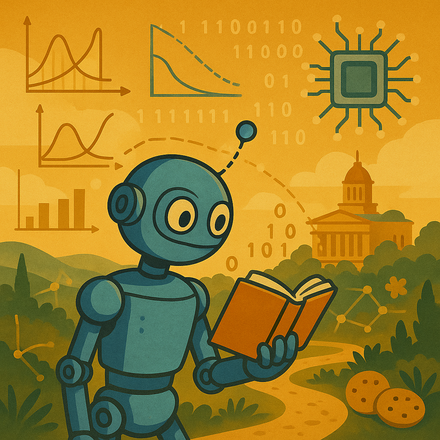 From VALIANT Fellows:
Notes from the Field | HIPAA-Safe in a Snap: Aditya Nanda’s Leap from the Lab to dbTwin
Aditya Nanda moved to Vanderbilt to explore “synthetic data for time series” —algorithms that could generate synthetic versions of fMRI, EEG, or ECOG signals to enable statistical modeling and hypothesis testing about brain structure and function. Five years later, he spotted a bigger gap: health-care organizations drowning in tabular data they cannot share. “There’s been an explosion in tabular synthetic data because of privacy laws,” he notes. “What we built at Vandy clearly had value there.”
That realization became dbTwin, a Nashville start-up whose linear-algebra core sidesteps GPU-hungry generators. Upload a CSV through the company’s API and minutes later you receive a statistically faithful, HIPAA-safe clone—ready for analytics, QA, or model training without PHI red tape. An NSF I-Corps grant funded the customer-discovery sprint: virtual interviews first, then three weeks of Silicon Valley walk-ups that confirmed demand. Two pilots are running, with two more slated for 2025 while dbTwin was housed in the Vanderbilt Launch incubator ( side-bar: Sadly, the Vanderbilt Launch space closed – so all the startups that worked have to move-out 🙁 ).
Enterprise data teams, he says, appreciate the lack of buzzwords: “They’re skeptical of AI hype and willing to try us because we’re not another deep-learning black box.” Yet the start-up sprint contrasts sharply with campus life. “At Vanderbilt you could chase any niche problem without asking if it’ll make money; a start-up trades some of that idealism for commercial urgency.”
VALIANT Ventures
- Katherine Van Schaik received her NIH K08 award!
- Keith Cole received his NIH K76 award!
- The Vanderbilt–Liverpool Eye-AI Working Groupstarted.
- Catie Chang gave a talk at the 2025 IEEE Brain Discovery & Neurotechnology Workshop in Vancouver, and a (virtual) keynote lecture for the 2nd Turkish Neuroimaging Congress (UNK2025) hosted by Baskent University, Ankara.
- Bennett Landman co-organized the NHLBI’s Digital Twins in Heart, Lung, Blood, and Sleep Research Virtual Workshop (videos coming “soon”).
- Multiple VALIANT Fellows presented at Vanderbilt’s Brock Family Center for Applied Innovation‘s Healthcare Artificial Intelligence Sessions 2025.
Deep Dive into Bibliometrics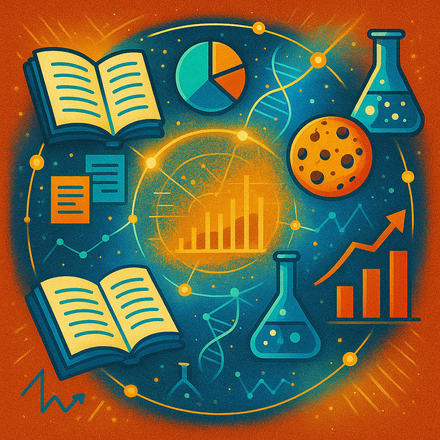
Is Software Patentable?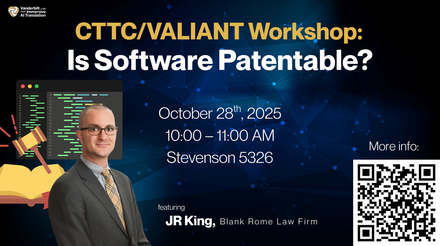
From Slices to Structure: Neural Networks for 3D Ultrasound
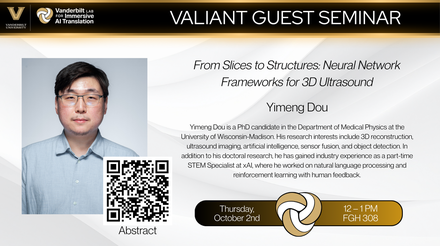 VALIANT will host Yimeng Dou, a doctoral candidate from UW–Madison, for a seminar on October 2 at 12 PM in FGH 308. Join us for an engaging talk, snacks, and coffee—details and free registration are available here.
Powering discovery with NVIDIA
Back-to-School Pizza Party and Backpack Decorating!
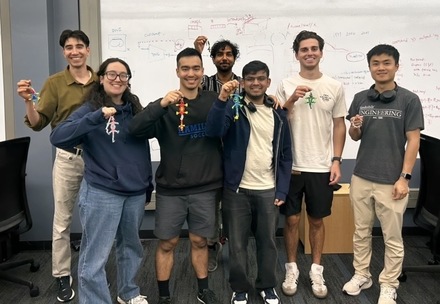 VALIANT Attempt kicked off the new school year with a Back-to-School Pizza Party and Backpack Decorating event, bringing trainees together to enjoy pizza, bite-sized appetizers, and creative decorating fun.
Cross-Modal Brain Insights at MICCAI 2025
Partner Spotlights: 28th VBI Retreat
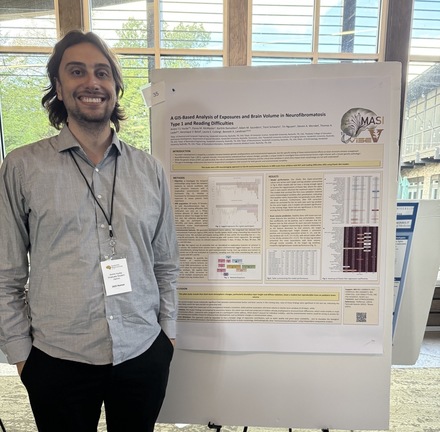 AI Scholar Andre Teixeira da Silva Hucke presented his poster at the 28th Annual Vanderbilt Brain Institute Retreat, joining a day of exciting science and collaboration.
Valiant-jobs
Alchemists’ Corner
- Functional MRI signatures of autonomic physiology in aging
- 3D collagen high-throughput screen identifies drugs that induce epithelial polarity and enhance chemotherapy response in colorectal cancer
- Cortical modulation of resting state BOLD signals in white matter
- Flexible and shape-adjustable coaxial capacitor (COCA) coils for ultrahigh field MRI: a comparative analysis with rigid coils
- Improving intracranial arteriosclerosic stenosis MRI using wireless resonator array inserts
- Secondary use of radiological imaging data: Vanderbilt’s ImageVU approach
- Sex-specific relationships between gray matter volume and executive function in young children with and without prenatal alcohol exposure
- A randomization strategy for a cluster-randomized controlled trial with variable operating room availability
- Bedtime sliding scale insulin is unnecessary for hospitalized patients with bedtime glucose < 300 mg/dL: A nudge-based quasi-experiment
- Early adipose tissue wasting in a preclinical model of human lung cancer cachexia
- StImage: A versatile framework for optimizing spatial transcriptomic analysis through customizable deep histology and location informed integration
- Robotic versus Electromagnetic Bronchoscopy for Peripheral Pulmonary Lesions: A Randomized Trial (RELIANT)
- Atlas-based templates vs. subject-specific tractography: resolving the debate
- Post-Thoracentesis Ultrasound versus Chest Radiography for the Evaluation of Effusion Evacuation and Lung Reexpansion: A Multicenter Study
- Biomarkers for the diagnosis of indeterminate pulmonary nodules: are we there yet?
- Characterization of neurite and soma organization in the brain and spinal cord with diffusion MRI
- BTS: A Comprehensive Benchmark for Tie Strength Prediction
- Discovery of a transiting hot water-world candidate orbiting Ross 176 with TESS and CARMENES
- Three hot Jupiters transiting K-dwarfs with significant heavy element masses
- Enhancing Code LLM Training with Programmer Attention
- A Comparative Study on ChatGPT and Checklist as Support Tools for Unit Testing Education
- ZeroReg3D: A zero-shot registration pipeline for 3D consecutive histopathology image reconstruction
- Comparison of Diagnostic Bronchoscopy Single-Arm Trials Using an Advanced Optimization Approach for Indirect Comparisons with Partial Individual Patient Data
- Enhancing Clinical Data Management Through Barcode Integration and Research Electronic Data Capture: Scalable and Adaptable Implementation Study
- Leveling up: along-level diffusion tensor imaging in the spinal cord of multiple sclerosis patients
- Modeling the MRI gradient system with a temporal convolutional network: Improved reconstruction by prediction of readout gradient errors