Lu, Ming, Sun, Caiwan, Jiang, Xiaoyu, Moore, Jason E., Gore, John C., & Yan, Xinqiang. (2025). Flexible and shape-adjustable coaxial capacitor (COCA) coils for ultrahigh field MRI: a comparative analysis with rigid coils.Journal of Magnetic Resonance, 380, 107955. https://doi.org/10.1016/j.jmr.2025.107955
Flexible radiofrequency (RF) coils are used in MRI to improve patient comfort and image quality. However, creating large, flexible coils that work properly at 7 T has been difficult. In this study, we present a new design called the coaxial capacitor (COCA) coil. This coil can be 10 cm in diameter and still operate in the first resonant mode at 298 MHz. Unlike traditional coaxial cable coils that rely on self-resonance, the COCA coil uses ultrasoft Litz wire for inductance combined with a short coaxial structure for capacitance.
Tests showed that a COCA coil with just one capacitor performs as well as conventional rigid coils with three capacitors, including stable tuning, effective detuning, and reduced interference between coil elements. MRI scans using the COCA coil demonstrated stronger signals, especially when the coil curved to match the shape of the body, with up to a 20% signal improvement compared to flat coils. The coil also kept its performance when used in different shapes, supporting the development of flexible, shape-adjustable coil arrays.
By enabling large, flexible coils to operate effectively at 7 T, the COCA design provides a promising approach for imaging body parts with complex shapes, such as the shoulder, foot, and spine.
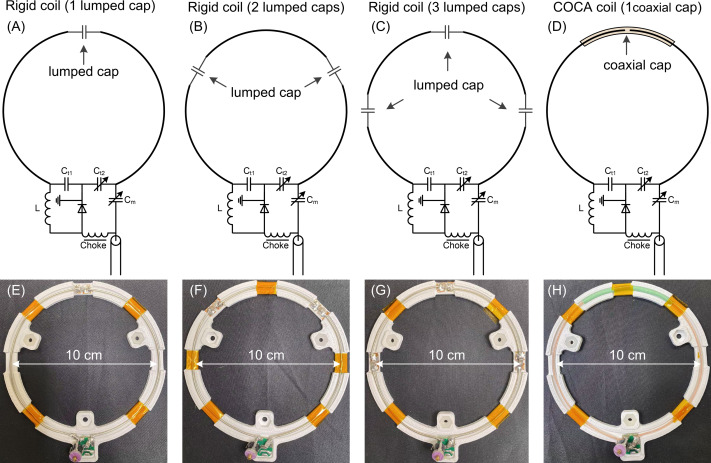
Fig. 1. Circuit diagrams and photographs of rigid coils and the COCA coil. (A–D) show four coil designs using 1, 2, or 3 lumped capacitors (rigid coils) and 1 coaxial capacitor (COCA coils). (E–H) show the corresponding coil prototypes.