Schilling, Kurt G., Zhang, Fan, Tournier, J. Donald, Vergani, Francesco, Sotiropoulos, Stamatios N., Rokem, Ariel S., & O’Donnell, Lauren Jean. (2025). Atlas-based templates vs. subject-specific tractography: resolving the debate. Brain Structure and Function, 230(7), 141. https://doi.org/10.1007/s00429-025-02974-w
The first annual International Society of Tractography (IST) debate, held in Corsica in 2024, focused on key challenges and controversies in tractography, a technique that maps brain connections using diffusion MRI. The debate centered on the provocative statement: “Tractography cannot give us anything we can’t get from an atlas template.” On one side, white matter atlas templates were highlighted as standardized, population-based maps of the brain that are especially useful for studying brain structure and making group comparisons. On the other side, subject-specific tractography was presented as a powerful approach that reconstructs the unique brain connections of each individual, allowing an in vivo “virtual dissection” of white matter pathways. This article introduces these concepts, summarizes the arguments for and against the statement, and, while acknowledging the strengths of both methods, underscores the unique value of tractography in advancing our understanding of individual brain connectivity.
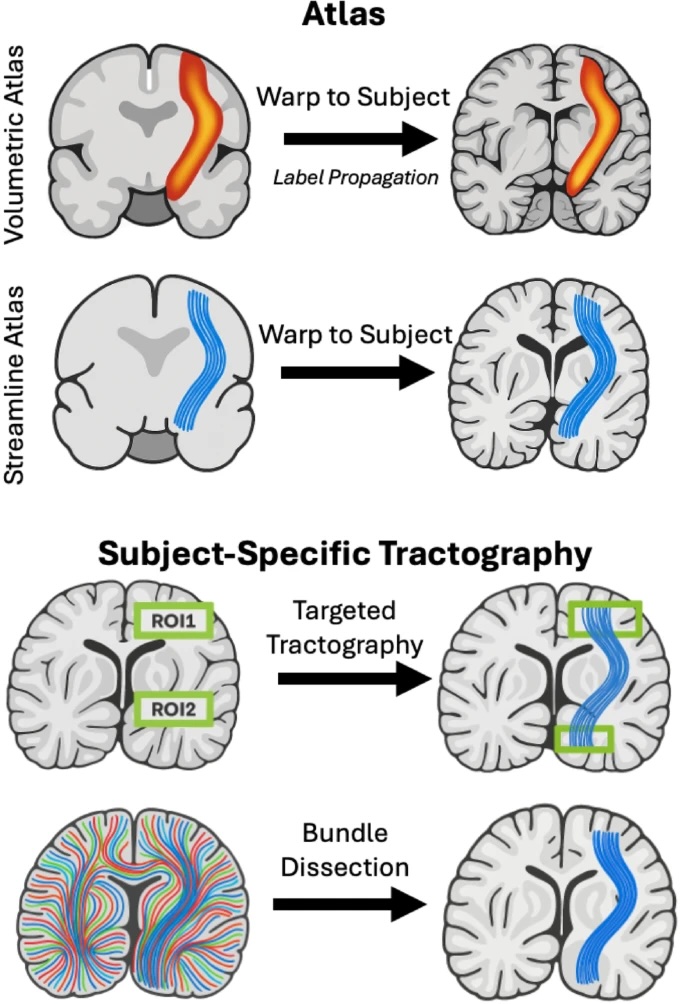
Fig. 1
Schematic illustration of distinctions between atlas vs. subject-specific tractography. Atlas: volumetric or streamline-based atlases can be warped to an individual subject in a process called label/streamline propagation, enabling the identification and labeling of white matter pathways or regions. Subject-specific Tractography: bundle segmentation can be performed using a targeted approach (often using inclusion/exclusion regions of interest), or by generating a whole brain set of streamlines and subsequent processing to dissect and segment the streamlines of interest. We note that bundle dissection can be performed using manual regions of interest, or even making use of atlases to compare shape/location similarity when extracting and labelling subject-specific streamlines