Sikora, James T., Rowe, Jason F., Splinter, Jared, Barat, Saugata, Dang, Lisa, Cowan, Nicolas B., Barclay, Thomas S., Colón, Knicole D., Désert, Jean Michel, & Kane, Stephen R. (2025). “Seasonal changes in the atmosphere of HD 80606 b observed with JWST’s NIRSpec/G395H.” Astronomical Journal, 170(2), 105. https://doi.org/10.3847/1538-3881/addfda
Gas giant planets with very stretched-out orbits give scientists a special way to study how atmospheres made mostly of hydrogen and helium behave under extreme changes in temperature and chemistry. One of the most dramatic examples is HD 80606 b, a “hot Jupiter” that orbits a Sun-like star with a very unusual orbit (eccentricity of 0.93). Because of this, the amount of starlight it receives changes by almost 1,000 times—going from far away at 0.88 AU (similar to Earth–Sun distance) to extremely close at 0.03 AU.
We observed this planet during its closest approach to the star using the James Webb Space Telescope’s NIRSpec instrument (covering 2.8–5.2 microns) for 21 hours, centered on the eclipse. During this time, we saw its emission spectrum change: at first it looked like a smooth “blackbody” (like heat radiation), but as it passed close to the star, features from gases such as carbon monoxide (CO), methane (CH₄), and water vapor (H₂O) became visible. Methane was detected after closest approach with high confidence (between 4.1 and 10.7σ depending on the analysis), while water and carbon monoxide were detected at slightly lower but still significant levels.
We also found no evidence of a strong “temperature inversion” (where upper layers of the atmosphere are hotter than lower ones), even though computer models had predicted one during closest approach.
Overall, this study shows that it is possible to investigate the atmospheres of extreme hot Jupiters using partial orbital observations with JWST’s NIRSpec, and highlights how much these planets can change as they swing through their orbits.
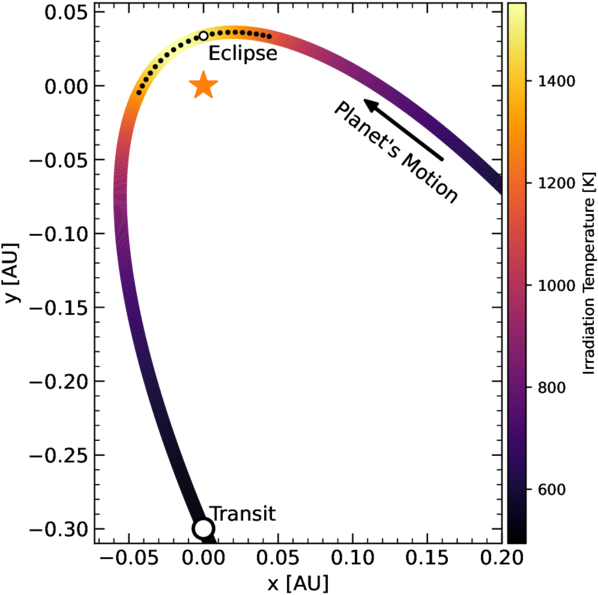
Figure 1. Black circles indicate the span of the NIRSpec observations plotted with 1 hr intervals. The color of the orbit indicates the irradiation temperature, calculated based on the instantaneous star–planet separation and assuming zero albedo and full heat redistribution.