Mészáros, Szabolcs, Jofré, Paula, Johnson, Jennifer A., Bird, Jonathan C., Bovy, Jo, Casey, Andrew R., Chanamé, Julio C., Cunha, Kátia, De Lee, Nathan, & Frinchaboy, Peter M. (2025). “SDSS-V Milky Way Mapper (MWM): ASPCAP stellar parameters and abundances in SDSS-V Data Release 19.” Astronomical Journal, 170(2), 96. https://doi.org/10.3847/1538-3881/ade4b9
The goal of this paper is to explain how we checked the accuracy of the Milky Way Mapper (MWM) APOGEE Stellar Parameter and Chemical Abundances Pipeline (ASPCAP) data, which were released in Data Release 19 (DR19) of the Sloan Digital Sky Survey (SDSS-V). In simple terms, this pipeline measures the physical properties and chemical make-up of stars from their light, as recorded by the APOGEE spectrograph.
We compared ASPCAP’s measurements—such as star temperatures (Teff), surface gravity (log g), and the amounts of 21 chemical elements (with multiple methods used for carbon, nitrogen, and oxygen)—with values from other studies to check both accuracy and precision. We also tested the calibration of the radial velocities (vrad, the speed at which stars move toward or away from us) determined by the APOGEE Data Reduction Pipeline.
This release includes ASPCAP results for 964,989 stars, covering all APOGEE-2 targets and adding new observations of 336,511 stars observed at Apache Point Observatory through July 4, 2023. Overall, the new temperature values agree very well with an independent temperature scale (IRFM), while surface gravity values show small but consistent differences compared to those measured with starquake (asteroseismic) methods.
For precision, the star temperatures are typically accurate to within 50–70 K for giant stars and 70–100 K for smaller dwarf stars. Surface gravity is measured with a precision of 0.07–0.09 dex for giants. For many elements—including overall metallicity, alpha elements, magnesium, and silicon—we achieve a precision of 0.02–0.04 dex, and at least 10 other elements are measured with a precision better than 0.1 dex.
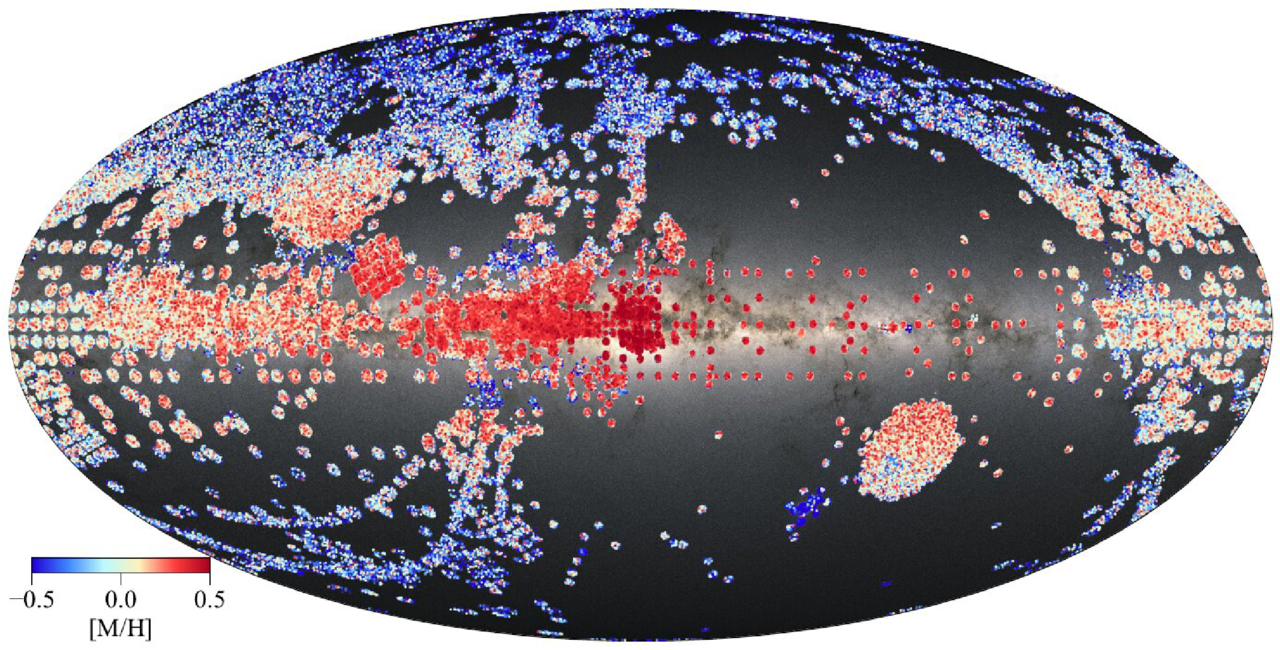
Figure 1. Position of stars that have parameters and abundances below 8000 K published by Milky Way Mapper in DR19 color coded by [M/H]. Only stars with signal-to-noise ratio (S/N) > 50 per pixel and no BAD flags that are farther than 1000 pc are shown here to reveal the metallicity gradient of our Galaxy.