Hesse, Katharine M., Mireles, Ismael, Bouchy, François, Dragomir, Diana, Ulmer-Moll, Solene, Eisner, Nora L., Stassun, Keivan Guadalupe, Quinn, Samuel N., Osborn, Hugh P., & Sousa, Sérgio G. (2025). “HD 35843: A Sun-like star hosting a long-period sub-Neptune and inner super-Earth.” Astronomical Journal, 170(2), 108. https://doi.org/10.3847/1538-3881/add7d7
We report the discovery of two planets orbiting the star HD 35843 (also known as TOI 4189), which is similar to the Sun but has relatively low metal content. The first planet, HD 35843 c, is a temperate “sub-Neptune” that passes in front of its star every 46.96 days. It was first spotted by volunteers with Planet Hunters TESS, and we used data from TESS and additional follow-up observations to confirm that it is indeed a planet and not a false signal. Using precise radial velocity measurements from the ESPRESSO instrument, we confirmed the planet’s mass and orbit. These measurements also revealed a second planet, HD 35843 b, which orbits the star every 9.90 days and has a minimum mass about six times that of Earth.
For HD 35843 c, combining light and radial velocity data shows that it has a radius about 2.5 times that of Earth, a mass about 11 times Earth’s, and an orbit that is slightly elliptical. Its density suggests it could either be a rocky planet with a thick hydrogen atmosphere or a “water world.” With a temperature of about 480 K (around 400°F), it is among the coolest 5% of planets discovered by TESS so far. Because the host star is relatively bright, HD 35843 c is a strong candidate for future studies of its atmosphere, which will help us learn more about this rare class of temperate sub-Neptunes.
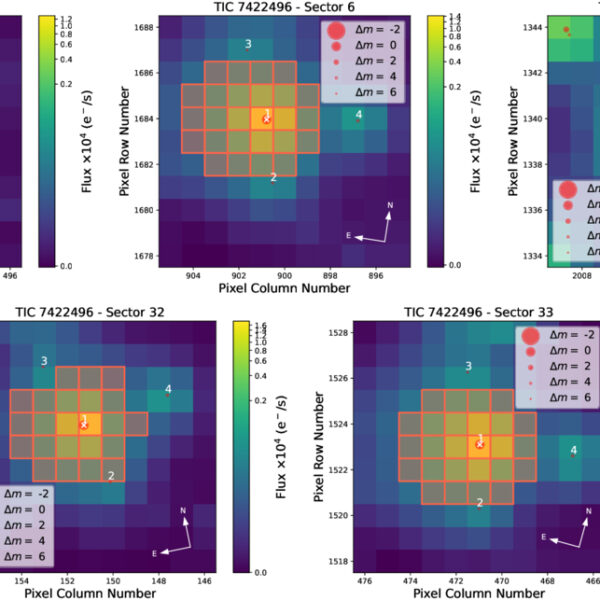
Figure 1. TESS target pixel files of HD 35843 (TIC 7422496) for all five sectors of observations made using tpfplotter (A. Aller et al. 2020). The SPOC photometric aperture is highlighted in each panel.