Crumpler, Nicole R., Chandra, Vedant, Zakamska, Nadia L., Pallathadka, Gautham Adamane, Arseneau, Stefan, Gentile-Fusillo, Nicola Pietro, Hermes, James J., Badenes, Carles, Chakraborty, Priyanka, & Gänsicke, Boris T. (2025). “A large catalog of DA white dwarf characteristics using SDSS and Gaia observations.” Astrophysical Journal, 989(1), 24. https://doi.org/10.3847/1538-4357/ade9a9
We present a catalog of over 27,000 DA white dwarfs (WDs)—8,545 from the latest Sloan Digital Sky Survey (SDSS) Data Release 19 and 19,257 from earlier SDSS data releases. This is the largest collection to date that includes both spectroscopic (light broken down by wavelength) and photometric (brightness and color) measurements of DA white dwarfs. The full catalog, along with the codes used to build it, is publicly available.
For every star in the catalog, we measured key properties such as radial velocity (how fast the star is moving toward or away from us), surface gravity, effective temperature, and radius. To ensure accuracy, we compared our results with other published white dwarf catalogs. When analyzing spectra with high signal quality, our measurements matched previous SDSS catalogs very closely—within about 7.5 km/s for velocity, 0.060 dex for surface gravity, and 2.4% for effective temperature. For measurements based on Gaia brightness and color data, our results agreed with other Gaia datasets to within 0.0005 times the Sun’s radius and 3% for temperature.
We also used this catalog to look at systematic differences between white dwarf measurements taken with SDSS-V and earlier versions of SDSS. For stars observed in both, we found consistent offsets: radial velocities measured with SDSS-V data were, on average, 11.5 km/s higher, and surface gravity values were 0.015 dex lower than those measured with earlier SDSS data. These differences may come from changes in how the survey’s instruments were calibrated across generations.
This catalog represents the most detailed and extensive resource so far for studying DA white dwarfs and highlights important measurement differences between SDSS survey versions.
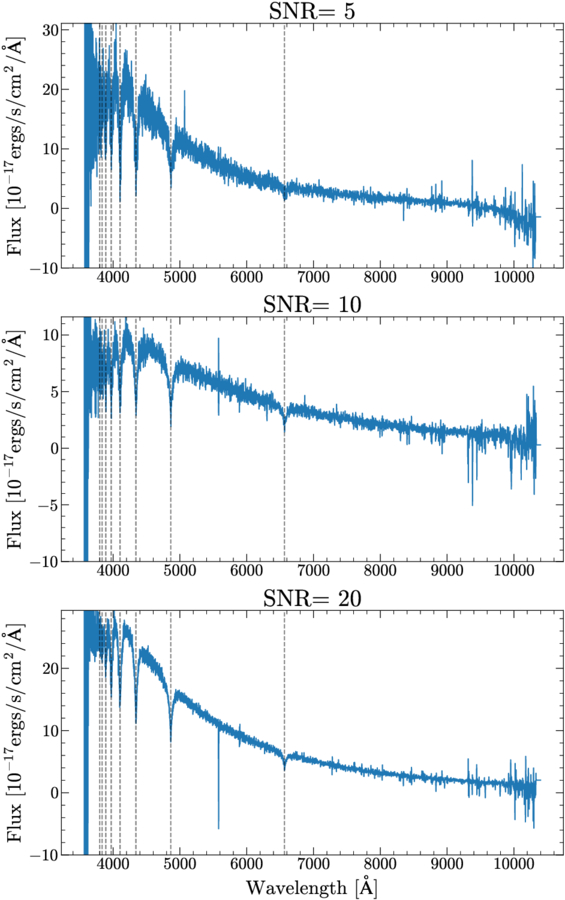
Figure 1. Three DA WD spectra from the SDSS-V survey included in this catalog. The top spectrum has a median SNR of 5, the middle has an SNR of 10, and the bottom has an SNR of 20. The dashed lines mark the wavelengths of the hydrogen Balmer series absorption lines, showing that these WDs have hydrogen-dominated atmospheres.